
A worker clears debris from a homeless encampment Sept. 26, 2024, in downtown Dallas.
Juan Figueroa/Dallas Morning News
A Dallas hotelier who financed a group that once threatened to sue the city for failing to clear homeless encampments is now backing service providers working to create a coordinated response hub.
Monty Bennett is among the business leaders supporting a plan to renovate a vacant Austin Street Center building in South Dallas into a center with 24 mental health beds and a walkable connection to the neighboring Stewpot resource center’s proposed dental and medical clinic.
Bennett previously pitched a 50-acre homeless services campus away from downtown Dallas that raised concerns among city officials about relocating a shelter and concentrating services in one location. He has since dropped that to support the smaller crisis center, said Mark Nunneley, senior managing director of Bennett’s Ashford Hospitality Trust.
That concept brought Bennett together with Frank Mihalopoulos, Austin Street Center’s board chair, who in 2024 chaired a political committee that opposed city charter amendments Bennett helped finance.
“Forget about our politics,” Mihalopoulos said. “We’re all working together to solve and make Dallas one of the leading cities in America that can be a homelessness model.”

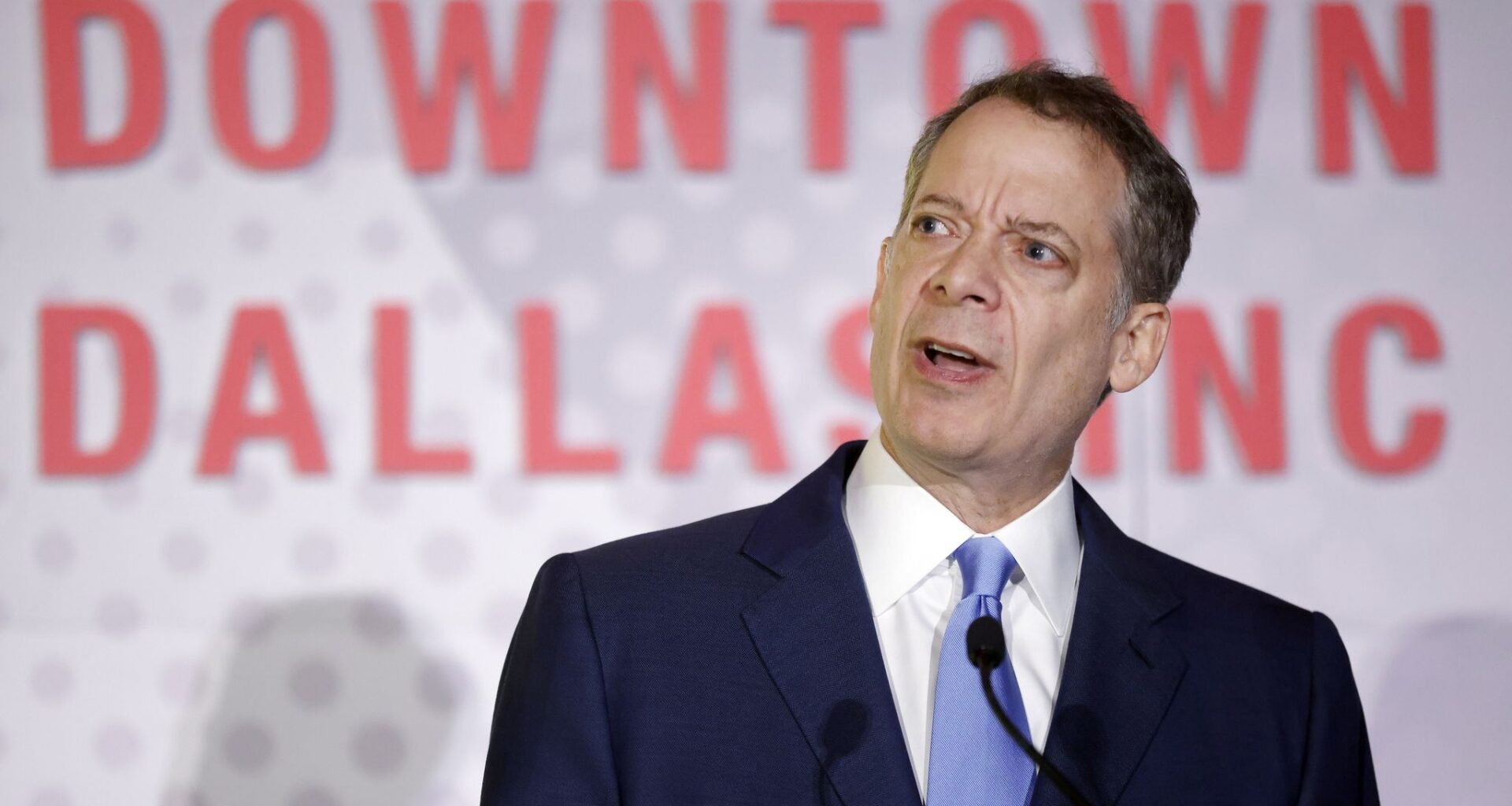
Ashford Inc. Chairman and CEO Monty Bennett speaks to those gathered for Downtown Dallas Inc.’s annual meeting at the Omni Dallas hotel, March 1, 2024.
Tom Fox/Staff Photographer
The previously unreported collaboration comes as voters consider Proposition A, a Dallas County property tax increase on the Nov. 3 ballot expected to generate about $100 million annually for homelessness services.
In its proposal for the tax initiative, Housing Forward, the nonprofit coordinating the county’s response to homelessness, identified Austin Street and Stewpot as the first coordinated intake hub. That’s where police or providers in other parts of the county could bring homeless people for treatment and services.
Mihalopoulos said the 24-bed crisis center will proceed regardless of whether the property tax initiative passes, but the tax revenue could help fund annual operations the nonprofit would otherwise have to raise through donations.
Bennett did not respond to an email or phone call from The Dallas Morning News to talk about the crisis center project or to say whether he favors the tax. Nunneley said Bennett will likely donate to the crisis center project in the future.
Along with the voluntary, short-term mental health beds, Mihalopoulos said the Austin Street renovation, tentatively called Pathways Transition Center, will have space for case management services, a kitchen, showers and potentially a dog kennel built in phases on the center’s existing property.
He said construction costs are $16 million, with five years of operating expenses at another $16 million.
Next door, the Stewpot has secured funding for a $2.5 million dental and health clinic to add to its meal program, ID services and other resources, said executive director Brenda Snitzer.
Landscaping and a walkable connection between the buildings would bring the services together into a cohesive campus, though the two organizations would remain separate, she said.
“We’re all coming to the table with how we see what’s needed for our neighbors who are unsheltered,” Snitzer said.
Article continues below this ad
Looking ahead
The renovation is considerably smaller than earlier proposals Bennett has been involved in.
Bennett told a Texas senate committee in 2024 he had “taken up the charge to try to help my city with this big homelessness problem.” He said in a radio interview his 50-acre Refuge for Renewal idea was modeled after San Antonio’s Haven for Hope, a consolidated homeless services campus, to be a “one stop shop” for services.
In September 2025, Nunneley met with four City Council members about Bennett’s refuge concept. They discussed relocating The Bridge, Dallas’ largest free emergency homeless shelter, from downtown to a proposed campus near Dallas Executive Airport, though Nunneley said 10 sites were being considered.
The unposted meeting drew accusations of violating the Texas Open Meetings Act because four members of the seven-member housing committee attended. Committee Chair Cara Mendelsohn disputed any violation, saying there were no deliberations.
Mihalopoulos said the meeting prompted him to contact Bennett and Nunneley to see where they could find common ground.
Together, he said they commissioned a consultant to develop a proposal for a 25-acre homeless services campus at the corner of Interstate 30 and South Malcolm X Boulevard around Austin Street, with 2,000 beds, a hospice, grocery store and mental health crisis center. The Dallas Regional Chamber and Dallas Citizens Council paid $50,000 for the study.
Nunneley said Bennett was open to supporting a smaller crisis center instead because it could help people quickly without having to raise hundreds of millions of dollars for a larger campus.
“We felt like this was a bird in the hand,” said Nunneley, who said he was speaking on Bennett’s behalf.
Sarah Kahn, president and CEO of Housing Forward, which coordinates local efforts to combat homelessness.
Juan Figueroa/The Dallas Morning News
Sarah Kahn, CEO of Housing Forward, said the nonprofit and members of its coalition have no plans for a larger campus within the 25-acre footprint around Austin Street.
She said no tax funds from the ballot measure would be used for construction of new facilities, just funding for services.
Daniel Roby, Austin Street Center’s CEO, said his priority is creating the 24-bed diversion hub where people can be connected with services. He said he has no plans beyond that project.
“This is what I feel we can commit to doing well,” Roby said.
Mihalopoulos and Nunneley said there is still potential for additional development around Austin Street Center, including transitional housing, if land becomes available and charities provide funding.
“This will be a model to bring other nonprofits down the road here,” Mihalopoulos said.
Article continues below this ad
He cited a police evidence warehouse across from Austin Street that could be repurposed if voters approve a separate $443 million public safety bond package Nov. 3 and the facility is relocated.
“If the bond happens and if they go somewhere else, that property is available for the city to do something. Could that be some kind of transitional housing?” Mihalopoulos said. “Theres too many ifs today but there is potential to do more in the area.”
They said relocating The Bridge, which sits on city-owned land, is not part of their proposal.
Spending plan
Housing Forward’s $100 million annual tax proposal calls for providers coordinating to connect people to mental health services, shelter and housing.
It proposes using $20 million to create hubs in six geographic zones across the county at existing service facilities for law enforcement or providers to bring people for assessment or transport to a central intake hub.
Contracts for auxiliary providers in the zones would be awarded through competitive bidding if the tax passes. Kahn said Austin Street and Stewpot’s unified campus was able to be identified as the central intake before bidding since it will have mental health beds.
The proposal calls for another $68 million for short-term rent help and employment support; $8 million for longer-term supportive housing; and $4 million for quick interventions to get people off the streets, such as travel assistance to reconnect with family.
Passage of the 2.4-cent increase per $100 of taxable property value would put the county’s property tax rate 15.4% above last year’s, including a separate increase already approved by commissioners. It has no automatic expiration.
Although the 25-acre concept is no longer in play, Nunneley said he spoke with a nonprofit he declined to identify a few weeks ago, telling it that “we would love to have you down in this area as part of Pathways.”
Dallas County Commissioner Andrew Sommerman, who helped develop the idea for the tax proposal with Housing Forward, said he would not support a campus-type development around Austin Street.
But Sommerman, a Democrat, praised Bennett’s support for the transition center as a step toward lasting solutions to homelessness. “It is a coalition of people who normally don’t always agree and that’s the beauty of it,” he said.
His Republican opponent in November, attorney Barry Wernick, opposes the homeless tax because of the added burden on homeowners but welcomed Bennett’s involvement as an example of private-sector cooperation.
“We don’t have to at all levels of our lives depend on the government,” Wernick said.
A contentious history
Bennett went to war with Dallas’ political establishment in 2024, financing three city charter amendments opposed by Mayor Eric Johnson, four former mayors, county officials and business leaders.
He accused Dallas leaders of ignoring residents’ concerns about crime as he campaigned for the measures through Dallas HERO, the advocacy group he financed.
Article continues below this ad
“The people in Dallas are concerned about crime, and it shows up in survey after survey after survey, and our elected officials just won’t listen,” he told KTVT-TV.
Voters approved two of the propositions, allowing residents to sue the city over certain legal violations and requiring Dallas to hire 900 more police officers.
Bennett also was pushing his own approach to homelessness.
In posts on X, he has advocated for prioritizing mental health treatment before housing and imposing “consequences for chronic offenders” of the law.
Council member Adam Bazaldua said he recently met with Nunneley, Mihalopoulos and others to discuss the collaboration. Bazaldua said he supports the coordination of services between Austin Street and Stewpot as well as passage of Proposition A.
But he said he opposes a campus for people experiencing homelessness that would concentrate services instead of diversifying options for people across the city. Any relocation of The Bridge would be “off the table” for him.
Bazaldua questioned Bennett’s motives and involvement. He said while the homeless services coalition is not backing a larger campus, Bennett’s interest in development and downtown Dallas’ future are also at play.
“I don’t believe this is a genuine wholesome attempt,” Bazaldua said.
Nunneley said he is not working to tie up any sites or push development, but in an interview pointed to parcels on a map to show where other nonprofits could be located in the future.
In September, Bennett posted on X that “$100 million more” won’t solve homelessness. Nunneley initially said Bennett opposed any tax increase but later clarified he did not know his position on Proposition A.
Article continues below this ad