
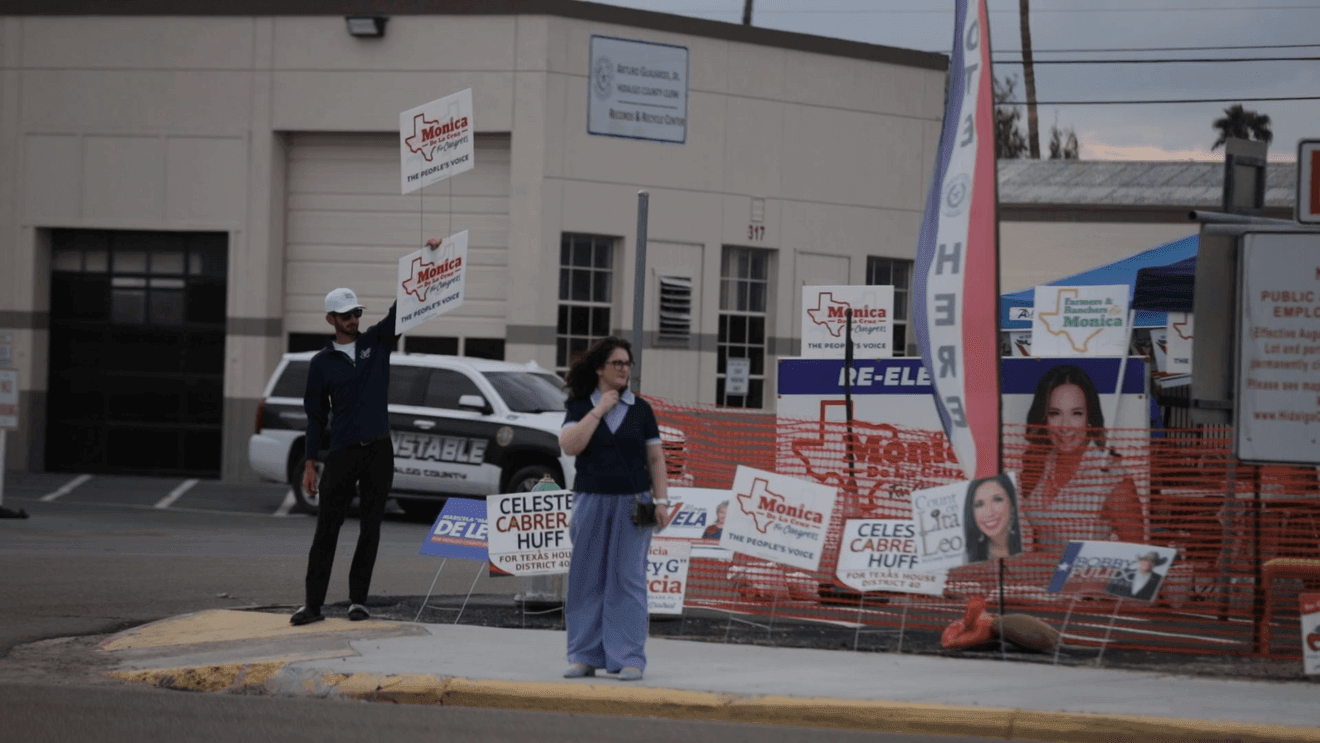
South Texas is emerging as one of the country’s most closely watched battlegrounds ahead of the Nov. 3 midterm election, as Republicans work to build on the region’s rightward shift in 2024 and Democrats try to win voters back.
Donald Trump won 14 of the 18 Texas counties within 20 miles of the Mexican border that year, after years in which much of the region had been a Democratic stronghold.
Now, three congressional contests are testing whether those gains will translate to a lasting Republican advantage down-ballot.
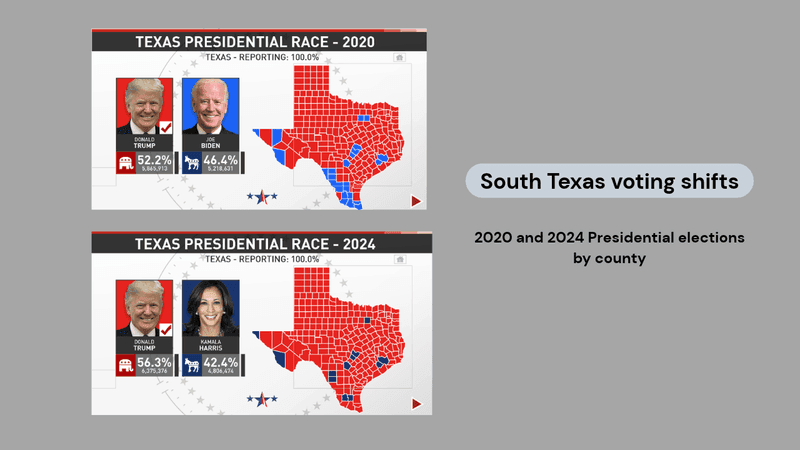
South Texas voting shifts 2020 and 2024 Presidential elections by county.png
Republican U.S. Rep. Monica De La Cruz is seeking another term in the 15th Congressional District against Democrat and Tejano music star Bobby Pulido.
In the newly redrawn 28th District, Republican Webb County Judge Tano Tijerina is challenging longtime Democratic U.S. Rep. Henry Cuellar.
Democrat U.S. Rep. Vicente Gonzalez is defending his 34th District seat against Republican Eric Flores.
The contests have drawn attention from national leaders, including House Speaker Mike Johnson, who traveled to McAllen to campaign with Republican candidates.
“South Texas will literally decide the majority of Congress,” Johnson said. “It will literally decide whether we hold this Republic.”
Recent polling shows tight races
A Texas Southern University poll conducted Oct. 13 through 16 showed Democrat Bobby Pulido leading Republican U.S. Rep. Monica De La Cruz, 51% to 44%.
“I don’t care what the polls say, because my God is bigger,” De La Cruz told the rally crowd in McAllen.
In the 28th and 34th Districts, the latest independent public polling dates to August. That Texas Southern University survey found Democratic U.S. Rep. Henry Cuellar ahead of Republican Tano Tijerina, 45% to 34%, while Democratic U.S. Rep. Vicente Gonzalez led Republican Eric Flores, 45% to 42%.
Cook Political Report currently rates TX-15 and TX-34 as toss-ups and TX-28 as Lean Democratic.
Republicans target more South Texas seats
Republicans say the political change began as border communities confronted historically high migration levels during the Biden administration.
Wayne Hamilton, a former executive director of the Republican Party of Texas who now leads Project Red Texas, said cities along the border felt the strain.
“Very poor towns up and down the border were just overrun with immigrants coming through their cities and to put a real strain on social services,” Hamilton said.
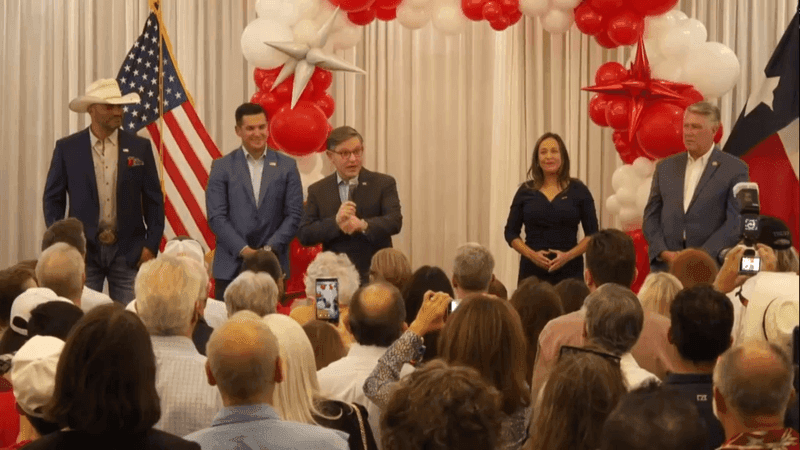
House Speaker Mike Johnson appears in McAllen alongside South Texas Congressional candidates
Project Red Texas focuses on local races, but Hamilton said the group saw an opening as voters became more receptive to Republican candidates.
“We were ready to capitalize on an opportunity,” he said.
At the rally with Speaker Johnson, Tijerina told supporters Republicans plan to flip the 28th District “for the first time in history.”
Flores told the crowd, “There is not a blue wave coming; there is a red tidal wave coming.”
Hamilton said border security is no longer the only issue shaping voter conversations. He said he frequently hears concerns about corruption, taxes and energy.
“Probably the number one thing I get hit with is corruption,” Hamilton said, pointing to concerns about long-entrenched political power in some South Texas communities.
Still, he expects fiercely competitive races.
“There’s no question, there’s tight races down there,” Hamilton said. “They’re kind of duke-outs.”
Democrats focus on persuadable voters and turnout
Democrats argue the 2024 results do not mean South Texas voters have permanently aligned with the Republican Party.
Pulido has directly appealed to voters who supported Trump.
“I don’t care if you voted for Trump before. I’m not gonna shame anybody,” Pulido said. “This is about giving you the right representation that we all need.”
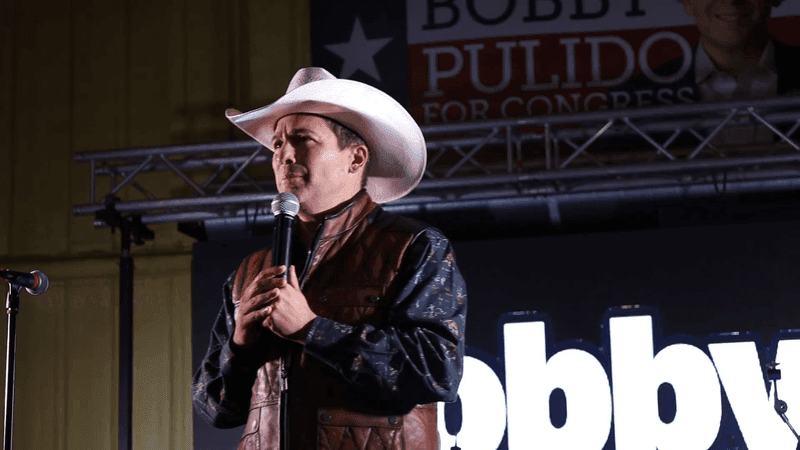
Bobby Pulido addresses a crowd ahead of his farewell concert
Pulido has also argued voters can support stronger border security while opposing aggressive immigration enforcement tactics.
“People here want a strong border. That’s a popular thing,” he said. “They do not like these aggressive tactics that were seen in the streets.”
For some voters, the economy remains central.
“Right now everything is high, and we need for prices to come down,” Rio Grande Valley voter Maria said.
Beatriz Lopez with Voto Latino said the organization estimates about 317,000 Latino voters in the Texas Rio Grande Valley did not cast ballots in the last election.
She said outreach efforts are focused on helping voters understand when, where, and how to cast a ballot.
“It’s gonna shape not just this election, but it’ll also shape future elections as well,” Lopez said.
Lopez said the organization saw increased Latino participation in Democratic primaries, particularly in the Rio Grande Valley.
“Texas is the epicenter,” Lopez said. “It is ground zero for what will happen in Congress.”