
The following op-ed was submitted by John Lewis, former executive director for Goals For Dallas.
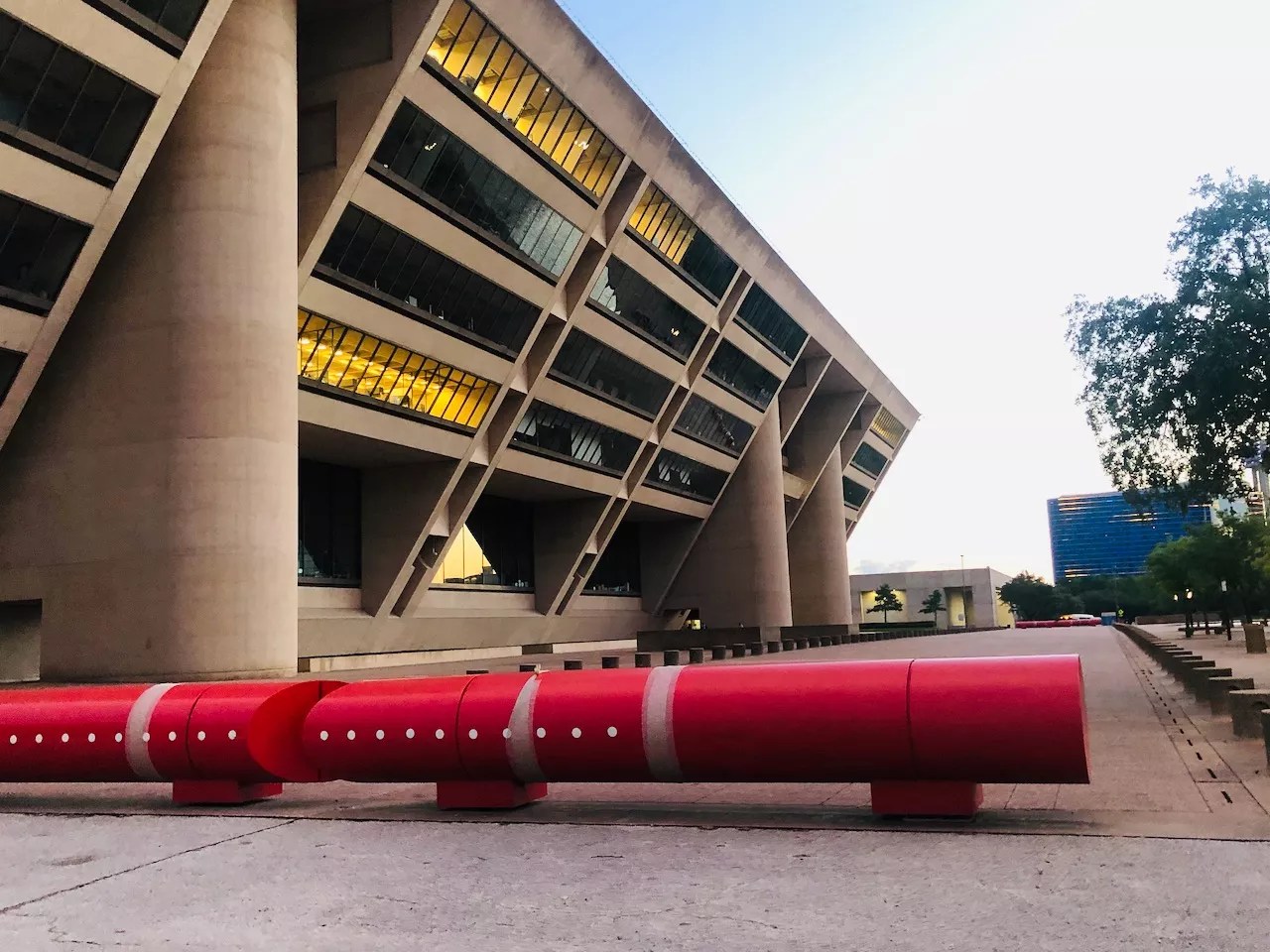
Dallas is debating whether to remain in its I. M. Pei-designed City Hall or relocate municipal operations elsewhere Downtown. That debate is often framed as a choice between buildings, costs and real estate opportunities. But it is more consequential than that. Dallas is considering a decision that, once made, may be impossible to undo.
Jeff Bezos has described major decisions by distinguishing between “one-way doors” and “two-way doors.” In his 2015 shareholder letter, he wrote: “Some decisions are consequential and irreversible or nearly irreversible — one-way doors — and these decisions must be made methodically, carefully, slowly, with great deliberation and consultation.”
That analogy fits Dallas City Hall unusually well.
Sign up for the This Week’s Top Stories newsletter to get the latest stories delivered to your inbox
THANK YOU!
You’re all set.
CLOSE
Dallas can change a landscaping plan. It can redesign a street. It can alter a renovation program. If a new lawn, stage, play area or promenade does not work as expected, it can be modified. Those are two-way doors.
Leaving City Hall is different. Once the City permanently relocates, sells the building, or allows the site to be radically redeveloped or demolished, Dallas may never again be able to restore the relationship among City Hall, the J. Erik Jonsson Central Library and the enormous public space between them. That is a one-way door.
If Dallas renovates City Hall and later decides that staying was a mistake, relocation would still be available. But if Dallas leaves and disposes of the property, returning may not be. Before walking through a door that could close permanently behind it, Dallas should examine not only what it might gain by moving, but what it could permanently give up.
That includes the possibility of creating a genuine Dallas Civic Center from assets the public already owns.
City Hall, the Central Library and City Hall Plaza already form the foundation of a purpose-built civic center. Instead of treating City Hall as an isolated aging office building, Dallas could treat the entire area as one civic place and reconceptualize it for the 21st century.
My August 31 white paper, “How to Save Dallas City Hall and the Dallas Civic Center.” proposes doing exactly that. Its 15 ideas are not a final architectural plan. They are an invitation to consider what Dallas would be preserving the option to create if it stays.
Start with identity. Call the entire place the Dallas Civic Center, and rename City Hall Plaza the Dallas Civic Center Commons — a name that signals the space belongs not just to government employees, but to everyone.
Then rethink the physical connections. A traffic study could determine whether Young Street can be narrowed through the Civic Center, making it easier for pedestrians to move between City Hall and the Central Library while reclaiming pavement for landscaping and public space. A landscaped promenade could connect the two buildings through the Commons.
The 5.2-acre plaza could become a greener and more active public destination. Imagine a substantial Great Lawn; movable tables and chairs under shade trees; a small performance stage; an Adventure Grove for children; and a more interactive version of the enormous reflecting pool. The shaded area beneath City Hall’s north façade could become a “Civic Front Porch” with seating, gathering space and perhaps a small café kiosk. Marilla Street could function more like a pedestrian-oriented civic corridor than an ordinary roadway.
The Central Library and City Hall could stop looking like separate institutions divided by six lanes of traffic and begin functioning visibly as two anchors of one civic campus. Better signage, lighting and seating could make both buildings easier to approach. Story stations could explain Erik Jonsson, I. M. Pei, the Central Library, Goals for Dallas and the thousands of citizens whose participation helped shape modern Dallas.
A permanent Civic Center stewardship partnership could oversee programming, promotion, design standards, maintenance and continuing improvement. That may be as important as any lawn, stage or promenade. Dallas did not arrive at City Hall’s current maintenance problems overnight. Major civic assets require continuous stewardship if they are not to fall back into another cycle of deferred investment.
None of these ideas requires Dallas to imitate another city. Dallas can study successful civic spaces elsewhere and create something distinctly its own. But it must preserve the opportunity to do so.
Former mayor Tom Leppert has said: “At some point it’s not what we want, it’s what the market wants, and we ought to listen to that.” This transfers the central decision criterion regarding City Hall from the public to private-market participants. The problem is not listening to the market. The problem is allowing what the market wants to become the measure of what Dallas should want.
Imagine a New York City mayor saying: “At some point, it’s not what New Yorkers want for Central Park. It’s what the market wants, and we ought to listen to that.” There would almost certainly be significant controversy if “the market” were presented as the controlling consideration for Central Park.
Why should private development demand determine the future of an asset that belongs to the public? The market can tell us what City Hall is worth to a developer. It cannot tell us what City Hall is worth to Dallas.
Cost matters. City Hall requires substantial investment, and Dallas has many competing needs. Any serious preservation proposal must address realistic costs, financing, phasing and long-term maintenance. But cost comparisons cannot capture the full public value of keeping the Civic Center intact and transforming it into a place people actively use.
A successful Civic Center could strengthen the southern end of Downtown as a place to live, visit and invest. It could serve library patrons, Downtown residents, families, Convention Center visitors, tourists, workers, Farmers Market patrons and people coming to their city government. It could also complement efforts to find new uses for obsolete Downtown office towers. Dallas does not have to choose between adaptive reuse elsewhere Downtown and reinvestment in its Civic Center.
The debate entered a new phase when the Save Dallas City Hall Coalition announced an effort to place a charter amendment before Dallas voters in May 2027. Whatever becomes of that effort, its emergence underscores how consequential — and difficult to reverse — the City Hall decision has become.
The central question should therefore be larger than, “Should we stay in this building or move somewhere else?” Dallas should also ask: “What could this entire place become?”
That question is in the tradition of the civic thinking that produced City Hall and the Central Library in the first place. Mayor J. Erik Jonsson launched Goals for Dallas on the premise that citizens could come together, think boldly about their city’s future and turn ambitious ideas into tangible results. Nearly 50 years later, Dallas has another opportunity to think on that scale.
The choice is not simply between an aging City Hall and another office building. There is another possibility: transform City Hall and its surroundings into the civic center Dallas never fully completed — a greener, livelier and more welcoming public place connecting government, the library and the people they serve.
Before Dallas walks through a one-way door, it should make certain it has fully examined everything that remains possible on this side of it.