
Abel Garza, left, and Meagan Garza walk by the largest Catrina and Catrín in the United States at La Villita in San Antonio on Monday. Standing at 38.5 feet, the Catrina and Catrín are part of the historic district’s Day of the Dead displays.
Katina Zentz/San Antonio Express-News
San Antonio goes big for Día de los Muertos — with giant painted skulls and a nearly 40-foot-tall catrina.

From the San Antonio Botanical Garden to La Villita and Pearl, larger-than-life displays turn the city into a colorful celebration of Day of the Dead.
Article continues below this ad
Where else will you find a garden of elegant lady skeletons called catrinas dressed in living plants? Or a historic arts district where a towering catrina and her dapper gentleman counterpart, a catrín, overlook dozens of giant painted skulls called calaveras?
People walk by a giant skull called “Dulce Recuerdo” by Melanie Yve at La Villita.
Katina Zentz/San Antonio Express-News
Linda Lopez-George walks by a giant skull called “Wabi Sabi #900” by Albert Gonzales at La Villita in San Antonio. The skull is one of 40 in the Calavera Collection for the Day of the Dead.
Katina Zentz/San Antonio Express-News
That’s how San Antonio rolls the bones for Día de los Muertos, the multi-day holiday honoring loved ones who have died.
Article continues below this ad
ALL SOULS: How do you observe Día De Los Muertos, or Day of the Dead?
“There has been a transformation in recent years of Día de los Muertos, a euphoria of Día de los Muertos,” said San Antonio artist Regina Moya, the talent behind the outdoor catrinas exhibit at San Antonio Botanical Garden and one of five giant painted calaveras at Pearl. “San Antonio gives you the opportunity to display it.”
A giant catrina by San Antonio artist Regina Moya, one of eight such works by Moya in her Jardín de las Catrinas exhibit at San Antonio Botanical Garden through Nov. 2.
Courtesy San Antonio Botanical Garden
San Antonio artist Regina Moya at work on her Día de los Muertos skull for display at Pearl. The culinary hotspot will feature five hand-painted skulls or calaveras by five different artists, each with its own story.
Courtesy Pearl
Moya moved here from Mexico around 23 years ago. She said San Antonio strives to be the mecca of Día de los Muertos, celebrated Nov. 1 and 2. Traditions include colorful ofrendas, or altars, dedicated to the deceased; a sweet bread called pan de muerto; lively music; and, of course, lively depictions of skeletons that seemingly laugh at death itself.
Article continues below this ad
Credit those fashionable cadaverous icons to Mexican political printmaker José Guadalupe Posada. His most enduring work, the posthumous 1913 piece “La Calavera Catrina,” satirized Mexican elites as cartoonish skeletons beneath their aspirational European fashions. Then in 1947, Mexican muralist Diego Rivera revived the skeletal figure as a national symbol in his fresco “A Dream of a Sunday Afternoon in the Alameda Park,” which canonized Posada and other famous faces in Mexican history.
Soon, la catrina became a symbol of Mexican pride and identity, as well as an icon of Día de los Muertos celebrations in Mexico and beyond. Meanwhile, the ornate sugar skull or calavera de azúcar, placed at an ofrenda in the dead’s name, likewise grew in iconography and stature as a Day of the Dead staple.
SAN ANTONIO EXPLAINED: What makes a proper Día de los Muertos ofrenda
And the skulls and skeletons just get bigger and bolder in the Alamo City.
Article continues below this ad
“What we’ve seen is that San Antonio has evolved to become this epicenter of Día de los Muertos in a way that we have never seen before,” said Martha Martinez-Flores, creative director of cultural programming for Pearl. “I think there is something to be said about making everything so big and almost magical.”
Here are a few extra-large displays of that Muertos magic.
The Tower of the Americas is shown behind the largest La Catrina and El Catrín in the United States at La Villita in San Antonio. The skeletal figures stand nearly 40 feet tall.
Katina Zentz/San Antonio Express-News
Chef Johnny Hernandez started the giant Day of the Dead skulls and skeletons displays at La Villita in 2019. And it doesn’t get bigger than 40 massive painted skulls and a towering power couple in their Dia de los Muertos finest. This year’s super-sized display includes the largest Catrina and Catrín in the country, standing approximately 38½-feet-tall in La Villita’s Maverick Plaza. Meanwhile, shoulder-high calaveras dot the grounds in various themes by various area artists. Works include “Amor Y Luto” by Vicente Apolinar, “Dulce Recuerdo” by Melanie Yve and “The Uninvited Guest” by David “Evil Dave” Gonzales. All that plus a menagerie of mythical creatures called Alebrijes.
Article continues below this ad
Meagan Garza, left, and Abel Garza look at a giant skull called “The Uninvited Guest” by David “Evil Dave” Gonzales at La Villita in San Antonio. The skull is part of the site’s Calavera Collection to celebrate Día de los Muertos.
Katina Zentz/San Antonio Express-News
La Villita Historic Arts Village, 418 Villita St., dayofthedeadsa.com, 210-207-8614
GOOD FACE: How an S.A. makeup artist helps bring life to Day of the Dead celebrations
Calaveras along the River Walk
“St. Michael Archangel” by Carolina Flores, located along the River Walk across from Casa Rio.
Rene Guzman/San Antonio Express-News
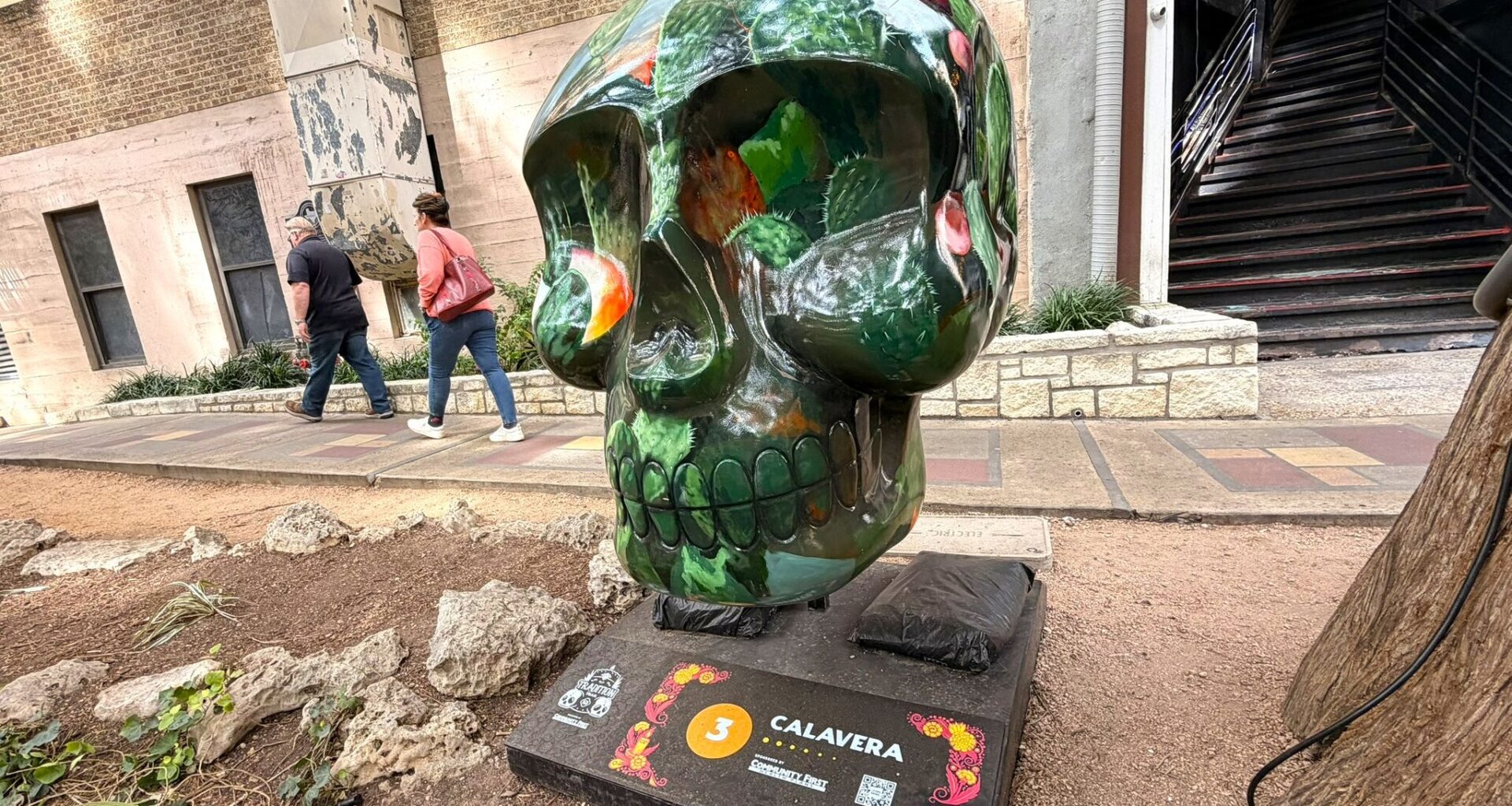
The Calaveras Collection continues along the downtown banks of the San Antonio River. Look for skulls at various river-level locations, which include Arneson River Theatre, Casa Rio, Home2 Suites, Houston and Losoya streets and Stargazer Bridge. Works include “St. Michael Archangel” by Smithsonian artist Carolina Flores, located across the river from Casa Rio, and the cactus-themed “Resilient Love” by Gabriel Garcia near Joe’s Crab Shack.
Article continues below this ad
“Resilient Love” by Gabriel Garcia, located on the River Walk by Joe’s Crab Shack.
Rene Guzman/San Antonio Express-News
San Antonio River Walk, thesanantonioriverwalk.com
“Kaluza” by San Antonio artist Lucia Zambrano, one of five giant painted skulls or calaveras on display at Pearl for Día de los Muertos.
Rene Guzman/San Antonio Express-News
Pearl upped its annual Día de los Muertos celebration by hiring five area artists to each paint their own personal story on a 4-foot-tall calavera for a canvas. In addition to Moya, those skull artists include Daniela Oliver de Portillo, Mauro de la Tierra, Manola y Maria and Lucia Zambrano. The painted skulls will remain on display through Nov. 3 and be part of Pearl’s permanent collection. The skulls are a centerpiece of Día de los Muertos events at Pearl from 5 to 9 p.m. Sunday.
Article continues below this ad
Pearl, 312 Pearl Parkway, 210-212-7260, atpearl.com
A giant catrina at La Gloria Pearl.
Rene Guzman/San Antonio Express-News
Skulls from the chef’s Calavera Collection and related works also are on display at Casa Hernán Alta Cocina, La Gloria Pearl and other Hernandez restaurants.
Article continues below this ad
Casa Hernán Alta Cocina, 411 E. Cevallos St., 210-225-1342, casahernan.com; La Gloria Pearl, 100 E Grayson St., 210-267-9040, lagloria.com
GREAT TASTE: Chef Johnny Hernandez concocts a perfect day in San Antonio
One of several catrinas in the outdoor exhibit Jardín de las Catrinas by San Antonio artist Regina Moya, on display through Nov. 2 at San Antonio Botanical Garden.
Courtesy San Antonio Botanical Garden
What started in 2023 with 10,000 marigolds has since blossomed into a fusion of culture and horticulture with Moya’s eight giant Catrina sculptures. The artist breathes new afterlife into the traditional Day of the Dead skeletons with plants incorporated into the floral figures, some standing up to 16 feet tall. Inspired by nature and Mexican sayings or refranes, each catrina is dressed in flowers and found objects that flow from their wide-brimmed hats to their giant bell-shaped gowns. Through Nov. 2. Included with admission and membership.
Article continues below this ad
A giant catrina at San Antonio Botanical Garden with the Mexican refrane or saying, “No todo lo que brilla es oro,” which translates to “not everything that shines is gold.” The work is one of several by San Antonio artist Regina Moya in the garden’s Jardín de las Catrinas exhibit, which runs through Nov. 2.
Courtesy San Antonio Botanical Garden
A giant catrina by San Antonio artist Regina Moya with the Mexican refrane or saying, “Al nopal sólo se le arriman cuando tiene tunas,” which translates to “People only approach the nopal cactus when it bears fruit.” The work is one of several in the Jardín de las Catrinas exhibit at San Antonio Botanical Garden through Nov. 2.
Courtesy San Antonio Botanical Garden
San Antonio Botanical Garden, 555 Funston Place, 210-536-1400, sabot.org
A giant painted skull or calavera outside La Panadería Bakery and Cafe in downtown San Antonio. The skull is one of seven on display at various La Panadería locations through November for Día de los Muertos.
Rene Guzman/San Antonio Express-News
The bakery chain has seven giant skulls spread across its five locations through November. Such works include “El Ocaso Sun Down” by Lisa Curn at La Panadería’s downtown location at 301 E Houston St., and “Lotería Mexicana” by Efrain Castro and “Vamos a Jugar” by Sylvia Garcia at the bakery’s midtown location at 2503 Broadway. Other locations include a skull at 8305 Broadway, another skull at 17030 Fiesta Texas Drive at La Cantera, and two skulls at 1011 N. Loop 1604 East in Stone Oak.
Article continues below this ad
La Panadería, lapanaderia.com