
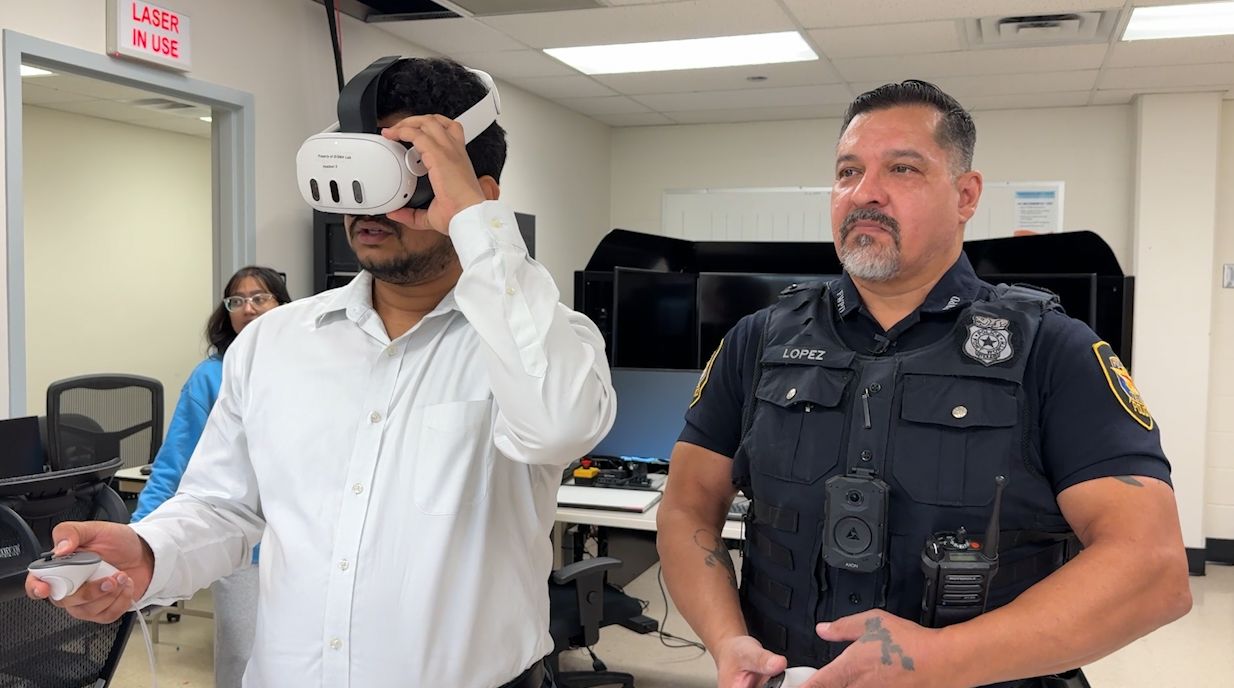
ARLINGTON, Texas — Students at the University of Texas at Arlington are developing a virtual reality training tool that uses artificial intelligence to help police officers practice de-escalation techniques when responding to people in crisis.
“Every single situation requires some level of de-escalation,” said Jorge Lopez, a Fort Worth police officer who has spent about 30 years in law enforcement, including roughly half that time in the department’s training division.
The technology places officers in virtual scenarios where an AI model responds to their words, simulating a person in distress. Officers wearing virtual reality headsets must decide how to respond as the conversation unfolds.
“We have developed an adaptive de-escalation trainer for police officers,” said Eshwara Prasad Sridhar, a doctoral student at UT Arlington who is part of the development team.
Lopez said the technology could help officers practice a wider range of encounters without requiring the same resources as traditional training exercises.
“This technology allows us to compress all of those factors in a way that is much more repeatable, much less reliant on resources,” Lopez said.
The students designed the AI model to respond to an officer’s statements, allowing the simulated encounter to change based on the officer’s approach.
“It’s pretty much like a game,” Sridhar said.
The team has developed five scenarios with varying levels of difficulty, giving officers opportunities to practice de-escalation before encountering similar situations in the field.
“It’s just like any other skill. The more often you do it, the more stress you’re under as you’re doing it and the higher consequences attached to you doing it correctly will make you better at it,” Lopez said.
The need for training extends beyond Fort Worth. San Antonio reported more than 28,000 mental health-related 911 calls in 2025. Austin reported more than 97,000 such calls between 2022 and 2024, while Dallas logged more than 16,000 behavioral health calls in fiscal year 2023-24.
Lopez said improving officers’ responses to people in crisis could also help strengthen relationships between police departments and the communities they serve.
“There’s lots of problems in law enforcement, and I think the best thing we could do to start building bridges with communities and rebuilding trust is to show that we are actually trying to get better,” Lopez said.
The team hopes to expand the technology to additional partners. For Lopez, the goal is to help officers prepare for real encounters with people experiencing a crisis, not simply to master a virtual simulation.