
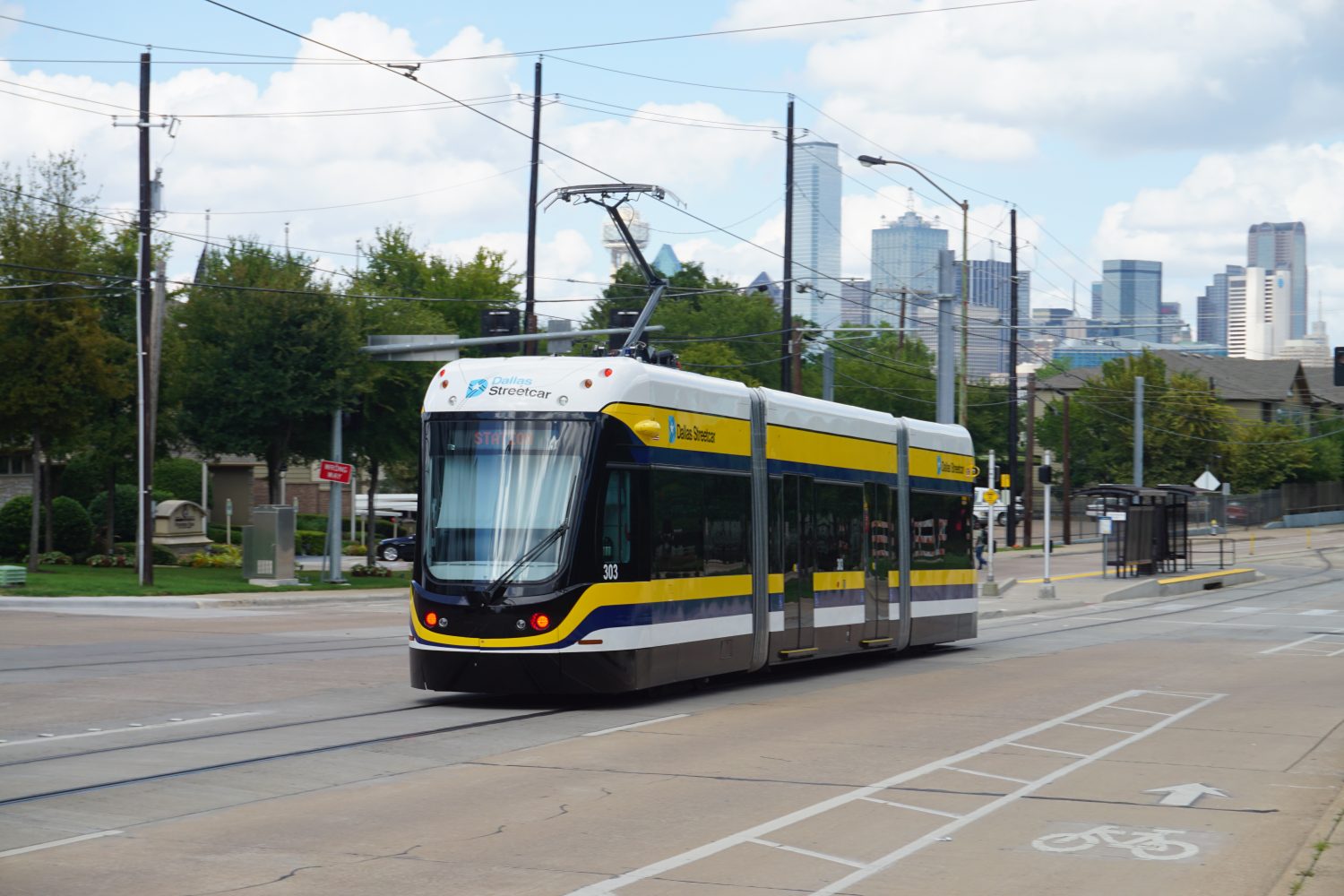
Dallas council members voted Wednesday to advance an expansion of the Dallas Streetcar. The city still isn’t sure how to fund current operations, but fear not; a study is on the way.
The long-anticipated project will link the city-owned streetcar’s existing line between Oak Cliff and downtown with the M Line Trolley in Uptown. When completed, the route will connect the Bishop Arts District to Klyde Warren Park, the Dallas World Aquarium and West Village, along with added downtown stops. Future expansions could also bring streetcar stops to Lower Greenville and Fair Park, but those won’t be around for a long while, even in transportation department terms.
On Wednesday, the council approved a $1 million agreement with AECOM to finalize a route generally supported in 2017 that will connect a coming streetcar extension near the Omni with the M Line in Uptown. Transportation and Public Works Director Gus Khankarli told council members that the process will involve stakeholder engagement and public engagement.
The discussion was brief, with council member Bill Roth questioning the contract fee, while Deputy Mayor Pro Tem Maxie Johnson asked whether the city could direct funds to bring connectivity to his community. A proposed future extension could bring a streetcar stop to the Dallas Zoo near the border of his district, although no further plans were discussed to extend it across Interstate 30 and into District 4.
Sign up for the This Week’s Top Stories newsletter to get the latest stories delivered to your inbox
THANK YOU!
You’re all set.
CLOSE
That followed a longer but still succinct discussion, by council standards, on approving operating and management funding for the coming fiscal year. Chad West, who represents the section of North Oak Cliff currently connected to downtown by the streetcar, opened council member comments by saying he hoped it would be an expedient decision.
“I hope we don’t spend a lot of wasted time going through our annual debating of the streetcar. I’m supportive of the work and continue to support the funding sources here that have been identified while we continue to identify new funding sources,” West said. “The streetcar is an important public transit tool to provide low-cost, car-free transit between North Oak Cliff and downtown.”
Not so fast
Council members were told the streetcar’s operating budget will run close to $2.8 million at an unusually short meeting presided over by Mayor Pro Tem Jaime Resendez in Mayor Eric Johnson’s absence. Of that total, $2.5 million will come from the city’s beleaguered general fund, which faced a $51 million shortfall prior to wide-ranging cuts to services and departments in September. The remainder, roughly $300,000, will come from DART sales tax returns, approved as part of a compromise with member cities to stave off exit elections last spring. Dallas will receive $211 million over the next six years in increasing amounts as part of a program designed to give cities more self-determination over their transportation needs. In a May memo, Khankarli said the city would receive over $21 million in 2026.
As she has with transit spending and projects in the past, council member Cara Mendelsohn criticized the cost of what appears to be a low-ridership service that charges $1 per rider, calling it a “terrible, terrible deal for the city.”
“The 2.5 million on this item, it’s just not sustainable,” Mendelsohn said. “When I started on council, I think it was 1 million. I mean, there’s an escalation of cost that’s huge, and then ridership is actually declining.”
Khankarli said subsidies have dried up, while inflation has driven up the cost of spare parts and other operating expenses.
The discussion also touched on the shelved D2 subway project. Before then-CEO Nadine Lee announced in 2023 that the rail extension connecting most of southern downtown was no longer part of the agency’s long-term plans, the council passed a resolution in 2022 stating that, if the project were deferred, DART would discuss future increased contributions to the streetcar. When Mendelsohn raised that point, Ghankarli said they expect to discuss it with DART’s shaken-up leadership team soon.
An extension of the streetcar could bridge transit gaps the D2 once sought to close in the Central Business District, while also adding investment to infrastructure around the Kay Bailey Hutchison Convention Center, which is in the middle of a $3.8 billion(?) expansion. Meanwhile, council member Bill Roth also criticized the costs of the current configuration and said he wanted the city to find a way to make it less expensive.
“We certainly have to approve it because we have an obligation to operate this thing for the time being, but I think I would encourage the transportation committee and us, generally in connection with all the convention center improvements, to take a hard look at what other alternatives there are, especially on a temporary basis during the construction period, to mitigate some of these costs,” Roth said.
As West noted at the start of the meeting, Dallas is currently conducting a study on possible funding sources that would stabilize or reduce the city’s general fund contributions. Those sources could include parking fees, advertising and sales tax contributions, according to a briefing delivered to the Transportation and Infrastructure Committee in May. After Uptown council member Paul Ridley questioned him, Khankarli said he was working to expedite a presentation to the council on ways to minimize future general fund contributions.
Council member Jesse Moreno said he supported approving the funding source for this fiscal year, but the city must reduce the burden on a budget that has seen multiple consecutive years of cuts amid rising costs and declining revenue.
“We should not even be hearing expansion of the streetcar without a source for the maintenance and for the operation,” Moreno said.
The funding study is expected to be complete in the first quarter of 2027.