
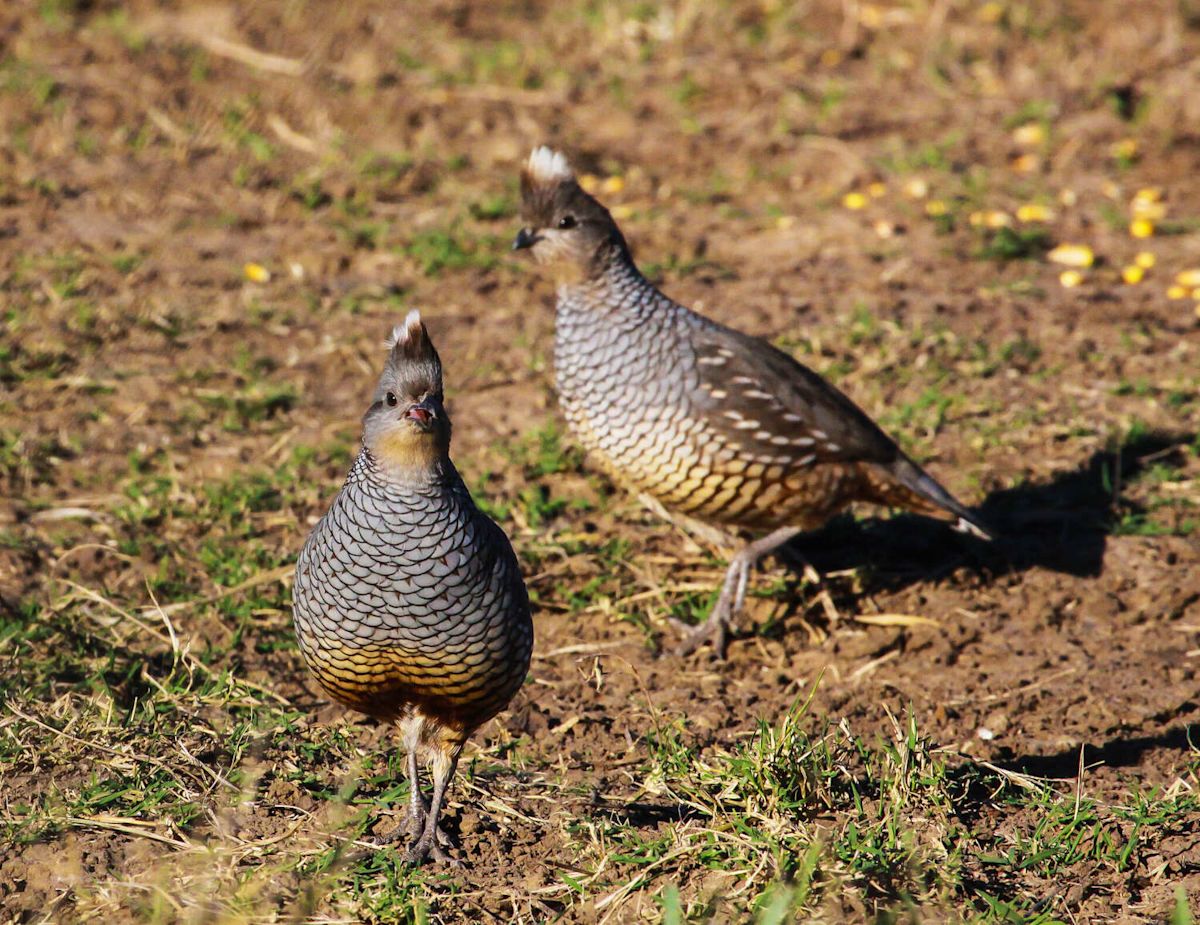
Scaled quail are booming in the Edwards Plateau.
Specifically in the western portion, which helped carry the ecoregion’s all-time high of 29.88 average birds per route in Texas Parks and Wildlife Department’s annual roadside survey.
“We’ve had really good breeding-season years, and the scaled quail just continue to be able to capitalize on that,” said Patrick Schutz, TPWD’s upland game bird program leader.
“They’re booming there.”
Schutz highlighted counties on the western end of the region, particularly Irion and Reagan, as being exceptional drivers of the strong estimate.
“A few of those routes out west really drove those numbers this year,” he said.
The ecoregion appeared to have strong carryover and production after a solid upswing in 2025, when the survey jumped to 14 birds per route from 6.38 the previous year. This year’s average is more than double last year’s count and a far cry from the 1.5 birds per route recorded in 2022. The only other years that saw an average of more than 20 scaled quail per route in the Edwards Plateau were 2017 (24.75) and 2005 (24.38). TPWD has been conducting the annual roadside survey since 1978.
The western edge of Texas’ centrally located ecoregion also offers one of the state’s unique opportunities for a mixed bag of both scaled quail, also called blue quail, and bobwhites, which also saw a modest increase in the region on the survey, though bobwhite quail abundance in the Edwards Plateau is relatively low compared to the state’s strongholds in South Texas and the Rolling Plains. The bobwhite estimate of 4.67 this year in the Edwards Plateau is a sizable jump from 1.28 last year and surpasses the 15-year mean of 3.15.
“I definitely think there’s opportunity for sure, no doubt,” Schutz said of the potential of bagging both bobwhites and blues in some areas of the Edwards Plateau.
Hunting opportunities largely exist on private lands, although there are some public-land prospects in the region, including at Twin Buttes, San Angelo State Park and other units as noted in TPWD’s public hunting lands booklet. Be sure to reference the booklet for appropriate hunting dates at these units. Quail hunting at Twin Buttes, for example, runs from Jan. 1 through Feb. 21.
“I would expect this year to be a good time to quail hunt at Twin Buttes,” TPWD wildlife biologist Preston McKee said. “The habitat of the area creates some challenges for quail hunters such as dense brush and pockets of dense prickly pear. Aside from the challenges though, Twin Buttes is one of the few public lands that allow quail hunting, so it’s worth a hunt or two.”
Quail season
When: Nov. 1-Feb. 28
Bag limit: 15 birds
Licensing: Requires upland game bird endorsement
TPWD senior wildlife biologist John McEachern said large portions of land around the lake do not make for good quail habitat, dominated by willow baccharis, and the large acreage (12,858) of the unit can be a bit deceiving.
“But, in the areas that are suitable habitat, quail numbers should be good but expect a fair amount of public hunting pressure in the area. As far as scaled quail numbers go, we are seeing a good increase there as well, however Twin Buttes lies on the eastern boundary of their range. I am sure there are a few coveys of blues on the area, but anyone specifically targeting them should look at opportunities farther west,” McEachern said.
As Horace Greeley once said, “Go West, young man.” It appears to be a theme this season as scaled quail opportunities also appear robust in the Trans-Pecos region.
The 2026 count averages 23.18 birds per route in the region. It is the fourth consecutive year with an average of more than 20 birds per route, rebounding from the 4.33 of 2021.
“We just had poor production and poor conditions in 2021, but those birds have been able to continue to come out of that and we continue to see improvement in that region,” Schutz said.
At Black Gap Wildlife Management Area in Big Bend country, things are looking fantastic.
“Conditions here at Black Gap are the best they have been in years, with 17.08 inches of rain to date,” said Black Gap WMA area biologist Travis Smith, noting the average is 11 inches.
“Heavy July rains kicked off quail nesting strong, and rains have continued into the fall. We are seeing a lot of birds, and this year should be better than last year. I am expecting an above-average year,” Smith said.
“With all that being said, I do believe this year will also be challenging to hunt due to amount of cover (grass and brush) making spotting and flushing birds difficult, but hunters should have plenty of opportunity.”
About 50 miles northwest of Black Gap, Elephant Mountain Wildlife Management Area also holds promise for scaled quail hunters.
“With above average rains and long growing season, the range conditions are better than we have seen in several years. There was an abundance of grasshoppers through the hatching season and recruitment appears high. Our latest roadside survey reported 4.6 birds per mile in contrast to two years ago when we recorded 1.1 bird per mile,” said Elephant Mountain WMA area biologist Cody McEntire, who noted covey sizes have ranged from 5-15 birds.
“I anticipate a good hunting season with high hunter success.”
Meanwhile, survey numbers dipped in the state’s two major bobwhite strongholds, though both the Rolling Plains and South Texas remain above their long-term averages. The Rolling Plains count decreased to 13.68 birds per route from last year’s 15.32, but still tops the 15-year mean of 12.79. South Texas fell to 10.17 from 12.7 and hovers just above the 9.92 long-term mean.
The Rolling Plains in particular appears to be a mixed bag.
“We definitely had some concerns there just because it was just super dry in many places starting that breeding season and carried through the breeding season. And we did have some rains that came through and helped in different areas, but it’s really kind of been a mix and it depends on where you’re located within the Rolling Plains,” Schutz said.
“As far as the bird numbers, I think it’s going to be, I would say, fair to good. But like I said, it depends on where you’re at.”
Brody Larkin at the Gene Howe Wildlife Management Area said things started off looking encouraging during the spring, but the dry summer heat seemingly took a toll.
“Based on our observations and current habitat conditions, we anticipate a slightly below-average quail season at Gene Howe WMA. Although we continue to observe quail on the area, reduced summer observations and smaller coveys suggest that hunters may encounter fewer birds than in a more productive year,” Larkin said.
“Numbers are poor at the Matador,” TPWD project leader Chip Ruthven said.
“We had extremely dry and hot conditions through the spring and summer with little nesting and brood rearing success. Based on trapping, only 30% of birds are young of the year, which is the opposite during a good year. This season will likely be well below average. Numbers are a little better at Teacup Mountain as they received some summer rains that we missed, but we still expect a below average season.”
Mitchell Riggs, operations manager at the Rolling Plains Quail Research Ranch in Fisher County, said he expects a poor year.
“We started the breeding season with a good carryover of birds from the winter. Unfortunately we had a dry spring. On top of the dry spring, much of the Rolling Plains had 50-plus days where the temperature was over 100 degrees and about 30 consecutive 100-degree days. So needless to say, due to the hot and dry spring and summer, we had very little reproductive success. We are seeing birds, just limited numbers,” Riggs said.
South Texas bobwhite hunting seems to hold higher optimism.
“All the reports that I’ve been getting out of South Texas continue to have multiple hatches, later than normal broods that they’re seeing. So, there was some ebb and flow as well in South Texas, but for the most part, the feedback I’m getting from our wildlife biologists and private landowners or entities, that the numbers are still looking good,” Schutz said.
“Even though we saw that slight dip, I still anticipate us to have some really good hunting opportunities in South Texas.”
TPWD wildlife biologist Dustin Windsor said Jim Wells County received ample rain in late spring and that there should be more birds on the landscape compared to the drought conditions of last year.
“Overall, across Jim Wells County, quail numbers should be quite good, as this year’s weather provided favorable conditions for a rebound from recent declines. As with most things, with the good comes the bad: good rains produced abundant herbaceous cover (grasses and forbs) and that cover, unless managed through shredding or grazing, is still around, offering great hiding spaces for quail. A little bit of forethought, and hunters should be able to have a great hunt this fall, but those that did not put in the work, may have trouble finding the coveys,” Windsor said.
Timely rain also seems to have had good effect on the Chaparral WMA near Cotulla.
“The Chaparral WMA received some good late spring and early summer rainfall. This created favorable conditions for quail reproduction. As a result, our fall roadside quail counts are up about 1.6 times higher than last year. We estimate this quail season to be better than last year. We have received additional rainfall in the beginning of October, greening the WMA back up and improving conditions as we head into the fall,” said Diego Navarro, TPWD’s South Texas ecosystem project leader.
TPWD wildlife biologist Onalise Hill is seeing similar in Live Oak County.
“Timely rains in May and June provided great grass cover, herbaceous forage, and insects for successful quail reproduction. Late summer and early fall saw things drying out, but a few pockets of rain earlier this month have helped. Hunting success varies greatly by property, of course, but well-managed properties are seeing good quail numbers this year,” Hill said.
Outside of the state’s bobwhite strongholds, perhaps the most encouraging news comes out of the beleaguered High Plains of the Panhandle.
The region has seen incremental increases in the annual survey the last four years. The 6.56 birds per route in the High Plains sits just below the 15-year average of 6.76, building steadily from the 0.78 birds-per-route count in 2022.
“That’s something that gets us excited. And again, we have to keep that in context of the average number of birds historically that we see within that region, but we’re creeping up and for the past four years we’ve continued to increase and gain traction and improve that population in that region,” Schutz said.
“It’s definitely something that we’re excited about and we just hope that trend can continue.”
Subscribe
There’s more to Houston with the Chronicle. Subscribe today for just 25¢.
This article originally published at Texas hunting season preview: Scaled quail booming in western Edwards Plateau, Trans-Pecos.