
They don’t attend the same school. They aren’t in the same grade. They don’t even share a diagnosis.
But Kim Medford’s seventh grader and Ashish Talwar’s first grader share one thing: a parent who says making sure Fort Worth ISD follows their special education plan has become a second job.
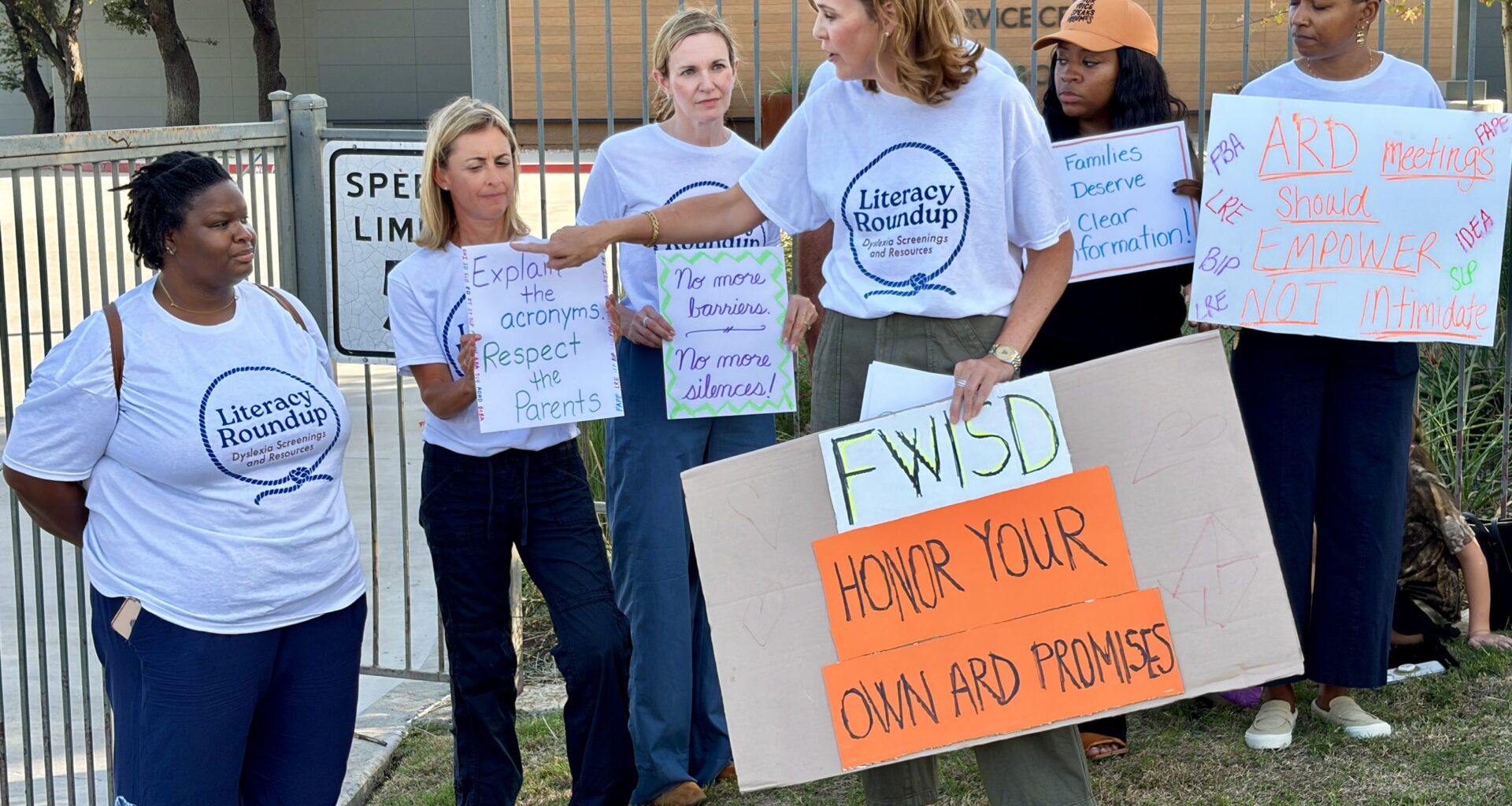
As cars buzzed by, the two stood outside the gates of FWISD’s District Service Center alongside other parents and advocates from Literacy Fort Worth. They want the district to make special education meetings work for children — and to prove the services it promises actually reach the classroom.
Both parents want FWISD to do its job.
“I’m a nurse by trade, but I’ve become my son’s caseworker,” Medford said.
“It’s not our job to act as daily auditors,” Talwar said.
Caroline James, executive director of Literacy Fort Worth, said parents shouldn’t have to become full-time case managers to make sure their children get basic support. James has attended more than 100 special education meetings in 10 Tarrant County districts. None are doing a great job, she said.
“We are failing students and families at scale,” James said.
FWISD Deputy Superintendent Mohammed Choudhury said in a statement the district checks service records against each student’s plan and monitors progress.
“When services are missed, the district documents and reviews the circumstances, assesses the impact on the student, and takes corrective action to address gaps in service delivery,” Choudhury wrote.
Medford said she spent three and a half years pushing FWISD to test her son, Noah, for learning disabilities. Noah was reading at a first-grade level when he started sixth grade last year.
The summer before Noah entered sixth grade, Medford raised her concerns with his principal. The answer, she said, was the same.
“Let’s wait. Let’s see. But he’ll probably catch up,” Medford recalled the principal saying.
Robert Rogers, president of The Reading League Texas, said parents across the nation get that answer. It’s not good enough, he said.
Screening tools can flag dyslexia risk before children even start learning to read and getting help early works, Rogers said.
“Dyslexia should be diagnosed as early as possible because the intervention can occur early,” said Rogers, who mentors FWISD elementary students.
Last school year, FWISD finished 52 of its 1,859 special education evaluations late, according to state-submitted data obtained through an open records request.
Texas sets a 100% target for completing special education evaluations on time, as federal law requires. FWISD’s 97.2% on-time rate was the district’s lowest in at least five years.
In 12 cases, the district cited a lack of available staff to do the testing.
 Parent Kim Medford speaks about the difficulty to secure dyslexia services for her seventh-grade son during a news conference Oct. 13, 2026, outside the Fort Worth ISD District Service Center. (Jacob Sanchez | Fort Worth Report)
Medford turned to Literacy Roundup, a city program that screens students for potential learning disabilities, after facing obstacles securing services for Noah. Volunteers screened him and found signs of dyslexia. Literacy Roundup helped Medford navigate an admission, review and dismissal meeting, where parents and educators determine what special education services a student receives.
“I felt his teachers were actually on board,” Medford said.
Then the school year started.
During the first week this year, Medford emailed each of Noah’s teachers, reminding them of his disabilities and the help he needs.
“I still have not heard back from any of those teachers,” Medford said.
She visited each of them during a meet-the-teacher night.
The first teacher read the email — two weeks after Medford sent it, she said. After reading the email, the teacher told her it explained what she’d seen in class. That teacher has since resigned, Medford said.
Another teacher told Medford that Noah would need to ask for his accommodations in class.
Medford asked the crowd in front of the District Service Center to imagine being a seventh grader who is far behind his classmates and knows it.
“Would you even raise your hand as an adult in front of your peers?” Medford said.
Choudhury said general education teachers have access to their students’ individualized education programs, are told which accommodations they’re responsible for and receive training from special education staff.
Medford said Noah’s dyslexia teacher recently told her that he was doing great and close to not needing services.
“How is that even possible?” Medford said. “And he’s failing reading right now with a 30.”
 Parent Ashish Talwar talks about how his son did not receive special education services for several months during a news conference Oct. 13, 2026, outside the Fort Worth ISD District Service Center. (Jacob Sanchez | Fort Worth Report)
Talwar’s son attends an A-rated elementary school. That hasn’t made his son’s plan any easier to enforce, he said.
Talwar’s son spends much of his school day in a self-contained classroom, but his plan requires him to spend specific amounts of time learning alongside his peers in a general education classroom. A staff member should take him between classes each day.
But that wasn’t the case. Talwar said his son didn’t receive general education classroom time for months in kindergarten. He raised those concerns with campus leadership, which blamed staffing constraints.
Choudhury said a student’s admission, review and dismissal committee, which includes the parent, decides whether the district must make up for missed services.
The issue returned in August when Talwar’s son started first grade. He said his son’s plan wasn’t followed during the first few weeks of school.
Talwar raised his concern with Superintendent Peter Licata during a listening session. Licata provided incorrect information, Talwar said. FWISD spokesperson Evan Anderson did not respond to a question about Talwar’s exchange with the superintendent.
“If a school lacks the staff or systems to follow an (individualized education program), that’s a problem the district needs to solve,” Talwar said. “My son shouldn’t lose out on services because the adults haven’t figured out how to make the system work.”
School systems and the adults running them need to be transparent with parents, Talwar said.
“And stop making families fight for what their children are legally entitled to,” he said.
James, the Literacy Fort Worth leader, described joining a parent during an admission, review and dismissal meeting where more than a dozen educators sat behind their computer screens. She said she couldn’t tell whether the educators were working on the student’s plan, or just shopping online.
“That’s not collaboration, it’s not partnership and it’s certainly not how you build trust with families,” James said.
James called on school districts to deliver promised services for children. They can’t wait, she said.
“Our students deserve a system that sees them, hears them and serves them — not a system that hides behind computer screens,” she said.
FWISD campuses need clear, consistent processes, said Rebecca Montgomery, a Literacy Roundup volunteer. Parents should know who to contact, how to submit a request and what they can expect in response.
When a parent requests an evaluation in writing, the district has 15 school days to respond, Choudhury said. Once a parent consents, the evaluation generally must be finished within 45 school days and the committee must meet within 30 calendar days after that to decide whether the student qualifies for services.
Teachers and other school staff deserve training, resources and support to recognize signs of dyslexia in students and help families, Montgomery said.
“This isn’t about pointing fingers,” she said. “It’s about working together to make sure no child with dyslexia falls through the cracks.”
Medford said she thought the new school year would usher in a new experience for her family.
Noah’s school is one of the campuses under the district’s new turnaround model, Medford said. She saw the principal of her son’s school on TV talking about the extra help students would get this year.
“I was optimistic that there were going to be tools in the toolbox for my son’s success this year,” Medford said. “Instead, I have gotten the opposite.”
Jacob Sanchez is education editor for the Fort Worth Report. Contact him at jacob.sanchez@fortworthreport.org or @_jacob_sanchez.
Disclosure: FWISD manager Pete Geren leads the Sid W. Richardson Foundation, a financial supporter of the Fort Worth Report. FWISD manager Laurie George is a member of the Report’s reader advisory council. At the Fort Worth Report, news decisions are made independently of our board members and financial supporters. Read more about our editorial independence policy here.
This article first appeared on Fort Worth Report and is republished here under a Creative Commons Attribution-NoDerivatives 4.0 International License. 