
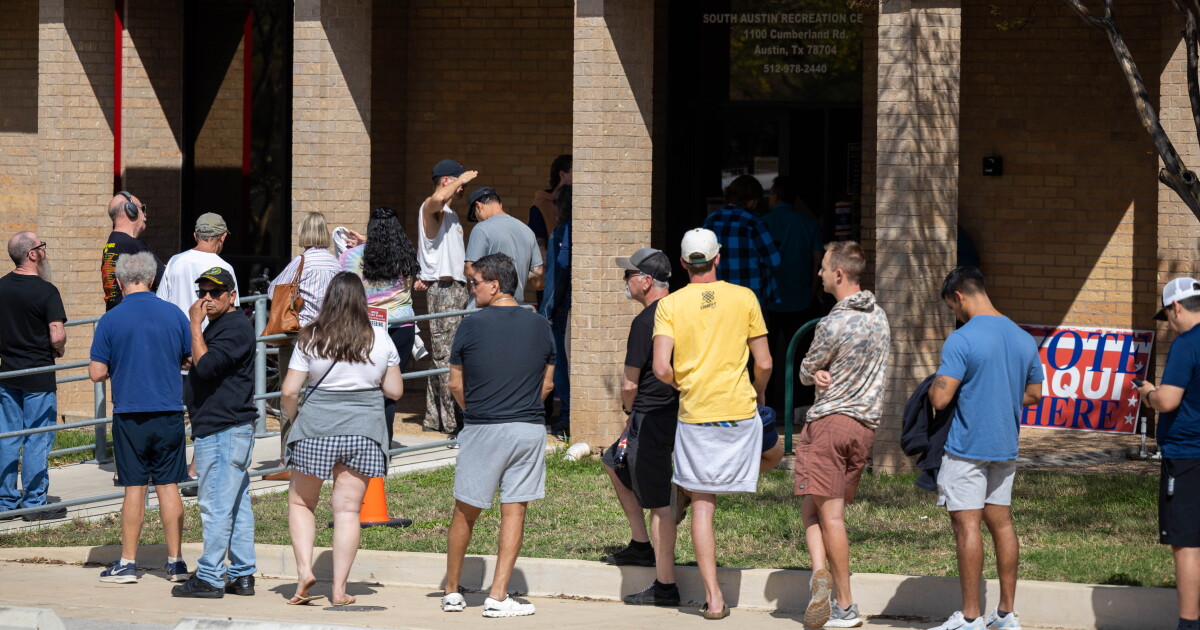
Voters across the Austin area will help determine the future of Texas and the nation during the Nov. 3 election.
Yes, it’s that big of a deal.
Major leadership positions are on the ballot, including Texas governor and U.S. senator. Locally, you might be voting on city council seats, school funding, bonds for parks and libraries, and more.
KUT News is asking people what questions they have about the voting process or specific races in the Austin area. We’ve put together a list of the most common ones with answers below.
If you’d like to ask us an election question, fill out our form at this link or at the bottom of this story.
Some voter-submitted questions have been edited for clarity or to group similar questions together.
When and where can I vote?
Early voting started Monday, Oct. 19, and continues through Friday, Oct. 30. Election Day is Tuesday, Nov. 3.
The hours for early voting can vary depending on location. On Election Day, polls are open from 7 a.m. to 7 p.m. As long as you’re in line by the time polls close, you can vote.
Where you can vote is tied to the county you live in. If you’re in Travis, Williamson or Hays counties, you can vote at any polling place within your county both during early voting and on Election Day. Polling places open during early voting may not be the same as ones open on Election Day.
Here’s a list of early voting locations and hours:
And here’s a map of early voting places for Travis County:
Here’s a list of Election Day locations and hours:
And here’s a map of Election Day voting places for Travis County:
In some other counties in the state, you may be limited to voting at a specific precinct on Election Day. You can double-check where you can vote through the Texas secretary of state’s voter portal or your county’s elections page.
What are some of the local races that I should be paying attention to?
In Austin, five City Council seats are on the ballot: District 1, District 3, District 5, District 8 and District 9. Find out which district you live in using this city map. Council members decide on everything from Austin’s budget and homelessness initiatives to data center regulations and automatic license plate readers.
Austin voters will also get to decide on a $295 million bond package for parks and libraries. We’ve got a deep dive into propositions A and B.
Proposition I has also been in the spotlight. It calls for an independent, recurring audit of the city’s finances.
The city has already recently implemented an audit through an ordinance.
Supporters of the proposition say that it has stronger standards than the city’s ordinance, and that a charter amendment is a more permanent way to hold the city accountable. Opponents say the proposition will be expensive and incentivize the auditor to make deeper cuts for a profit.
We’ve got more on Prop I and other Austin propositions in this guide.
This only scratches the surface of local races. We have more in-depth voter guides for Travis County, Williamson County and Hays County.
Want to see your personalized ballot? Type your address into these county tools:
What are the statewide races I should know about?
While the race for U.S. Senate between Republican Texas Attorney General Ken Paxton and Democratic state Rep. James Talarico has made national headlines, there are several other high-profile statewide races on the ballot you should know about.
Along with Talarico, several Austin-area Democrats are vying for statewide races. If you believe recent polling, multiple top races are close. No pressure, but a Democrat hasn’t won a statewide race since 1994.
In the governor’s race, Austin state Rep. Gina Hinojosa will attempt to deprive Texas Gov. Greg Abbott of a historic fourth term in office.
Vikki Goodwin, another state representative from Austin, is giving Lt. Gov. Dan Patrick his toughest challenge yet. The race for Texas comptroller, the state’s chief financial officer, will see Austin state Sen. Sarah Eckhardt face off against incumbent Don Huffines.
Because Paxton is running for Senate, that creates an open race for the next Texas attorney general. Republican state Sen. Mayes Middleton, Democratic state Sen. Nathan Johnson and Libertarian candidate Tom Oxford are challenging each other.
While these races have gotten the bulk of voters’ attention, you will also find the General Land Office commissioner and agriculture commissioner on your ballot. The race for a spot on the three-member Texas railroad commission — the agency that regulates the state’s oil and gas industry — has attracted more scrutiny than usual. The Republican candidate, Bo French, was accused of making racist comments about UT Austin students filmed celebrating at a Texas football game.
You can find more candidates running for statewide office, including third-party candidates, by viewing a personalized ballot in the county where you’re registered to vote.
What should I bring to vote?
Remember to bring a photo ID. There are seven types that are accepted at the polls, including a Texas driver’s license, Texas election identification certificate and U.S. passport.
If you don’t have a photo ID and can’t get one, there are also alternatives you can bring — you’ll just have to fill out a form saying you had a reasonable impediment to getting an ID.
For a full list of accepted IDs and alternative procedures, check out the Vote Texas website.
Is it too late to register to vote?
If you’re not yet registered to vote in Texas, the deadline has passed for this election. The Vote Texas website has instructions for registering for future elections.
Not sure if you’re registered to vote? You can check online at the Texas secretary of state’s voter portal.
What do I do if I’m listed as a voter in ‘suspense’?
You can still participate in the election if you’re listed as a voter in suspense, but it might require some extra steps.
Voters end up on a voter suspense list for lots of reasons, but it mostly happens after a move. The list exists to make sure that voter rolls are staying up to date and voters are participating in local elections for where they live.
If you’ve moved within the same county and find yourself on a suspense list, you will be able to fill out a statement of residence at a polling place. If you’re in a county like Travis, Williamson or Hays with countywide voting, you can go to any polling place within your county both during early voting and on Election Day and cast a ballot.
If you’ve moved counties, you can vote in your new county with a limited ballot — which includes statewide races and any races that your old and new addresses have in common. Limited ballots are only available during early voting and must be cast at the county’s main early voting location.
You can check whether you’re on a suspense list by going to the state’s election site.
What if I’m registered, but I recently moved?
If you moved but haven’t yet updated your voter registration with your new address, it’s too late to make that change for this election. But you still have options for voting — essentially what you should do if you’re a “suspense” voter.
If you moved within the same county and you’re in a county like Travis, Williamson or Hays with countywide voting, you can go to any polling place within your county both during early voting and on Election Day and cast a ballot. You’ll fill out a statement of residence. If you moved to a different county, you can cast a limited ballot at your new county’s main early voting place, only during the early voting period.
To make sure you’ll be able to vote with a limited ballot, the Texas secretary of state’s office recommends reaching out to the early voting clerk in your new county to check.
When I went to vote, I looked through my selections on the ballot screen and noticed some of my votes were different from what I intended. Why is this happening?
Some voters in Travis County have reported that when they make selections on their ballot using electronic voting machines at the polls, their selections appear to change as they move from one page of the ballot to the next. This issue has come up in past elections.
State and county officials say electronic voting machines are not intentionally causing this issue. Rather, when voters tap the touch screens on those machines, a screen sensitivity issue or the voter’s own error can result in an unintended selection.
In Travis County, ballot-marking devices, scanners and tabulators are isolated from external networks and the internet, a spokesperson said in an emailed statement. Voters also receive printed paper ballots, which election officials use to double check the electronic vote count after the election.
Travis County’s voting equipment has been in use since 2019, the county said. That equipment and software undergoes maintenance, calibration and testing before each election.
“The printed paper ballots also provide the record used to verify tabulator results during the post-election audit,” the spokesperson said.
Bexar County officials said reports of ballot selections getting switched are typically caused by touchscreen sensitivity, not equipment malfunctions.
Regardless, when you vote, you should always review your selections on the screen and your printed paper ballot carefully to make sure both formats accurately reflect your choices. You can request a replacement ballot up to two times from election workers at the polls, if needed.
If you experience issues at the polls in Travis County, tell an election worker at your polling location or call the county’s Elections Call Center at 512-238-VOTE (8683) so officials can document and investigate the concern.
I’ve been hearing about voter registration backlogs in the news. Is it possible that, even though I registered by the deadline, my registration might not show up when I check online or when I go to vote? Can I still vote if that’s the case?
You may have heard about two separate software errors with the state’s voter registration portals that created a recent backlog of hundreds of thousands of voter registration records. State and county election officials say they’ve cleared that backlog, and the Texas Association of County Election Officials told KUT News that the issue doesn’t appear to be creating problems for voters at the polls.
Still, it’s possible that election workers won’t be able to immediately verify a voter’s registration, due to the state’s software issues or some other reason. If that happens, you can still vote, but you’ll have to cast a provisional ballot.
Provisional ballots are separated from regular ballots while officials review your records to determine if you are eligible to vote and whether your ballot will be counted or not.
If you have to cast a provisional ballot, you’ll fill out an affidavit explaining why you’re eligible to vote. The affidavit will be used to process your vote. Bring an acceptable form of photo ID — such as your Texas driver’s license — when you head to the polls to vote, and bring proof that you registered to vote if you have it.
To check if your voter registration record is up to date, visit the Texas secretary of state’s voter portal or contact your county voter registrar.
Where can I find a progressive voter guide to help with propositions and city council races?
KUT News is a nonpartisan news source, so we don’t make endorsements for candidates or ballot measures. But we have informational voter guides for the Austin area and stories on specific local races that you can find on our elections page. Our reporters are making an effort to hear from all the candidates in the races we’re covering and break down local propositions.
The League of Women Voters also publishes nonpartisan voter guides for Travis, Williamson and Hays counties.
If you’re looking for a list of endorsements to help you decide, the Austin American-Statesman and Austin Chronicle publish their own.
How do I vote by mail?
In Texas, you can vote by mail if you meet certain requirements, which include being: 65 years old or older on Election Day, sick or disabled, or away from your registered county during early voting and on Election Day.
If you qualify, the deadline to submit your application for a ballot by mail for this election is Friday, Oct. 23. Your application has to be received (not just postmarked) by your county’s early voting clerk by then.
For more instructions on applying to vote by mail, plus what to do once you get your mail-in ballot, check out the Vote Texas website.
Have a voting question we didn’t answer? Fill out the form below. We’ll continue to add to this story as responses come in.