
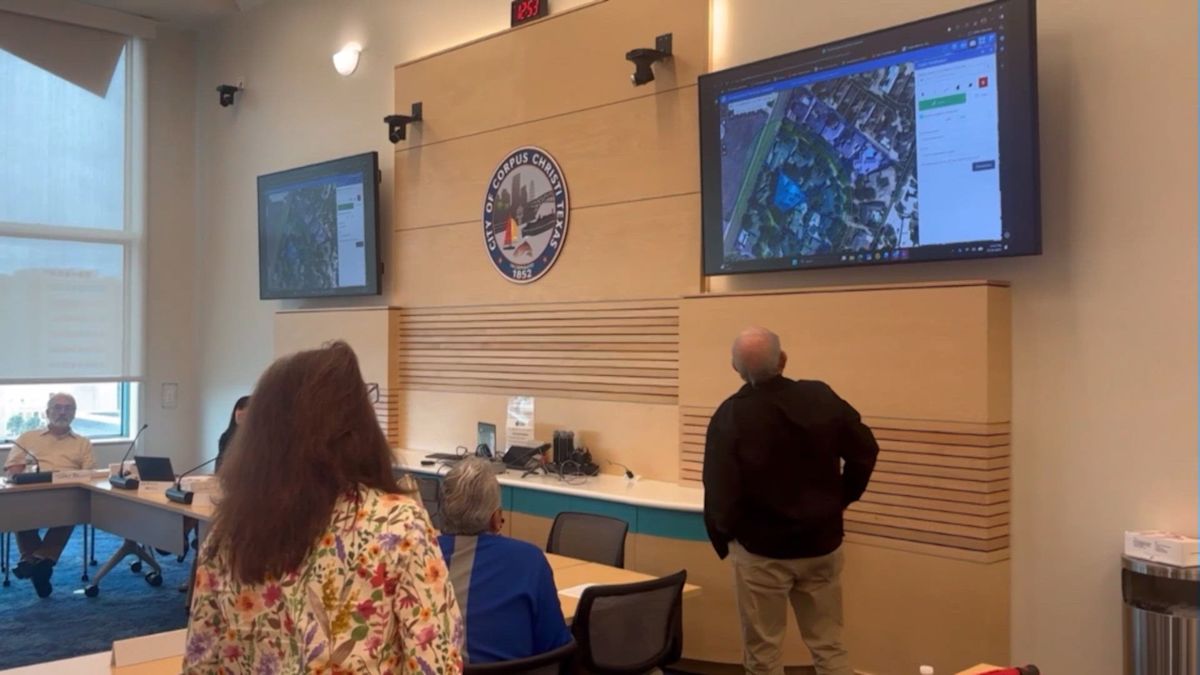
A committee made up of Corpus Christi city staff, short-term rental operators, residents and other local stakeholders reviewed a draft of proposed changes to the city’s short-term rental ordinance Friday.
The proposed regulations could significantly change how short-term rentals, commonly known as STRs, operate in single-family neighborhoods.
The meeting comes after residents along Ocean Drive brought their concerns to City Council, citing loud parties and other disturbances they say are tied to short-term rental properties in their neighborhood.
The 20-page draft includes several significant proposed changes, including a reduction in the STR density cap from 15% to 12% of a block face.
Another proposal would prohibit short-term rentals from operating within 200 feet of another STR, measured from property line to property line.
The draft also calls for mandatory property inspections, noise monitoring equipment paid for by operators and an occupancy limit of 15 people per property.
Parking requirements would also become more specific. Hosts would have to update guest rental agreements to include a maximum of one parking space per bedroom and inform guests that parking on dirt or grass is prohibited.
The city’s Development Services Department says the proposed regulations are intended to balance the property rights of STR operators while preserving the character of single-family neighborhoods.
Alex Harris, owner of Brite Star Construction, is a member of the committee. His company has built more than 500 short-term rental properties.
Harris said he supports the proposed regulations, arguing that residents living near STRs should not have to deal with repeated disturbances.
“The people in that neighborhood that are being disturbed every Friday and Saturday night are property owners too,” Harris said. “They shouldn’t have to suffer because another person thinks that their property rights are better than theirs.”
Harris said addressing occupancy and parking could resolve many of the problems neighbors have reported.
The draft also outlines a stricter enforcement policy. Four documented code violations within a 12-month period would result in full permit revocation, with the administrative appeal process handled directly by Municipal Court judges.
Yvette Wallace, interim director of Corpus Christi Development Services, said the city wants to strengthen enforcement as complaints continue.
Wallace said police and fire personnel are frequently called to problem properties, with some incidents involving parties, overcrowding, shootings and stabbings.
Chris Munro, whose company Coastal Family Homes owns 38 short-term rental properties along Ocean Drive, is not a member of the committee.
Munro told 3NEWS the company had no comment until it had received and reviewed a copy of the proposed ordinance.
Wallace said the city wants to move forward with the changes before short-term rental permits come up for renewal in 2027.
However, the proposal could face uncertainty depending on the outcome of a case before the Texas Supreme Court involving the City of Dallas and the Dallas Short-Term Rental Alliance.
The case, City of Dallas v. Dallas Short-Term Rental Alliance, et al., involves Dallas’ efforts to regulate short-term rentals in residential neighborhoods. The Texas Supreme Court has scheduled oral arguments for December 3, 2026. Its outcome could have broader implications for how Texas cities regulate these properties.
The proposed Corpus Christi rules could also be superseded by changes to state law. However, Harris said he believes the city should continue pursuing changes to the ordinance.
“If you can’t rent your home and make your neighbors happy, you shouldn’t rent your home then, because there is a problem,” Harris said.
The final draft of the proposed ordinance is expected to be posted to the City Council’s online agenda Monday.
City Council is scheduled to consider the proposal on first reading November 10 before second reading on November 17. The proposed changes would still need to go through the city’s approval process before taking effect.