
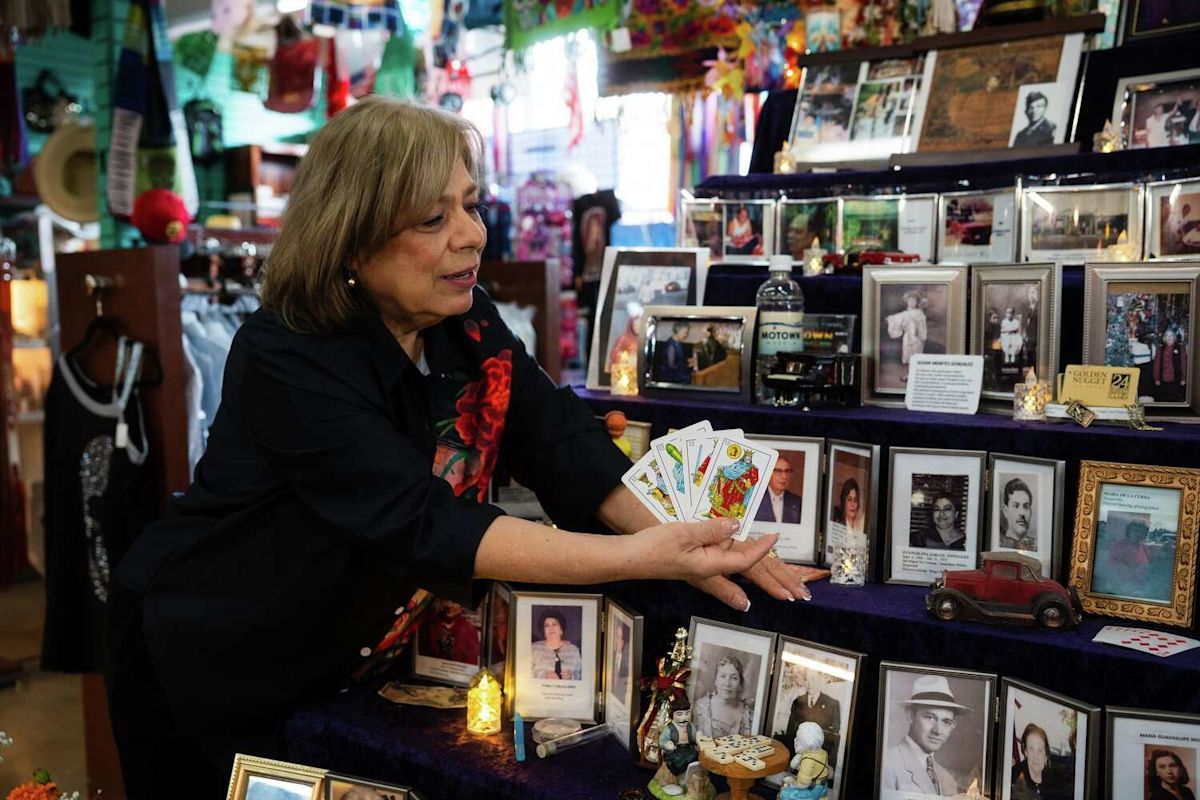
When you step into G’s Gonzalez Gift Shop, a nine-tiered, five-foot-tall ofrenda rises above you like an Aztec pyramid.
Two vases full of orange marigolds flank the shrine, draped with purple velvet cloth and laden with photos and symbolic items representing the dearly departed.
About the author
A 22-year veteran of the Air Force, Vincent T. Davis embarked on a second career as a journalist and found his calling. Observing and listening across San Antonio, he finds intriguing tales to tell about everyday people. He shares his stories with Express-News subscribers every Monday morning.
Photos of loved ones glow in the light of flickering, battery-powered candles. Porcelain figurines of Nuestra Senora de San Juan (Our Lady of St. John) top the display. The scent of incense drifts beneath skeletal mariachis in black outfits and sombreros and La Catrina (the Elegant Skull) in a red dress.
For Día de los Muertos (Day of the Dead) each year, store owner Thelma Gonzalez and her family set up the ofrenda in the shop, which is inside the Farmer’s Market at Market Square downtown. It honors the memory of deceased family members, friends and co-workers
The mementos are varied. There is a CD of Motown’s greatest hits compact disc that was a favorite of Gonzalez’s mother, Susan Gonzalez. A red model 1964 Mustang convertible like the roadster her father, Rene Gonzalez, drove with pride. A Falstaff beer bottle honors another relative.
“It’s a time of remembrance for loved ones who were part of our life here on Earth,” said Gonzalez, 75.
READ MORE: How an S.A. makeup artist helps bring life to Day of the Dead celebrations
‘When no one else is left’
The altar is one of many Día de los Muertos tributes set up across the city, following a tradition that dates to Mayan and Aztec celebrations of death and long-observed practices in Mexico and Latin America countries.
Adapted into the Catholic calendar in the United States, Día de los Muertos marks the first two days of November as All Saints Day and All Souls Day. Remembrances typically include visits to cemeteries and homemade altars set up by artists, families, businesses and schools.
Malena Gonzalez-Cid, executive director of Centro Cultural Aztlan, said the tradition has pre-Columbian elements blended with Christian symbolism after the colonization of the Americas.
She said Centro built the city’s first community altar in 1977, when then-program director Ramon Vasquez Sanchez invited residents to bring shrines set up in living rooms, dining rooms and altarcitos, or little altars to their gallery. They invited artists to add their spin to the public altars, which have grown over the years.
Monday, from 6 p.m. to 9 p.m., Centro Cultural Aztlan continues the celebration with its 49th Annual Altares y Ofrendes exhibit and Dia Los Muertos Celebration that includes altars by community members and artists. The free event will take place at 1800 Fredericksburg Road, Suite 103.
Gonzalez-Cid said before the traditions became popular, some people criticized them, alleging that burning incense and ceremonial dances were pagan rites.
Gonzalez-Cid said an article by local writer Victor Landa about the Mexican legend involving a person’s three deaths deeply resonated with her. She said the first death occurs when the heart and organs cease to function. The second death is when the body is lowered in the ground.
“The final death, and this is what gets me in my heart, is when no one else is left on this earth to remember you,” Gonzalez-Cid said. “That’s why it’s so important we’re honoring our dearly departed.”
ALSO READ: San Antonians honor their departed loved ones on Día de los Muertos
‘It really impacted me’
The ofrenda at G’s Gonzalez Gift Shop was born in the aftermath of a national tragedy. Shaken by the terrorist attacks of Sept. 11, 2001, Gonzalez decided to transform a bookcase into a makeshift ofrenda, using candles and New York souvenirs to honor those who lost their lives.
“It was all the people helping the survivors,” Gonzalez said. “It really impacted me.”
The one-platform display was her first altar. The current version of the ofrenda requires several people working over the course of a week to set up, she said. When dismantled, the display’s items and decorations are stored at the shop.
Sharing information about the ofrenda is a highlight of her job, said Santa Rivera, a retired teacher who’s worked at the shop for more than 10 years. She’s explained the tradition to people visiting from other states, and even from Canada and Italy.
“Everyone takes something away with them,” said Rivera, 69. “They’re thinking, ‘I’m going to start one up at home.’ A lot of people say they’re going to try.”
At her family-owned business, Gonzalez also keeps a treasured photo album that details the store’s history. It includes her sibling Maria Blanca Cabellero, who co-runs the shop, her brother, Rene Gonzalez Jr. and sisters Adela Rivera, Rita Alanis and Ruthie Garcia.
During a recent day at the store, Gonzalez gently touched photos of her father, retired from Eastern Airlines, and mother, who loved music. Both helped at the shop Gonzalez opened in the 1980s. Then, she knelt at a plate bearing Pan de Muerto (bread of the dead) and brushed her hand across a black coffee cup labeled with the insignia “Fire Department – City of New York.”
Even though she never met them, Gonzalez each year still honors the fallen from Sept. 11, her ofrenda keeping their memories alive alongside her own loved ones.
Subscribe
There’s more to San Antonio with the Express-News. Subscribe today for just 25¢.
This article originally published at 25 years later, a San Antonio shop’s ofrenda still honors Sept. 11 victims.