
The whir of sewing machines, the hiss of hydraulic-driven machines and the rustic aroma of genuine leather are the heartbeat of the only shoe manufacturer in San Antonio.
Founded as the nation celebrated its bicentennial 50 years ago, San Antonio Shoemakers has carved out a niche in the footwear industry – a family business that still runs on the blueprint that founders Terry Armstrong and Lew Hayden put in place when they started the company in 1976.
“To say it’s a lost art is an understatement,” said Neal Dellocono, the head of wholesale. “Terry and Lew were shoemakers, and 50 years later, we’re still shoemakers.”
Today, SAS still crafts all its women’s and men’s shoes in Texas, including the athletic trainers that every U.S. military recruit will wear during basic training.
READ MORE: San Antonio Shoemakers General Store is a charming step back in time
As one of the rare domestic shoe manufacturers, the family-owned company takes pride in its longevity, while most of its competitors outsource the work overseas and use cheaper materials.
SAS has two production factories, one at 1826 Centennial Blvd. on the South Side and a larger facility in Del Rio. The company manufactures sandals, athletic shoes, loafers, boots and more. It offers 110 men’s sizes and widths and 88 women’s sizes and widths. SAS sells its shoes in more than 15 countries and operates more than 100 retail stores in the U.S.
Some of SAS’ most popular products include the men’s Journey Lace Up sneaker, the women’s Tour walking shoe, as well as men’s leather dress shoes and women’s sandals.
“Because our shoes fit properly, people can leave the house in the morning, work all day and still go out for the evening without needing to change their shoes because their feet are killing them,” Dellocono said. “They last because of the quality of the materials we use and the craftsmanship involved.”

San Antonio Shoemakers’ Mission One athletic sneakers are shown. The company has been awarded a new three-year contract with the Defense Logistics Agency to manufacture athletic footwear for U.S. military recruits attending basic training. (Andrew J. Whitaker/San Antonio Express-News)
The Mission One trainer
The company’s dedication to stateside artisanship is what caught the attention of the U.S. military. Last month, the Defense Logistics Agency renewed its contract with SAS as the sole manufacturer of athletic shoes for every U.S. Army, Navy, Air Force, Marine Corps and Coast Guard recruit attending basic training.
SAS originally won the contract in 2017, winning a one-year extension in 2021 and a three-year renewal in 2023. Its recent $98 million contract is for another three years. The company is the only manufacturer to continually provide American-made athletic trainers to military recruits since Congress extended the Berry Amendment to recruits’ athletic footwear in 2017. The law requires the U.S. Department of Defense to buy U.S.-made goods, including textiles, clothing, food and tools.
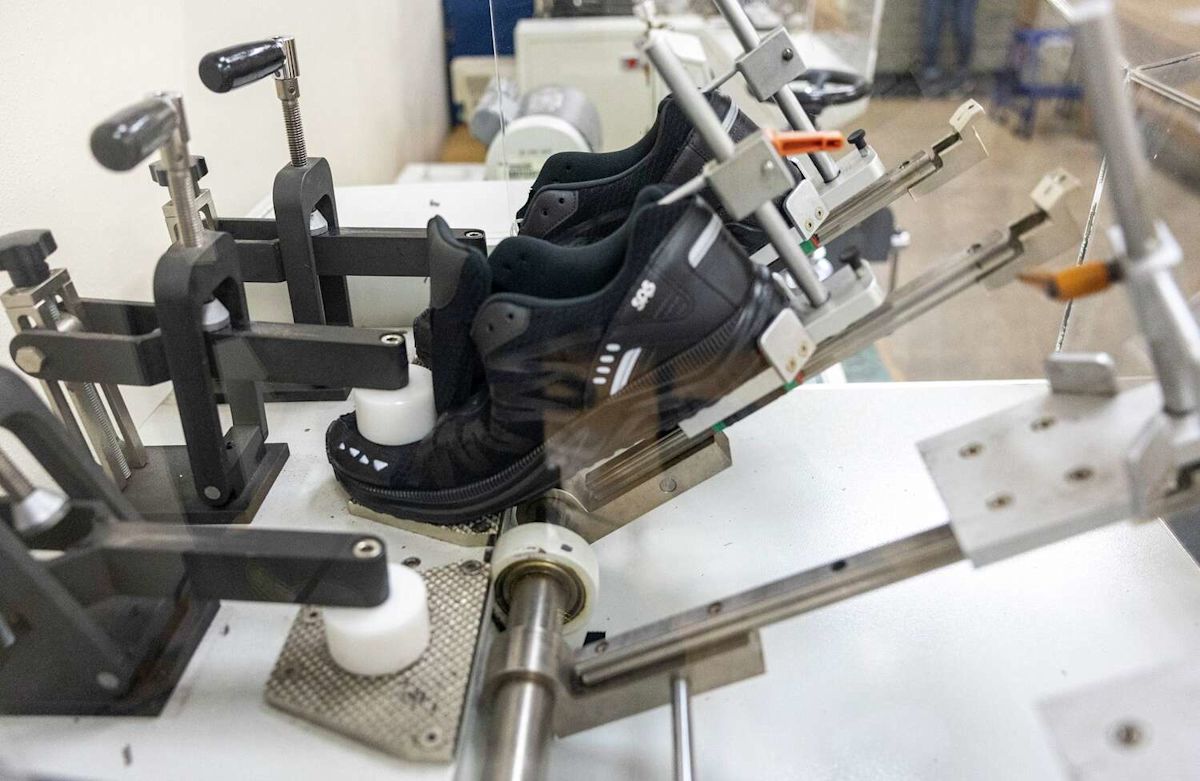
A portion of the SAS factory in San Antonio has an assembly line dedicated to just the Mission One. The athletic trainer is lightweight and slip-resistant with black breathable mesh, knit lining, a shock-absorbing footbed with heel support, a cushioned rubber outsole and a polyurethane midsole with stability control. SAS makes up to size 20 in the shoe.
RELATED:
“It has to be a very versatile shoe,” Dellocono said. “It has to be slip-resistant because they train in water, on mud, on cement and on sand. It has to be very durable because of extensive wear. It has to be very supportive for injury prevention. There are a lot of things that go into it from a design and development standpoint.”
All of SAS’ shoes go through a series of tests in its factory lab, including pull tests to make sure the glue and stitching hold up, flex tests to examine the bend of the shoe and compression tests to ensure they rebound properly. Then, they complete a wear test, with participants reporting back at intervals starting after one week’s wear.
Over the years, SAS has made adjustments to the Mission One shoes based on the recruits’ wear and tear. For example, they added a stitch line to the toe after seeing how burpees on cement ripped open the fabric.
“These military contracts really challenge us because they force us to be better shoemakers,” Dellocono said. “Every shoe that doesn’t make it through training camp is sent back to us, and we analyze it to see where we went wrong.”
Since 2017, the several hundred employees at the company’s San Antonio factory have made more than a million pairs of the athletic trainers for the military.
SAS also has manufactured boots for Boeing’s Starliner space suit and shoes for NASCAR pit crews.
They’ve even made footwear for the San Antonio Spurs Coyote.

SAS, founded in 1976, has a manufacturing facility in San Antonio and another in Del Rio. (San Antonio Shoemakers)
The lost art of shoemaking
Each SAS shoe starts with a last, a foot-shaped mold used to determine the size, width and shape of a shoe.
“The last comes first in shoemaking,” Dellocono said. “It starts with a block of wood.”
SAS hand-carves its own lasts, which is why it can produce so many sizes and widths. The company also makes its own metal cutting dies to cut all the materials for the shoes, and it produces its own polyurethane for cushioning and comfort in the midsoles.
“We’re very self-sufficient,” Dellocono said. “This is why we’re able to provide so many fits and customizations for our customers. We have a huge advantage over our competitors.”

SAS makes its own metal cutting dies to cut all the materials for the shoes. (San Antonio Shoemakers)
SAS employees are involved in every step of the shoemaking process. It’s a lifetime commitment for some, who’ve been with the company for 40 years.
“That’s unheard of in the footwear industry,” Dellocono said. “The big factories in Asia have up to 80% turnover. After a one-year contract, they have to retrain everybody. Because we have such longevity with our shoemakers, it makes all the difference in the world. It’s the only reason why we can execute what we do.”
The company even has employees who’ve brought in the next generation of shoemakers – for some, it’s their children; for others, their nieces and nephews.
MORE SHOE NEWS:
‘Do what you love to do’ – San Antonio’s Shoeman Sam provided personal service of a bygone time
There are more than 100 individual steps for each pair of shoes.
At the San Antonio factory, an assembly line of workers, mostly women, cut patterns with the dies, stitch leather, rough the leather or lining material, glue and cement outsoles to the upper sections of shoes and use hydraulic pressure machines to complete the bonding process. After a shoe receives an inspection, it’s boxed up and shipped out for delivery.
From design to delivery, the whole process for a new shoe can take up to two years.
“It’s not like you can go to school and get a degree in shoemaking,” Dellocono said. “This is all done through apprenticeship programs that we conduct here.”

The company makes its own lasts, a foot-shaped mold used to determine the size, width and shape of a shoe. (San Antonio Shoemakers)
When Armstrong and Hayden set out to create SAS 50 years ago, they had a vision for how a quality leather shoe should be produced. They started off with just 13 shoemakers in an unused aircraft hangar but expanded as word of their shoes’ comfort and quality spread and their customer base grew.
Today, Armstrong’s daughters, Cheryl Remmert and Lisa Armstrong, and his grandson Tyler Remmert own the business.
“The owners would be very proud of what they’ve created, and the owners today are proud of the complex business model we execute,” Dellocono said. “We’re the only company in the United States that is doing what we do, selling to wholesale accounts, in our own corporate retail stores, to international markets and being the largest supplier of athletic footwear for the military. If we continue to be quality shoemakers, then the next 50 years will be even bigger.”
Subscribe
There’s more to San Antonio with the Express-News. Subscribe today for just 25¢.
This article originally published at Inside the San Antonio factory keeping ‘the lost art’ of shoemaking alive in America.