
Daniel Sanchez did exactly what he was trained to do.
That was the message the Austin police officer’s defense attorneys sought to drive home Wednesday as they opened their case in a jury trial stemming from Sanchez’s fatal shooting three years ago of tech entrepreneur Rajan Moonesinghe.
Testimony from various witnesses affirmed the notion that Sanchez’s split-second decision to open fire on Moonesinghe in November 2022 was a reasonable — and trained — response to what he perceived as an immediate threat.
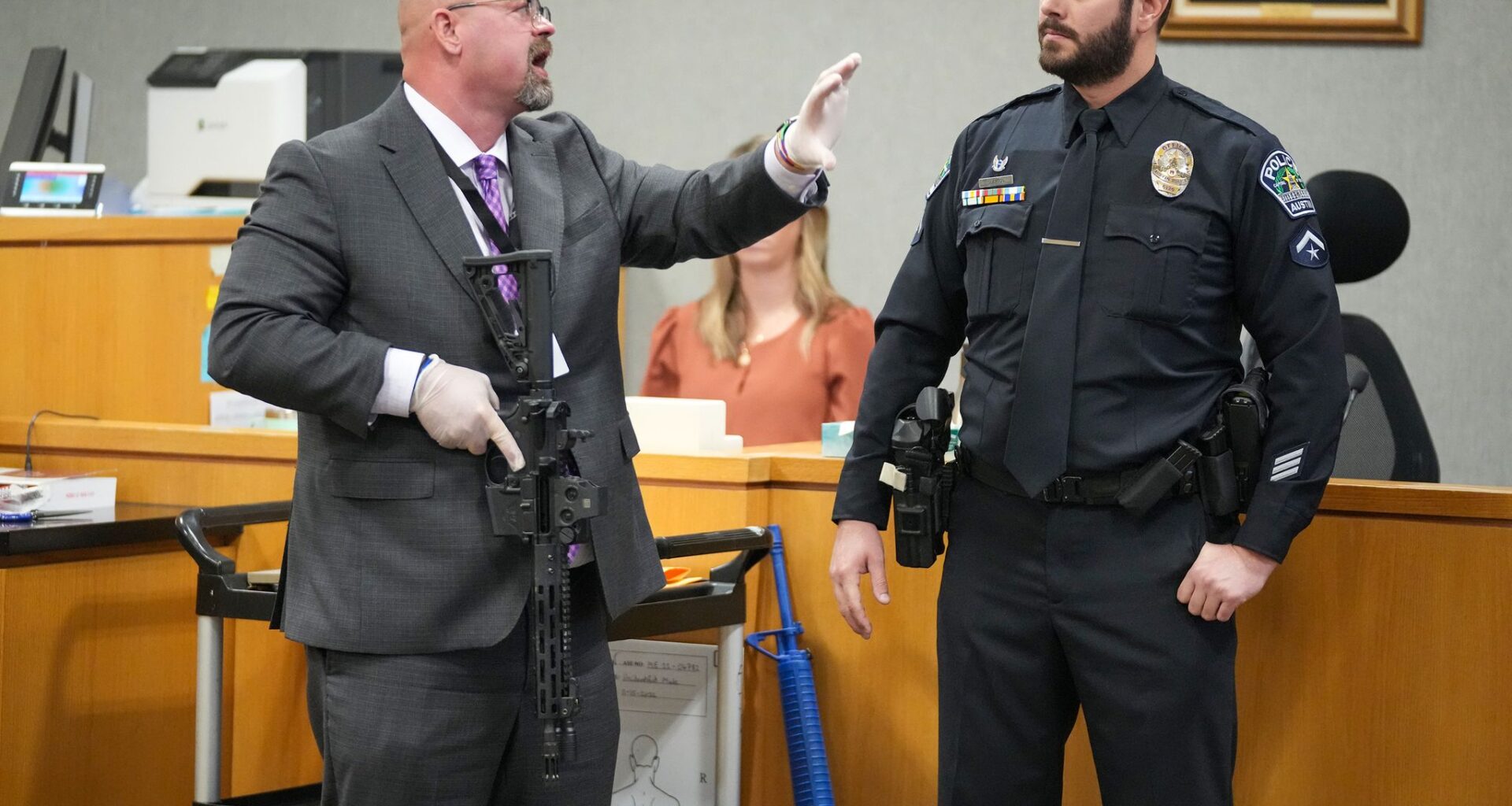
“We would not train our officers to stop and see if a suspect will murder them,” Jonathan Slayton, a former firearms and control-tactics instructor at the Austin Police Academy who trained Sanchez, testified during cross-examination.
Sanchez was the first officer to arrive at Moonesinghe’s Bouldin Creek duplex after a neighborhood security guard called 911. When Sanchez pulled up, Moonesinghe had fired two rounds from an AR-15 rifle into his own house.
Slaton said the academy trains officers to treat such confirmed gunfire as an active-shooter situation even if the shooter stops firing, so Moonesinghe’s two shots followed by a pause would still trigger an active-shooter response.
Body-camera and doorbell video played in court shows Sanchez shouting for Moonesinghe to drop his weapon without identifying himself as police. Less than a second later, Sanchez opened fire.
Several Austin police officials, including those in the department’s chain of command, testified that Sanchez’s actions did not violate the Police Department’s use-of-force policy. They said the officer likely believed he was confronting an active shooter, and that Moonesinghe’s “low-ready” stance — holding a rifle pointed toward the ground — can still signal a threat under department training.
“Action will always beat reaction,” said Jeffrey Woodward, a 19-year Police Department veteran who also trained Sanchez at the police academy. Officers are taught to respond immediately when someone holds a rifle in that position, he said, because it takes only a moment to raise and fire.
Police Department Chief of Staff Robin Henderson, who was serving as interim chief at the time of the shooting, outlined how the department’s use-of-force policy is created and updated. The process involves multiple layers of review, she said, and instructors are prohibited from teaching tactics not allowed under the policy.
Henderson also stood by her earlier public statement that Sanchez acted “consistent with his training,” though she acknowledged under cross-examination that it’s uncommon for a police chief to publicly support an officer facing criminal charges.
The prosecution rested its case Monday after presenting video footage, forensic evidence and emotional testimony from Moonesinghe’s family.
Testimony from a medical examiner said toxicology tests conducted as part of an autopsy showed Moonesinghe had a blood-alcohol level of 0.33% and traces of cocaine in his system at the time of the incident. Defense attorneys have argued the substances could have affected his judgment and behavior.
The trial is scheduled to continue Thursday with the defense’s final witnesses before closing arguments.