
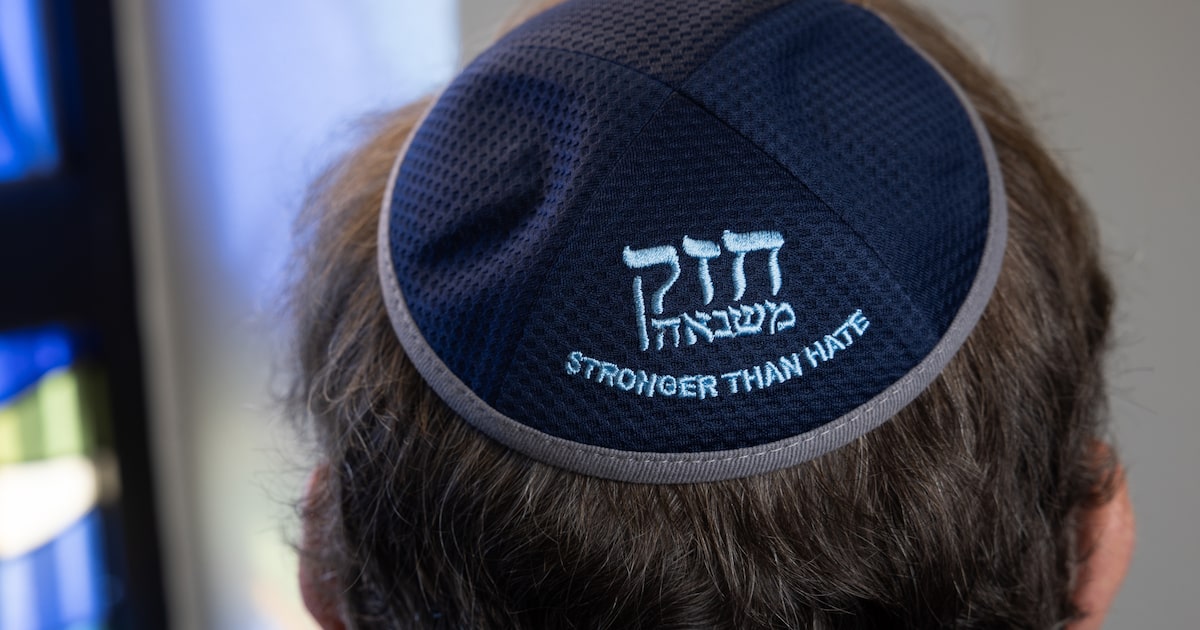
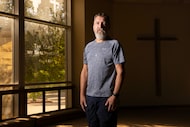
In January 2022, Jeffrey Cohen was one of four people held hostage by a gunman for 11 hours inside his synagogue, Congregation Beth Israel in Colleyville.
Related
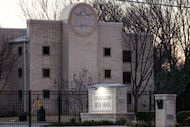
Today, the synagogue has a security committee — Cohen chairs it — and armed security on hand for almost every event or service.
“You walk in, you say hello to the officer,” Cohen said. “That’s just how it is now.”
Breaking News
Congregation Beth Israel knows too well a fear that is spreading beyond its increasingly-fortified walls. All over the world, houses of worship are facing an alarming rise in violence. In recent months, churches in Minnesota and Michigan suffered mass shootings that left six people dead and 27 injured.
In October, a synagogue and mosque in the U.K. were attacked within days of each other, as advocacy organizations continue to report rising antisemitism and Islamophobia. Experts who study hate crimes against Jewish, Christian, and Muslim congregations report a surge over the past few years in violence motivated by bigotry against people of their faith.
In the U.S., this uptick in violence suggests Americans are becoming less tolerant not only across political differences, but across religious ones, as well.
Houses of worship have long brought neighbors together to care for the most vulnerable – and the violence they’re facing may portend a larger fraying of the spiritual and cultural bonds holding society together.
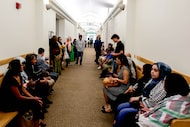
Faith and community leaders in North Texas said their sacred spaces no longer feel as safe. Pastors, rabbis and imams are locking doors during services and using tighter and costlier security.
An increase in violence
Researchers who study hate crimes and faith community leaders pointed to a range of factors that could explain an increase in violence against houses of worship, including intense polarization, hostility toward individual faiths and extremism online. The leaders urged against demonizing people of certain faiths, and called for more mutual respect across religious differences.
The FBI publishes annual reports on hate crimes, including those at churches, synagogues, temples and mosques. Reported hate crimes at one of those sacred sites have more than doubled from 2014 to 2024, from 200 to 427 reported incidents, according to the agency. Hate crimes committed at one of those houses of worship made up 4% of all reported hate crimes in that period.
Related
Thousands of law enforcement agencies voluntarily report to the FBI when they classify a criminal offense as a hate crime. Incidents included intimidation (the largest category in recent years), vandalism or damage of property and simple or aggravated assault.
Texas has also seen an increase in these kinds of incidents. Hate crimes reported to the FBI at a church, synagogue, temple or mosque in Texas rose from eight incidents in 2014 to 24 in 2024.
Incidents in Texas tagged as “anti-Jewish” saw a particularly large increase from 2022 to 2023, from 1 to 13.
Related
Since the attack at Congregation Beth Israel, Cohen said he often wears a kippah when he prays that says “stronger than hate.” He urged others to join the Jewish community in fighting antisemitism, and to condemn all acts of violence, including those that targeted their ideological or political opponents.
“At a bare minimum, people need to meet their neighbors, meet people who live around them, meet people from different groups,” he said, “so that they see what they have in common.”
Antisemitism and Islamophobia
The Anti-Defamation League is a global nonprofit fighting antisemitism and hate, and it releases an annual report on antisemitic incidents, including harassment, vandalism and assault.
The organization said this spring that there were 88 antisemitic incidents in North Texas in 2024, including 22 targeting a specific individual or Jewish organization.
Related

Nationwide, the ADL tracked 9,354 antisemitic incidents in 2024. It reported a 344% increase in those incidents over the past five years, pointing to anti-Zionist and anti-Israel animus as a driving force behind that rise.
Michelle Golan, director of community relations and public affairs for the Jewish Federation of Greater Dallas, said the Jewish community has seen a “massive spike” in antisemitism since the Hamas attacks of Oct. 7, 2023.
Antisemitism can come from a range of places, Golan said. Conspiracy theorists build on bigoted stereotypes such as the Nazis belief that people with Jewish ancestry are racially inferior. Particularly since Oct. 7, she said anti-Zionism and hatred of Israel have also been driving antisemitism.
Golan said amid this spike, Jewish day schools and community centers in the area have significantly increased security measures, which include gates around the perimeter, cameras and security guards, since her youth here.
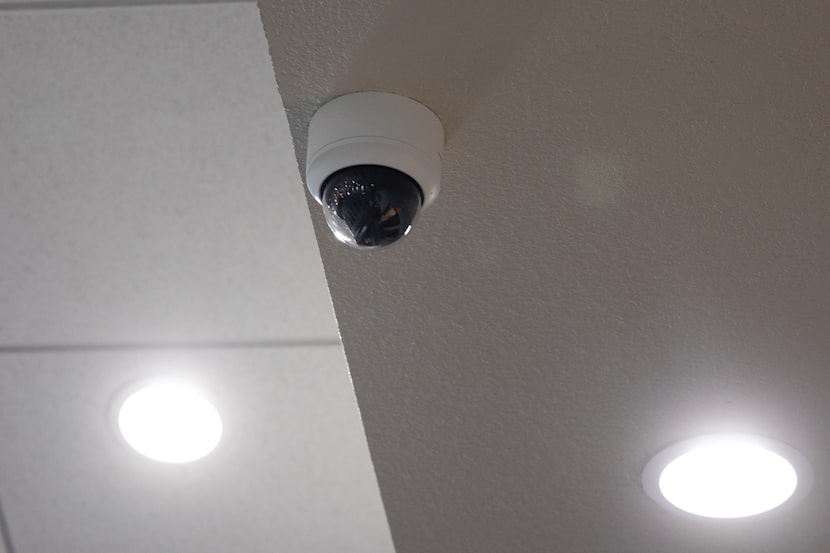
Extra security cameras were added at Congregation Beth Israel following the January 2022 hostage situation in Colleyville. Photo taken on Friday, Nov. 14, 2025 where four people were held hostage by a gunman for 11 hours inside the synagogue.
Juan Figueroa / Staff Photographer
Related
“It pains me that we have to have that, and my kids are going to grow up… around that kind of security,” she said. “It’s really difficult that this is where we have to put our money towards.”
Golan said Jewish Federations in Texas successfully lobbied for $7 million for security grants for nonprofits, including houses of worship, in Texas’ 2025-2027 budget.
Bill Humphrey, director of community security for the Jewish Federation of Greater Dallas and a former deputy chief of the Dallas Police Department, agreed with Golan that antisemitism has risen dramatically.
“In my seven years of working here at the Jewish Federation, I’ve never seen anything like it,” Humphrey said. Many synagogues, like schools, are now under a “soft lockdown” after services begin, he said.
Mustafaa Carroll, D-FW executive director for the Council on American-Islamic Relations, a Muslim civil rights and advocacy group, said his organization in 2024 received the highest number of annual complaints — 8,658 — since its first civil rights report in 1996.
The organization in 2024 identified 40 incidents in the U.S. targeting spaces designated for Islamic worship.
Carroll said local politicians are contributing to high levels of Islamophobia. He condemned fear-mongering rhetoric about “Sharia law” or Muslims trying to “take over” the U.S. “I think it’s fairly new that the administration, the political leadership in Texas, is now leading in the [anti-Muslim] rhetoric,” he said.
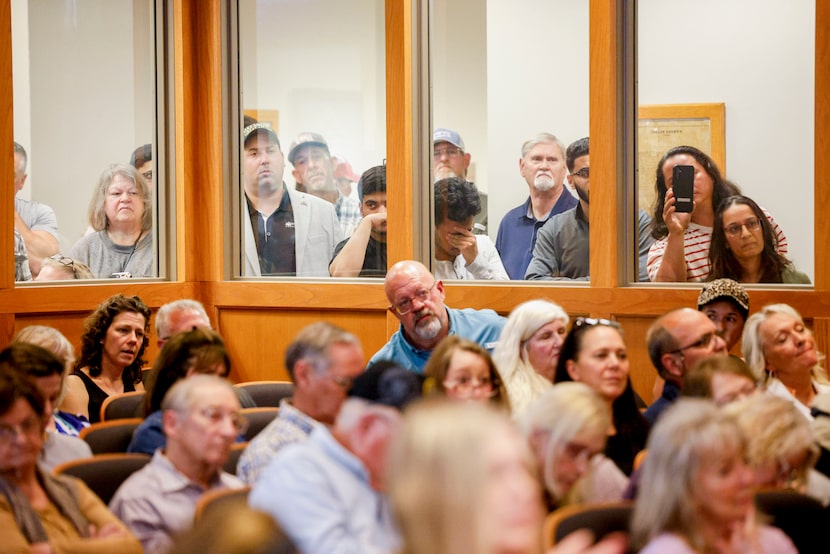
More than 90 people sat in the audience at a tense Collin County Commissioners Court meeting in McKinney over the future of a Muslim-centric neighborhood planned for an empty field near Josephine. Adil Faraz (center right), of Allen, Texas, reacts to public comment during the hearing on Monday, March 31, 2025.
Liz Rymarev / Staff Photographer
Related
He highlighted the slew of investigations directed by Texas leaders, including Gov. Greg Abbott and Attorney General Ken Paxton, into plans to develop a Muslim-centric neighborhood near Josephine. Officials have accused the developers of discriminating against non-Muslims and taking advantage of investors.
Almas Muscatwalla, a Shi’a Ismaili Muslim who lives in Plano, recounted coming across a Facebook post, with about a thousand reshares, that celebrated efforts to shut down the development.
“I don’t even want to do the math, but that just gave me a sense of there are just so many people who don’t like the idea of having Muslims in their neighborhoods,” she said. “There’s so much of this kind of ‘you are the other, and this is my country, and you are not meant to be here.’”
Muscatwalla, who works with many interfaith organizations in Dallas, said she responds to Islamophobia by leaning into vulnerable, difficult conversations with people who may not understand or agree with her.
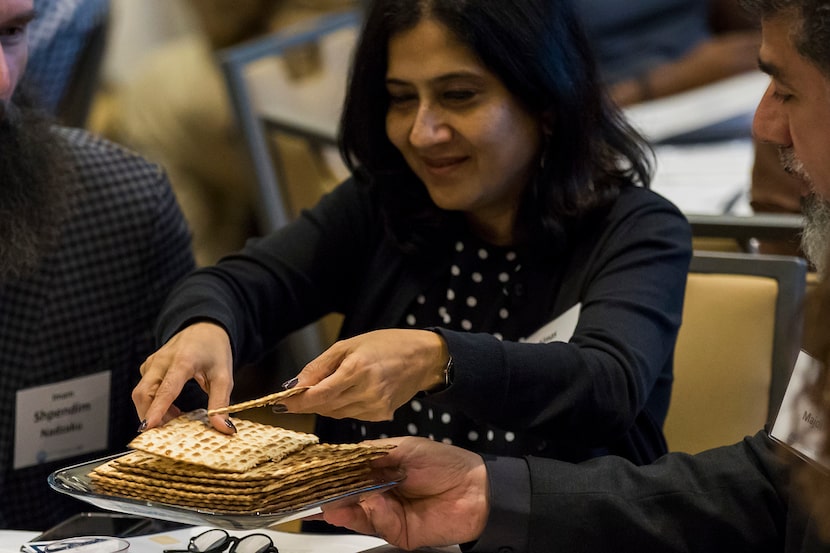
Almas Muscatwalla breaks matzah during an interfaith seder at Congregation Shearith Israel on March 22, 2018, in Dallas.
Smiley N. Pool / Staff Photographer
Related

“It takes everything out of you,” she said, “but one has to commit to that, if one wants to see the change.”
She doesn’t want to withdraw, or retreat into a cocoon of like-minded people. “We are different in the ways we live and we pray and we believe, but we got to anchor ourselves in what is common between us — that common humanity.”
Violence against Christian churches
Travis Weber, vice president for policy and government affairs at the Christian organization Family Research Council, said his organization has tracked a rise since 2018 in acts of violence and vandalism targeting Christian churches.
The group’s annual report tracked 50 incidents of hostility against churches, most of them vandalism, in 2018. That number skyrocketed to 485 in 2023 and 415 in 2024.
Weber said places of worship have come to be seen as “less sacred” in recent years, citing polling from Pew and Gallup that has found a decline in the number of Americans who say they regularly attend church services.
“If places [of worship] are not looked at as special,” he said, “then it’s seen as fine or normal to attack them.”
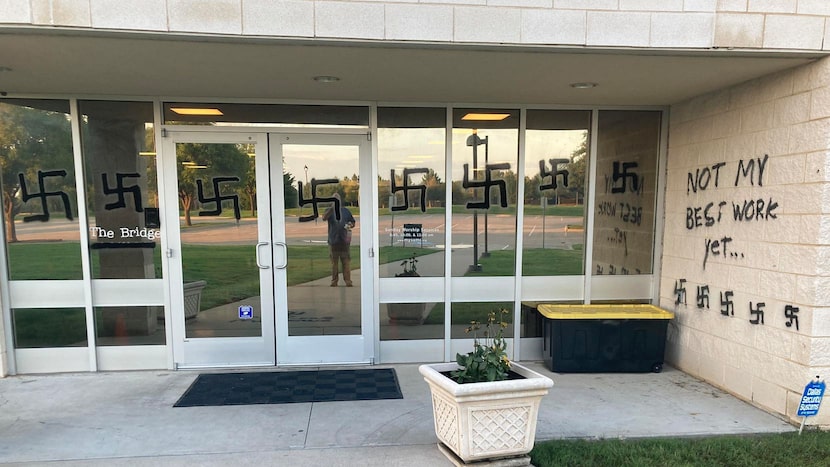
Stonebridge United Methodist Church was vandalized for the second time in six weeks on August 28, 2022. Nelson Smith, facility coordinator and a church member for over two decades, said in an interview that he prayed for the perpetrator, and the hate in the world, as he cleaned the messages off.
Courtesy of Stonebridge United Methodist Church
Related
He said disagreement is part of a healthy society, but the labeling of conservative Christian views, including about sexuality and gender, as “out of bounds” puts a target on Christians’ backs.
Weber believes it’s a problem when people view conservative Christian beliefs as harmful or as a threat to their physical or emotional wellbeing, and not just as a different opinion. People who think like that are more likely to think violence against Christians is acceptable, he said.
Rachel Carroll Rivas is interim intelligence project director at Southern Poverty Law Center, a national hate-monitoring group. In her work, she said she often sees far-right groups target mainline or progressive Christians, calling them inauthentic.
She believes the increase in violence against houses of worship correlates with increased radicalization and extremism online and rising political polarization.
“We’re finding that there tends to be a decent online record of engagement in extremist spaces online by those people who are involved in physical acts of violence, mass shootings, etc.,” Carroll Rivas said. She urged parents to consult resources that can help them screen for signs their kids engage in extremist spaces.
In 2023, a Plano Unitarian church suffered an arson attack that church members believed was connected to a controversial YouTube video.
In July of that year, a group of anti-LGBTQ YouTubers posted the video “We acted LGBT at LGBT Church,” which showed them insulting the Community Unitarian Universalist Church of Plano. The video has received over 200,000 views.
A week and a half later, someone intentionally set the church’s front doors on fire. Plano Fire-Rescue investigated the attack, according to one of their public information officers, and classified it as a hate crime. No suspects have been charged.
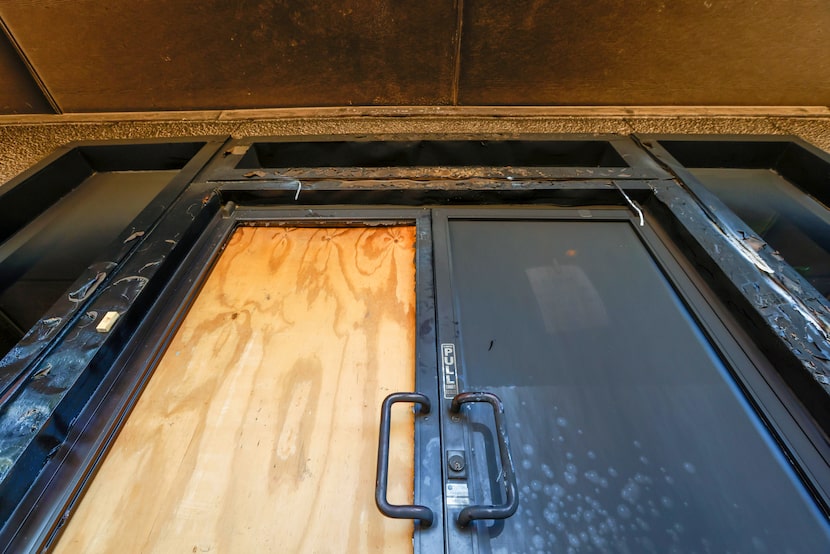
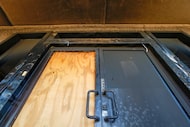
Damage to the doorway of Community Unitarian Universalist Church of Plano is visible on Monday, July 24, 2023, after an arson attack early Sunday night, according to police and church officials.
Liesbeth Powers / Special Contributor
Related
Jodie Zoeller, 65, has been a member of the church for over 30 years, served as a past president of its board, and was helping lead the congregation when the attack occurred.
“We forgave whoever did it to the church,” she said, “but we do watch more closely now.”
These days, during Sunday services, the church keeps its front doors locked. Greeters wait by the doors, letting people in one by one.