
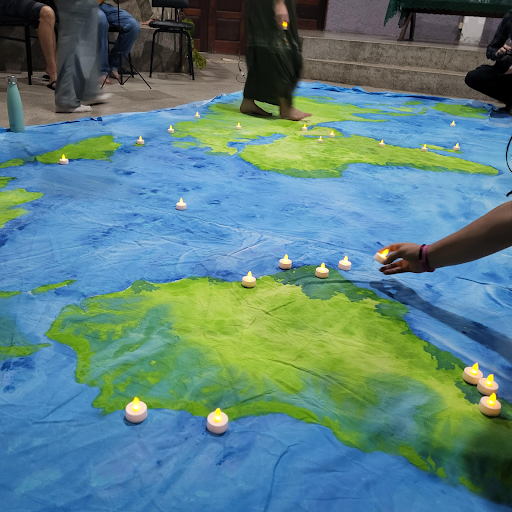
As the world’s eyes turn to Brazil for the United Nations Climate Change Conference (COP30), Austin-based Texas Impact/Texas Interfaith Power & Light is sending dispatches from the conference to the Chronicle.
The Women and Gender Constituency opened Tuesday’s Consultation with the COP Presidency and NGOs with a powerful call for a major course change in the way we think about the just transition to a carbon-free economy:
“A just transition that is only an energy transition is not just. An energy transition built on extraction of mineral resources is not a just transition. Transition built on mineral supply chain that is exploitative is not a just transition. A just transition requires a complete shift in the systems of patriarchy, colonialism, extractivism. A just transition must return power from billionaires and super wealthy people and megacorporation to communities in the global south.”
Picking up the thread, COP President André Corrêa do Lago affirmed that the Just Transition Work Program goes to the heart of what COP30 seeks to advance. Not just an energy transition, but a whole of society transformation of the way we live, work, and thrive together in a way that promotes dignity. The climate fight is a fight for justice and the path forward must be just, orderly, and equitable. Most importantly, a true just transition will not leave anyone behind.
President Corrêa do Lago’s comments echo a series of letters he distributed prior to the start of COP in which he called for unity, collaboration, and a positive tone for COP30. He calls this spirit Mutirão.
“Mutirão” is a continuous method of mobilization that begins before, extends through, and continues beyond COP30. A proposal to transform the conference into a true milestone of civilizational turn: the establishment of spaces for active listening, strengthening the ties between the local and the global, and valuing the diversity of voices and knowledge.
The COP30 presidency proposes, via joint efforts, a new form of climate governance: more participatory, fairer, and more supportive. Because when we unite around a common purpose, we create something greater. A whole more potent than the sum of all parts.
The concept of the Just Transition has in the past referred to the idea that communities dependent on fossil fuel production would be supported through an energy transition. At this COP, delegate after delegate has advocated for an almost universal new understanding of the Just Transition that means a whole of society reworking.
Not just transitioning from internal combustion engines to electric vehicles. Not just putting solar panels on houses. Not just supporting job retraining programs so that former oilfield workers can continue to support their families.
Instead, the Just Transition refers to an orderly, whole of society transition from the system we now have to one based on community, relationships, sustainability, and dignity.

In the U.S. that means accessible and affordable public transit, so that all people can travel to work and school even if they cannot afford a car, can not drive, or prefer not to drive.
It means renewable energy and distributed power systems that are more affordable and resilient, so that people don’t have to choose between lights and food and the power stays on after storms.
It means ensuring access to healthcare and childcare and workers’ rights and attention to the sustainability and justice of supply chains for things like critical minerals.
Globally this means a reordering of international relationships, a true multilateralism that brings all voices to the table: governments, constituencies, and all stakeholders; to include the wisdom of indigenous people. And it means countries who need the minerals and resources sourced in developing countries adequately compensate workers and national governments and behave with integrity and responsibility in interactions with foreign governments and Indigenous leaders, up to and including leaving those minerals in the ground to preserve sacred land.
In that spirit UNFCCC Executive Secretary Simon Stiell said “This is not a negotiation table, this is a shared space where we have gathered to listen to one another and to hear one another’s stories and needs.”
Constituencies including Women and Gender, Business, the Association of Small Island States, Local Governments and Municipal Authorities and multiple national governments all called for a holistic just transition in their interventions. Some of their comments reflect the pain and frustration of being ignored and overpowered at past negotiations.
It was a hopeful consultation that set the tone for Wednesday’s negotiations, which President Corrêa do Lago described as collaborative, open, and productive in his evening stocktake address. A spirit that carried over to Evening Devotions at the Igreja Evangélica de Confissão Luterana, just a short walk from the COP venue, where participants sang the hymn “Somos el Barco” in English and Spanish.
Somos el barco, somos el mar
Yo navego en ti, tu navegas en mi
We are the boat, we are the sea
I sail in you, you sail in me
About Texas Impact
Texas Impact exists to put faith into action. We equip faith leaders and their congregations with the information, opportunities, and outreach tools to educate their communities and engage with lawmakers on pressing public policy issues. We are an interfaith group that works together on issues that impact the most vulnerable people in our communities. We help people live out their faith in the public square, moving the faith community from charity to justice.
A note to readers: Bold and uncensored, The Austin Chronicle has been Austin’s independent news source for over 40 years, expressing the community’s political and environmental concerns and supporting its active cultural scene. Now more than ever, we need your support to continue supplying Austin with independent, free press. If real news is important to you, please consider making a donation of $5, $10 or whatever you can afford, to help keep our journalism on stands.