
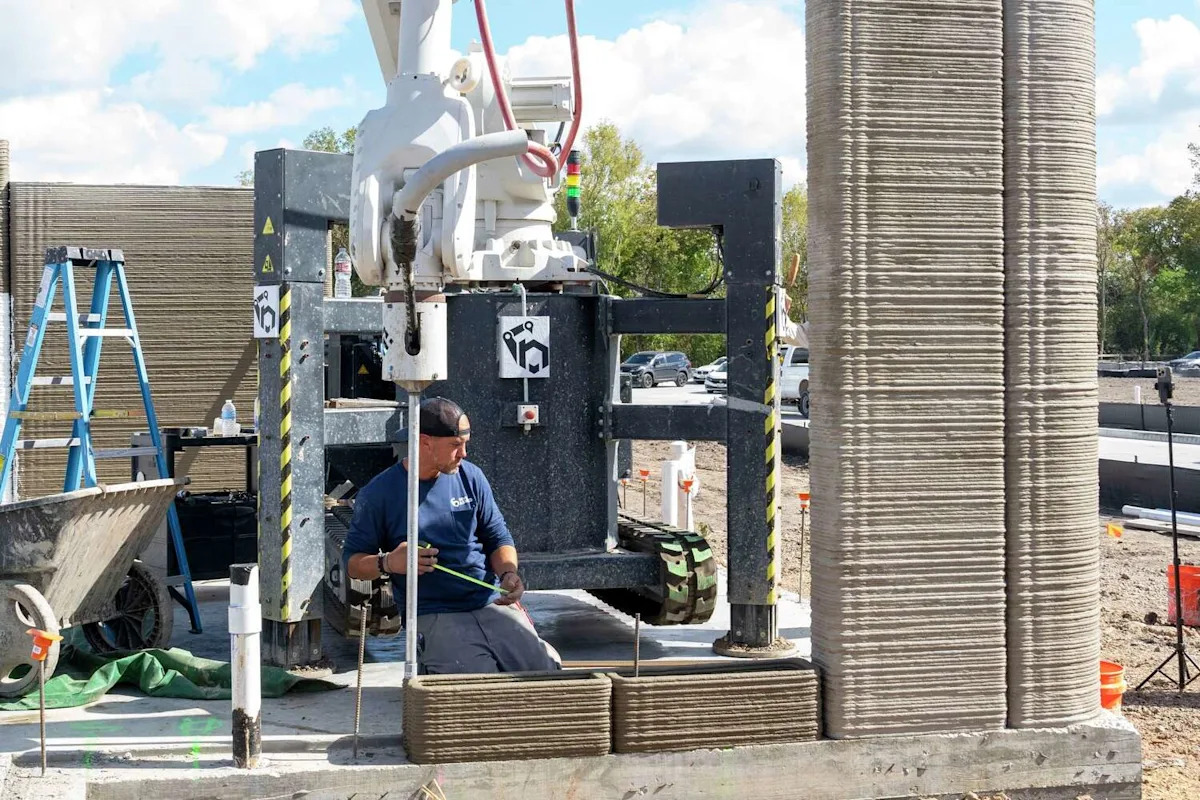
3D printing began on Thursday at a southeast Houston site expected to become the city’s first 3D-printed home community by next year.
Hundreds of people including politicians, high school students and prospective investors attended the official groundbreaking ceremony for Zuri Gardens, the planned 80-home development on 13 acres near the William P. Hobby Airport. The 2-bed, 2.5-bath homes are expected to go on the market by early next summer.
“Across every American city they’re talking about two things: housing innovation and housing affordability,” said Houston city council member Tiffany Thomas at the ceremony. “And I think Zuri Gardens is an opportunity for us to celebrate that Houston is continuing to lead around housing.”
RELATED: Search the most and least expensive ZIP codes in Houston
The 1,360-square-foot homes will feature first floors 3D-printed by construction tech startup HiveASMBLD and second floors built with conventional methods by Cole Klein Builders. The site, on Martindale Road adjacent to Sterling High School, will include more than 140 street parking spaces, a community space with 3D-printed benches and a pavilion, and an adjacent 5-acre park, said Cole Klein Builders partner Vanessa Cole.
Politicians and developers have touted Zuri Gardens as an example of how 3D printing can make homeownership more accessible by speeding up construction and lowering labor and material costs. HiveASMBLD can build the first story of a Zuri Gardens house in four days, co-CEO Timothy Lankau said.
“We’re replacing siding, cladding, house wrap, framing, insulation, drywall, tape and float – so we’re replacing seven trades with one process,” Lankau told the Houston Chronicle. “And that’s how we get that speed and those economics.”
The homes’ expected price tags – in the mid- to high-$200,000s, Cole said – will likely be on par with market rates for new builds in the area. The median sale price for a new home in the Medical South area was $298,000 this year, according to data from the Houston Association of Realtors. Still, the Zuri Gardens homes will be more affordable than the roughly $400,000 rates for the country’s only other major 3D-printed home community: 100 homes in Georgetown, Texas, built by Austin startup ICON.
Only households who make between 80% and 120% of the area’s median income – about $101,000 for families – will be eligible to buy the Zuri Gardens homes. The income restrictions are a condition of a $1.8 million forgivable loan Cole Klein Builders received through the city of Houston’s Affordable Home Development Program to partially fund the project.
ALSO READ: Houston’s affordable housing system helps insiders make millions
About 800 people have joined the wait list to buy the homes, though staff have yet to vet whether those people qualify to apply, Cole said. Buyers will have a choice of two floorplans, both with a dedicated office space and a covered patio. Cole said developers had not yet decided how to choose buyers if qualified applicants outstrip available homes.
The homes’ concrete foundations and first floors – built with low-carbon mortar manufactured by Eco Material Technologies – are designed to withstand Houston’s extreme weather, from floods to fire, Lankau said. Concrete’s ability to store heat also makes it more energy efficient than traditional construction.
“I like to say they’re forever homes,” Lankau said at the ceremony. “Archaeologists are gonna dig up these houses in 1000 years and wonder what they were.”
At Thursday’s ceremony, attendees crowded around to watch the first Zuri Gardens home take form – not with whirring power tools, but with the quiet, robotic arm of HiveASMBLD’s 3D printer. The 20-foot-tall machine laid down concrete in thin bands, building each wall segment layer by layer. Occasionally the machine’s nozzle clogged and workers stepped in to clean it.
Zuri Gardens marks HiveASMBLD’s largest housing development to date. Lankau previously told the Chronicle that the company plans to build more 3D homes in Houston if this development sells well.
“This really marks that technology in the building system is ready to go,” said HiveASMBLD co-founder Ethan Wong. “Everybody’s after housing affordability and being able to do this at scale, and the fact that we’re here really just shows that we’re ready to build.”
For a couple of Austin-based investors, the live 3D-printing demonstration clinched their decisions to back HiveASMBLD in its goal of scaling up home construction to meet the country’s shortage. Shaun Dharshan, an independent investor who made the trip to the ceremony as part of his due diligence, told the Chronicle he planned to email the company’s leadership on Friday and offer to invest.
This article originally published at Houston’s first 3D-printed home community breaks ground near Hobby Airport.