
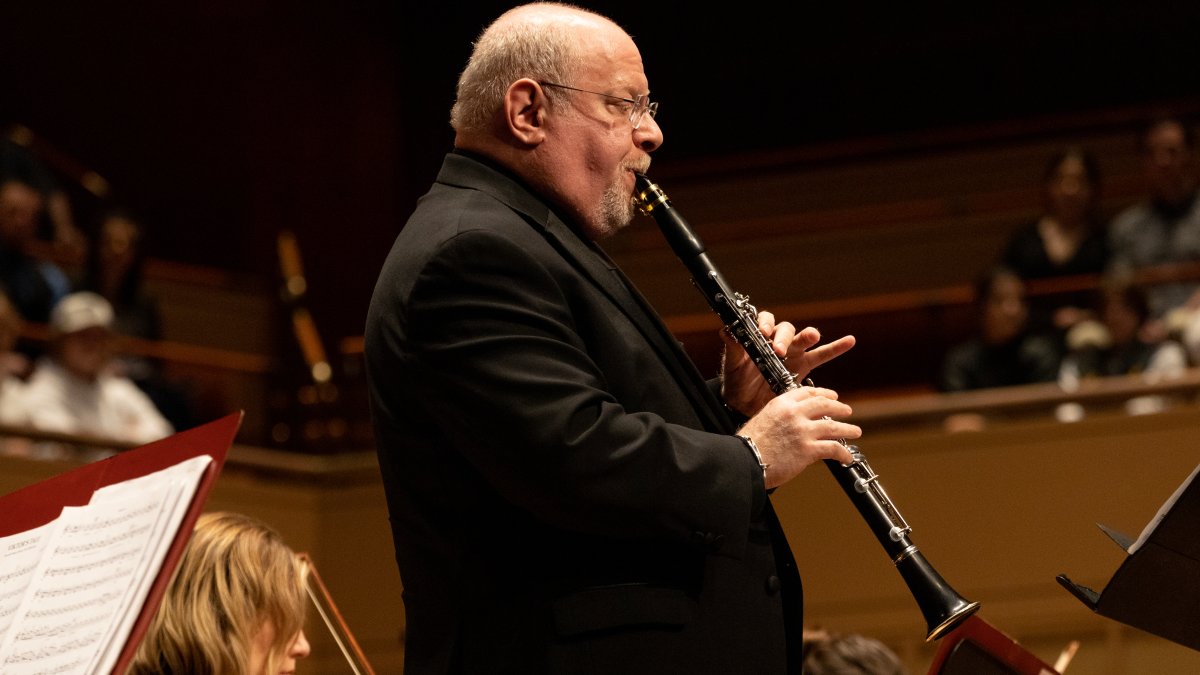
Collaboration yields beautiful things. When the Dallas Symphony Orchestra debuts Jon Cziner’s new piece, Clarinet Concerto, Nov. 20 – 22 at the Meyerson Symphony Center in Dallas, the audience will hear the result of a multi-year collaboration between the composer and the orchestra’s Principal Clarinet, Gregory Raden.
Raden initially approached the Dallas-based composer and artistic director of Dallas’ Voices for Change before the pandemic about a project for a clarinet and a quartet. The project stalled during the pandemic. Eventually, Cziner and Raden revisited the project, redeveloping it into a much larger piece.
“It’s a much different piece than it was when it was first composed, but a lot of the ideas in that original piece which is about nine minutes long and for five instruments made its way into this much larger-scale three-movement work for full orchestra and Greg, solo clarinet,” Cziner said.

Jon Cziner
Jon Cziner
As artistic director of Dallas’ Voices of Change, Cziner is a champion of new music.
Cziner and Raden are from neighboring towns in Westchester County in New York and both are from Jewish families.
“That very much influenced some of my thinking in terms of the last movement which I see as this very klezmer-inspired piece, a dance, if you will. And the first two movements are very inspired by more spiritual Jewish music you might hear in a synagogue and Greg takes on the role of a cantor who leads the musical portions of services,” Cziner said.
Thematically, the work speaks to what is going on in the world now.
“In terms of the work that we live in today, there’s a lot going on in the world and it’s a very dark and violent place,” Cziner said. “There’s a lot of sadness in this piece. There’s a lot of anguish in this piece, but there’s a lot of hope for peace and a better future.”
Raden, who has served as the orchestra’s Principal Clarinet since 1999, appreciates how this piece shows off what the clarinet can do.
“It has a really wide range of capability in terms of the instrument love to high, volume, color. And I also find it to be a very vocal instrument. To me, that’s so appealing because we’re always trying to be like great singers. I think the best musicians and the best wind players think vocally and I think the clarinet is a really good vehicle for that. Jon’s piece really explores that range a lot,’ Raden said. “The clarinet sings, but the clarinet also screams and cries. There are real tests of the range and volume, very high extreme stuff and very low, quiet things and everything in-between so it’s a very good vehicle to witness the clarinet’s capabilities and range.”
The solo clarinet’s relationship varies throughout the piece.
“Some of it is call and response, playing of each other back and forth. The second movement of the piece is a cadenza, quite an extensive cadenza where it is just the clarinet alone. Halfway through the cadenza, the orchestra joins in, coloring and responding and reacting. The last movement is a frolic for everyone,” Raden said.

DSO/Sylvia Elzafon
DSO/Sylvia Elzafon
Raden has been the orchestra’s Principal Clarinet since 1999.
The orchestration builds throughout the work, beginning with strings, harp, percussion and celeste in the first movement, adding winds and horns in the second movement and finally the horns join in the third movement.
“I see this or hear this philosophically as coming together or feeling empty at the beginning and moving and feeling fulfilled at the end,” Cziner said.
Playing a world premiere allows Raden some artistic freedom.
“It doesn’t have the familiarity factor for the listener, so they are getting something they’ve never heard before and you’re always interested in how they are going to perceive it and react and hopefully in a positive way,’ Raden said.
Cziner and Raden have enjoyed the collaborative process of creating the concerto. Cziner does not play the clarinet, and he has worked with Raden to edit the part and refine ideas to fit the instrument and his playing.
“It’s something I really appreciate as a collaborative spirit,” Cziner said.
“It’s amazing. You think of the past great composers and what it would have been like to ask them questions and collaborate and here we have that,” Raden said.

Jon Cziner
Jon Cziner
As artistic director of Voices of Change, Cziner is a champion of new music.
This new work is featured on a program that combines new works with music written by the great masters, including Beethoven’s Leonore Overture No. 3, Mozart’s Symphony No. 40 in G minor, and another world premiere, Moni Jasmine Gijo’s “the sound of where i came from”. The eclectic program highlights the role of new music in the classical music world.
“I believe a vibrant arts scene in any place needs new art, new music because living composers and living artists can express elements and important theme of our time,’ Cziner said.
“In this piece, his reaction to what’s has been going on in the world, while some of the things are unfortunately repeats of history in some ways, it is still important to have that real-time reaction and influence in art and music,” Raden said.
Learn more: Dallas Symphony Orchestra