
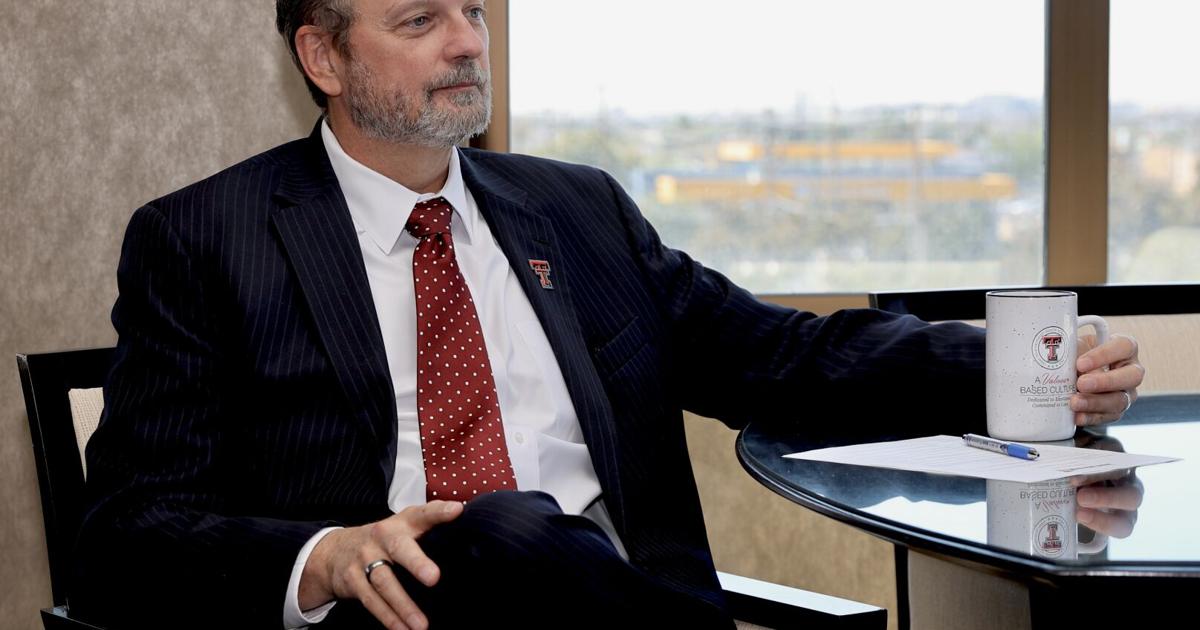
When Dr. Eric Rohren visited El Paso for the first time, he was surprised by the city’s size and struck by the friendliness of its people.
He and his wife, Nancy, drove from Houston to the Sun City almost a year ago. They hiked the Franklin Mountains and enjoyed the region’s food.
Rohren also had an interview at Texas Tech Health El Paso, competing against 40 other applicants to become the next dean of the Paul L. Foster School of Medicine.
Rohren, whose first day on the job was Oct. 1, is ready to make his mark as a campus and community leader.
“This was an opportunity to get involved with an organization that not only carries forward that mission for teaching the next generation of health care providers but also aims to provide care to the underserved patients here in our Borderplex,” said Rohren, 58.
There are more than 500 students enrolled at the Foster School of Medicine.
Rohren succeeds Texas Tech Health El Paso President Dr. Richard Lange, who had also been the medical school’s dean since 2014. Texas Tech University System officials asked Lange to step down as dean to focus on his role as president of the growing university.
Rohren, a Nebraska native who was raised in Minnesota, has 30 years of experience in health care.
Most recently, he was a professor and chair of the department of radiology at the Baylor College of Medicine in Houston for almost a decade. He also worked at the MD Anderson Cancer Center in Houston as the positron emission tomography section chief.
Rohren earned his bachelor’s degree in biology in 1989 from St. Olaf College in Minnesota. In 1996, he graduated from the Mayo Clinic Alix School of Medicine and the Mayo Clinic Graduate School of Biomedical Sciences with his medical degree and doctorate in immunology.
In 1997, Rohren started the diagnostic radiology residency program at the Duke University School of Medicine in North Carolina. He also completed fellowship training in nuclear medicine at the school.
Rohren sat down with El Paso Inc. in the dean’s office in the Medical Education Building at Texas Tech Health El Paso. He shared why he accepted the position in El Paso, his goals and how his father influenced his career in health care.

Photo by Herman Delgado
Q: What made you want to work at Texas Tech Health El Paso?
I love mission-driven organizations. I saw that at MD Anderson. When I was there, they had a focus on cancer and taking care of cancer patients. Baylor College of Medicine was a strong educational organization dedicated to an educational mission.
I was amazed when I first came here and learned that this is really the only health care mecca for a 300-mile radius. The ability to be involved in a project like this, in a mission-driven organization, to teach and take care of patients, that really attracted me to this area.
Q: As dean, what are your responsibilities?
I oversee all the mission areas in the clinical realm here at Texas Tech Health El Paso. That encompasses three major pillars.
There’s the medical school. We enroll 130 medical students per year and hope to grow that in the coming years.
Then we have the next level of education, and that is the residency program. Once our medical students graduate, they go on for postgraduate training in the medical specialty of their choice. A lot of them stay here.
I will also oversee the clinical operations – including our faculty that is part of the Texas Tech Health El Paso system, our surgeons, our internal medicine people and our hospital-based services – as we deliver care to patients through our health care partners, like University Medical Center and the Tenet health system.
All the clinics that we have in the El Paso area will be part of my purview as well.
I’m working on that right now. I’ve really been playing a lot of catch-up and getting to know the stakeholders here. I have meetings with the leadership of the hospital systems. That’s all in progress right now.
Once I have gathered all that information, I’ll start turning that around and developing goals for next year and conveying that to the faculty.
Q: Is there anything you want to focus on?
I’m going to start by hammering down any rough edges we have in the clinical mission and looking for barriers that people are experiencing.
El Paso, being somewhat isolated, can be a challenge for recruitment or getting people to move here. Again, that’s why the medical school was developed in the first place. We know that our greatest asset is the people of El Paso.
We need to supplement that with people coming in from other places, so recruitment is a little bit of a challenge. I’m going to tackle that.
Being a recruit myself, not coming from El Paso, I know what it’s like coming from the outside and being greeted by a very welcoming city.
I want to convey that to other people as we look to recruit certain specialists to the area. I want to work with them to convince them that this is the place to be. I’ll work on that with our clinical faculty.
I’m going to be meeting with the medical students in all the classes here over the coming weeks. I want to be accessible so that they know who I am and know I’m somebody that they can come up and chat with if they’re having issues.
I’ll work with our residents as well, hearing what’s going on in their lives and making it as easy as possible for them. And once they complete their training, they would love to stay and work at Texas Tech El Paso.
Q: Where do you think the focus is right now in the world of medicine?
It’s an interesting and exciting time in medicine right now, being driven forward by new technologies. Artificial intelligence is obviously first and foremost in people’s minds.
AI is having an impact on every single industry in the world, and medicine is no exception. We’re all struggling to understand where we are on the curve.
Q: What applications does AI have in the exam room?
You can have AI in the background as a physician as you walk into the room and interact with the patient.
In the past, I would have been interviewing you, and you would have told me how you’re feeling, and I would turn to my computer and type away.
You and I are supposed to be having a conversation, and I’m over here working on the computer, which breaks that interpersonal interaction. They have tools now where AI will listen in the background, and you and I just have a conversation.
It can streamline and improve the interaction. It improves interpersonal experiences, and it decreases fatigue on the physician’s part.
We’re still learning how that can be incorporated into health care. The challenge is all those tools cost money, and there are companies that are making them.
Q: Is Texas Tech Health El Paso incorporating AI tools in its curriculum?
I just returned from a meeting at the American Association of Medical Colleges in San Antonio. There’s a part of that meeting called the Council of Deans, where all the medical school deans are invited to get together.
We had some interesting conversations about AI.
When the question was asked, “Which of you at your schools are including AI in your medical school curriculum?” By the end of it, pretty much everyone had their hands up.
We’re all dabbling in that space right now. We have some exposure to AI for our students here at Texas Tech, but I would like to see that increase and maybe even have a specific track for students to have kind of an AI focus in medicine.
That’s something we can work on over the next few years. I have connections both in the region, around the country and worldwide with people who are interested in AI. I’d love to bring in some of those resources as visiting lecturers and help develop a curriculum specifically geared towards AI.
With Meta setting up a new data center here in El Paso, that’s a great opportunity for us to partner with an industry that is bringing in AI programmers and data scientists.
We want to reach out to them and see what the opportunities are to collaborate and create pathways for our students to interact with people at that level.
Q: Do you plan on staying in El Paso for the long term?
I anticipate this to be a long-term move. There’s so much to do here. It’s going to take years to get some of these programs moving.
Dr. Lange has been here for 13 years now and counting. I definitely see this as a career move for me to come in and make a difference in the El Paso community.
My reputation, in terms of my ability to accomplish things, will be very much tied to what we accomplish as a team here at Texas Tech Health El Paso.
Photo by Herman Delgado
Q: What inspired you to have a medical career?
I’m a second-generation physician. My father is a Navy physician. He practiced general internal medicine and worked at the Mayo Clinic. He went through medical school on a Navy scholarship and was deployed to sea during Vietnam on a destroyer as a ship’s doctor.
Right after I was born, he had to go to sea for six months, but then he was stationed at Pearl Harbor for three years. I spent years there, from age 1 to age 4, living in Honolulu. Then we moved to Minnesota when I was 5, when he joined the Mayo Clinic.
He worked there all his career, retired, but then went back to work. He’s now 83 years old and still goes in and works and teaches residents and staff at the clinics.
He still loves what he does, so he was always a very positive role model to me, the quintessential physician.
I grew up in that environment, went away to college, thought I wanted to do more science and biology, maybe get a job in industry.
Working in clinics in the summer, I realized that I loved patient care. I decided to come back to Rochester and did my medical school training at the Mayo Clinic.
Q: Any memories that were the most impactful for you during your career in health care?
As an imager, there have been numerous times when there have been patients who have moved around and seen different physicians. They come in, get their scan and we solve the mystery.
The most difficult ones are with children. Having children of my own and making that diagnosis of cancer is difficult.
I have had that happen in my career. A young person who has come in with leg pain and had some X-rays, and things aren’t getting better. They finally go for an MRI scan or a PET scan, and we realize that they have cancer in their bone.
Identifying what’s going on gives them the opportunity to get connected to a pediatric oncologist, somebody who’s going to treat their cancer.
My particular area of radiology is called nuclear medicine, so it’s working with radioactive materials, both to diagnose patients but also to treat patients.
There was a compound that came out about a decade or so ago called radium-223. It’s an agent that was approved for treatment of prostate cancer.
When prostate cancer gets into the bones, it can be very difficult to treat. But radium gets into the bones, and it targets areas where the cancer is and delivers a dose of radiation.
That can decrease pain and treat some of the disease and make the patients feel better and live longer. We were one of the first sites, when I was at MD Anderson, that was offering this treatment in the Houston area. We had patients who had been waiting for this to be approved.
To give an example of how humbling this experience can be, I was treating a patient. He was on the list, and he was coming in for his treatment.
When I introduced myself, he kind of didn’t want to shake hands. I said, “Oh, sir, it’s nice to meet you. You know it’s OK to shake hands.” He reached out his hand, and they were black and just looked filthy. He was so embarrassed.
He said, “You know, Doc, I’m really sorry. I tried to wash my hands and everything.”
It turns out that he lived in rural Texas. On the way to his appointment, his timing belt for his engine broke. He went to a local Auto Zone in the small town he was in, bought a new timing belt, replaced it himself, got his hands all greasy and drove to the appointment.
It just highlighted for me how meaningful that appointment was for him, that he went through all that effort, and at the end of the day, his main concern was that he was embarrassed that his hands looked dirty.
That highlighted what a privilege it is to be a physician – to be part of a patient’s health care experience and their journey towards trying to achieve a cure or a treatment for the diseases that they have.