
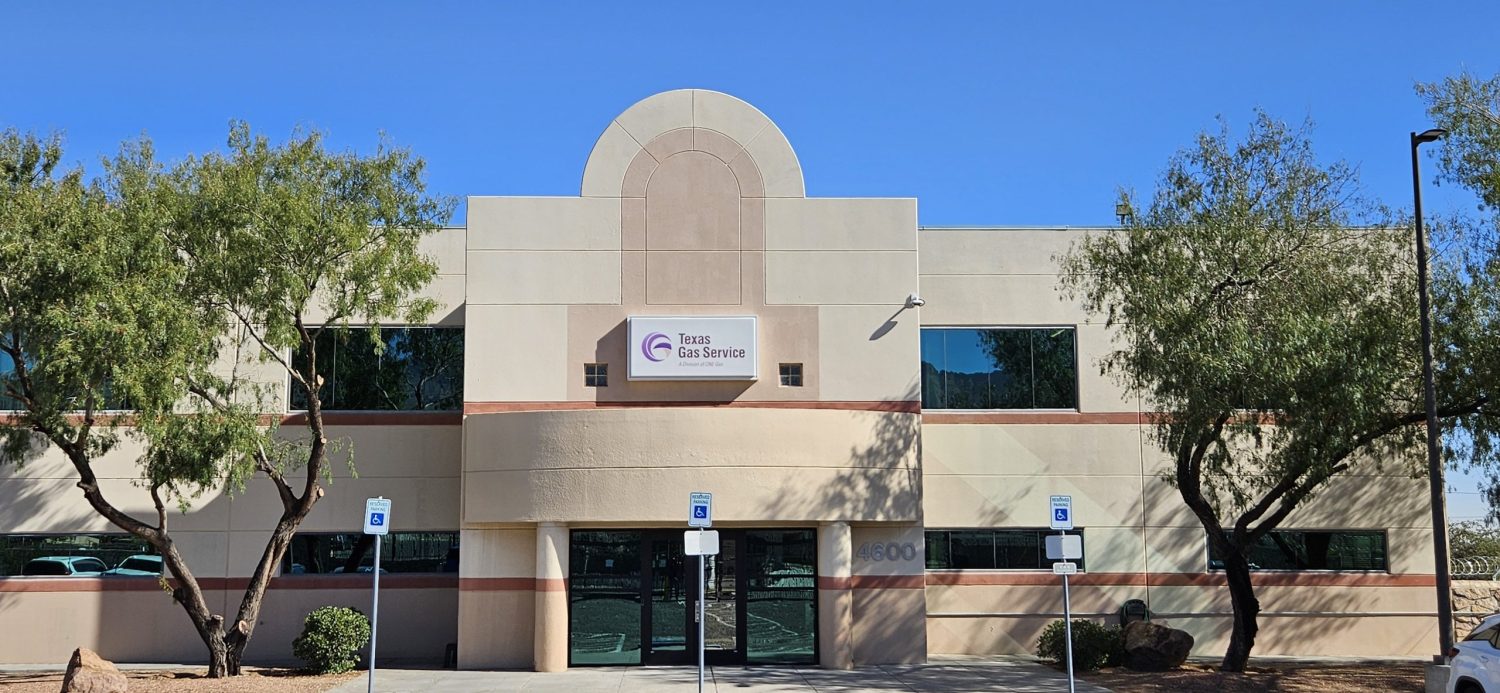
El Pasoans’ natural gas bills are going up. Here’s why
Diego Mendoza-Moyers: Today, let’s talk about Texas Gas Service and the rate increase on the table that would lift natural gas bills in El Paso.
The proposed rate increase would increase average residential gas bills here by about $10 per month for small customers who use an average of less than 330 cubic feet of gas monthly, and almost $15 for large customers who use more than that. And you can see your usage on your bill every month.
The typical bill in El Paso would be about $49 for small household customers and about $74 for the larger customers if this rate increase is adopted as is. And while all residential gas customers in El Paso would see their bills increase as a result of this rate hike, households down in the Rio Grande Valley would actually get a break on their gas bills. And it’s all part of Texas Gas Service’s request to merge its service areas across Texas, which we’ll talk more about in a few minutes.
Small businesses in El Paso could see a slight decrease in their gas bills, while larger businesses here will likely see a bump in their bills of about 15%. But why is Texas Gas Service seeking a rate increase now? And what are our city leaders doing to push back?
Editor’s Note: On Monday, Nov. 17, after this podcast was recorded, the El Paso delegation of the Texas House of Representatives sent a letter to the city of El Paso asking it to fight the proposed increase. “We’re writing to say very clearly that our people can’t afford an increase,” the letter states.
LEARN MORE: Texas Gas Service customers in El Paso face 27% rate increases under proposal
I want to spend a few minutes talking through different aspects of this Texas Gas Service rate increase, which will probably take effect early next year around the same time as rate increases that El Paso Electric and El Paso Water are also likely to implement.
We’ve heard a lot about the affordability crisis in the last couple of years, and things don’t seem likely to get a lot easier for El Pasoans in the near future.
Before I move on, I want to mention that this El Paso Matters Podcast episode is brought to you by our podcast title sponsor, Tawney, Acosta and Chaparro, truck crash and injury attorneys. Their team of local, seasoned trial attorneys are ready to help if you’ve been injured in a crash.
We’re also sponsored by the Greater El Paso Association of Realtors. If you’re looking for a realtor or for a property to buy or rent, visit elpasotexas.com.
OK, so let’s get a little more into this. Why is Texas Gas Service seeking to raise rates? They filed a 1,600-page document last summer telling their regulator, the Railroad Commission of Texas, “Hey, look, the rates that we’ve set in the last couple of years, they’re not bringing in enough money to pay off these investments we’ve made to deliver gas to customers. They’re not bringing in enough to pay off the interest on our debt, and also to provide a return in the form of dividends to our stockholders, right?”
And, so, they file that request and then it becomes kind of a legal proceeding. The city of El Paso and many other cities in Texas Gas Service’s service areas across Texas, they join in and they say, “Look, don’t raise our rates, and here’s why.” The staff of the regulator of Texas Gas Service, which is the Railroad Commission, the state’s oil and gas regulator, staffers at the RRC jump in and they issue their own kind of recommendations to the railroad commissioners. And whether or not the commissioners listen to that –it’s up to them – but it’s basically the RRC’s staff’s point of view.
And, so, they file this big document and they say, “Look, we need to bring in $41 million of additional revenue annually from our customers” to, like I said, pay off these investments that Texas Gas Service says they’ve made in the last couple of years and also to pay off debt and provide a return to stockholders, right? Texas Gas Service is a monopoly utility where it operates, so it can’t set its own prices. So, that’s why it has to say, “Look, let us – our regulator – let us set rates in a way that we can pay off all of these things that we need to.”
And, as far as investments in El Paso, right, because they serve El Paso, but also parts of the Panhandle, the Rio Grande Valley in South Texas, parts of Central Texas around Austin. But the question has come up: “Well, you want to raise the rates in El Paso, what have you done here, right? What investments have you made in El Paso to improve service for El Pasoans?”
And the one example that a Texas Gas Service employee who’s based here in El Paso brought up recently was the sort of replacement or refurbishment of a pipeline that delivers gas into El Paso that was built 100-plus years ago. And, so, they’re going in and replacing it. And that was the primary example of an investment that has been made locally by Texas Gas Service as far as things to improve service here locally for us.
I also want to mention Texas Gas Service is a subsidiary of ONE Gas, which is a larger publicly-traded gas company that also serves customers in Kansas and Oklahoma as well. It’s valued at about $5 billion, paid out about $80 million in dividends to stockholders over the first six months of this year, essentially from revenue from bills paid by ratepayers. So, it’s a big publicly traded company. Texas Gas Service is a subsidiary, and they’re the ones that are providing service to us.
Moving on, Texas Gas Service is requesting a shareholder return, basically, of 10.4%. That’s a profit margin to shareholders of 10.4%. Like I said, as a monopoly, they don’t set their own prices. And, so, they have basically a regulated price and a regulated, allowed, authorized rate of return, similar to electric utilities, but in the gas world, and it’s set by the Railroad Commission.
So, the 10.4% is – that’s the request of Texas Gas Service. But, since they filed the rate increase last summer, it’s kind of the point of contention, right, in these sort of legal proceedings that the city of El Paso has lawyers who come in and say – and expert analysts – who say, “No, really your profit margin should be 9%.” The Railroad Commission, their staffers say, “Well, we think a 9.5% is more of a reasonable rate of return for you to earn off of customers, right?”
And, so, that might sound like a small difference, right? Maybe 1, 1.5% difference between that. But, really, if the Railroad Commission were to approve the 9% profit margin or shareholder profit margin that the city of El Paso is recommending, that would mean about $15 million less that customers pay to Texas Gas Service every year statewide. And, so, these small shifts in the rate of return are significant as far as the money that customers are paying to the company.
RELATED: Meta to build $1.5 billion data center in Northeast El Paso
So, that’s not set, right? The rate of return isn’t set. We’re going to see the Railroad Commission likely weigh in and issue a final decision in late January. So, we’re still a couple of months out and we’re going to see haggling and negotiations over that. But I think it’s important to note that Texas Gas Service is requesting a 10.4% shareholder return since they last raised rates in the El Paso area in early 2023. Since then, they’ve been operating with about a 9.6% profit margin.
And, so, I think from a customer’s perspective, you could say, “Well, we get it. You’ve made investments here and elsewhere, and you need to bring in more money to pay off your investments you’ve made in your system and infrastructure that delivers gas to customers, right? You spent money on that. We get it. You have to recoup it.” I think a fair question in the minds of ratepayers and consumer advocates is “Why do you need an increase in your profit margin,” right?
And when I spoke with Texas Gas Service representatives and employees a couple of nights ago, they basically said, “Look, that’s what we’re requesting. We know we’re not going to get that 10.4%,” right? There’s going to be this series of haggling.
Like I said, city of El Paso said 9% is more appropriate. The RRC Commission staff, who might be viewed as kind of the neutral party here, right, they recommend 9.5%.
And, so, I think that’s an interesting component of all of this is that you have this rate of return that is essentially set by regulators and it’s kind of an almost guaranteed rate of return. So, what should that be is going to be a question of discussion for the coming weeks. But like I said, the profit margin up to now for the last couple of years for Texas Gas Service here in El Paso has been about 9.6%.
SIGN UP: Our free weekly newsletters deliver news like this straight to your inbox. Sign up now.
I want to also touch on probably the most contentious issue beyond the profit that the company’s allowed to make. The other contentious issue is this issue of consolidation.
So, Texas Gas Service, they operate several service areas. that are not contiguous around the state. I mentioned, obviously, El Paso, and they call it the West-North Service Area, but it’s El Paso, it’s other parts of West Texas, as well as some parts of the Panhandle, the Rio Grande Valley, and then they call it the Coastal Gulf Service Area that’s kind of near Austin and a little bit south of there.
And, so, they’re wanting to merge these areas into one large service area, right, where essentially rates are flat. And, so, I mentioned at the top the impact of this rate increase is not equal, right?
Texas Gas Service is essentially saying that, somehow, El Paso’s rates have been too low and the rates elsewhere in the Rio Grande Valley in particular have been, they’ve been too high. And, so, as a result of this rate increase, basically, bills are going to be going down in the Rio Grande Valley for just about every household universally, and they’ll be going up here. And, so, that’s one of the biggest things that the city of El Paso, they hire all these – the city attorneys – they hire all of these expert witnesses and that’s what they’ve pushed back on a lot over the last several months, just battling over, is it really fair to charge customers the same rate across the state?
Texas Gas Service says, “Well, look, our service technicians and our trucks and our equipment, they go all over the state, right? And, so, why should we be charging customers differently when our technicians will drive across and we effectively operate it as one service area?”
I think one interesting point that the city of El Paso has brought up is that, is it truly the same cost to deliver gas in El Paso relative to, say, a city in the lower Rio Grande Valley in South Texas? We know there are differences in where the gas comes from, right, whether it’s the Permian Basin or some other oil and gas producing area. And, so, there’s differences in pressure, right, that affects the delivery. There’s differences in miles of pipeline that it takes to transport gas from one place to another and into the service area.
And, so, that’s been the biggest point of contention. And there’s been hundreds if not thousands of pages filed in this rate case in front of the RRC debating this issue of is consolidation appropriate? Does it make sense? And really, I would say one of the arguments from Texas Gas Service that I found a little bit interesting was that essentially, by merging all of these three service areas and creating equal rates across them, you’re spreading risk.
That was the line from one Texas Gas Service employee, that if there’s some sort of disaster or a big destruction of natural gas infrastructure, rather than one service area bearing that cost and having to raise bills to, for Texas Gas Service to pay to fix the system, they can sort of do that across the whole service area. Of course, if you’re in El Paso, where we’re not immune to natural disasters, but they’re less likely to happen here, and something bad happens in another part of Texas, then we’re on the hook for those repairs as well. So, it goes both ways, but that was one of the arguments from Texas Gas Service.
Another argument that they made about why this consolidation is appropriate is that in the future when they want to raise rates, it’s a lot cheaper and easier to just raise rates across one service area than it is to do it in El Paso and in the Rio Grande Valley and in the area kind of around Austin. Like, that’s three separate rate cases. And like I said at the top, they filed a 1,600-page document initially to raise rates. And then there’s many hundreds and thousands of pages of testimony and calculations and formulas that go into subsequent filings, right?
So, in the eyes of Texas Gas Service, it’s a lot cheaper and easier to just do one rate increase. And something else to note is, as the cities and Texas Gas Service are battling it out, and debating profit margin and consolidation, all these different things, they’re paying these expert Ph.D. economists, witnesses on both sides, they’re paying them to go deliver testimony and to do these things. And, so, it’s not a cheap price, right? I mean, the city attorneys are spending time, a lot of time on this case. So, in some ways, that’s a valid argument, but still, I think whether that’s enough of a reason to basically raise rates here and lower them elsewhere, I think it’s a fair question. That’s something the city of El Paso has really been pushing back on and saying, “Look, charge us based on the cost of service for El Paso, not across the whole state.”
And, so, I’ll end on the consolidation part by just mentioning the Railroad Commission staff support consolidation. And, so, whether that means that the commissioners of the Railroad Commission will actually approve the consolidation is a different question, but the trend of the Railroad Commission has generally been to support these kinds of service area consolidation requests. We see the staff do that, and so that could point to the Railroad Commissioners potentially approving this consolidation and basically charging us a flat rate across the state. Again, the impact to El Pasoans, though, is significantly higher bills, and in general, lower bills elsewhere to pay for that.
And before we move on, I just want to take a quick break to hear from one of our sponsors, the Greater El Paso Association of Realtors, and we’ll be back in about 30 seconds.
GEPAR: 279 steps. That’s how many steps there are in the process of buying a home. Miss one and it could cost you time, money, or even the house you love. First time home buyers, don’t go at it alone. An experienced realtor knows every step, every form, every deadline. They’ll guide you from your first showing to your final signature, making sure nothing slips through the cracks. Find your realtor at elpasotx.com. Greater El Paso Association of Realtors. Local knowledge, real relationships right by you.
Diego: OK, coming back, I also want to touch on an affordability assistance program that Texas Gas Service is requesting to essentially ease the impact of this rate increase on customers. So, Texas Gas Service, they’re talking about establishing a pilot program that would be open to 30,000 customers statewide out of the roughly 700,000 customers that the gas utility serves across Texas. So, it would be a relatively small percentage of customers. Eligibility would essentially be the same as if you’re eligible for SNAP or other government benefits like that. And people who are enrolled in this affordability program would get essentially a 25% discount on their bills, right? So, that’s the first steps in, I think, Texas Gas Service, seeing the impact of the challenge to affordability that this rate increase presents. And, so, they’re saying, “OK, look, we’ll try to do this and ease the burden on 30,000 customers.”
Whether that goes to a broader pool of customers in the future and moves beyond this pilot phase, we’re not sure. We’re not even sure if it’ll be implemented at all, which I’ll mention in a second. So, there’s that aspect of the affordability program.
But Texas Gas Service is also saying, “Hey, look, Railroad Commission, if you approve this rate increase, we’ll also kick in $2 million into this fund, basically, that helps struggling customers pay their bills.” And typically, this fund is entirely made-up of customer donations from around the state. And Texas Gas Service employees told me that typically it’s about $100,000 donated to it (annually), right? So a fairly minimal amount, considering 700,000 customers statewide, only $100,000 typically donated to this, but they’re saying “We’ll put in $2,000,000 as a reserve fund to help customers weather emergencies and pay their bills.” And, so, that’s one minor step the company’s taking to ease the impact here.
I think it’s important to note though, again, going back to the Railroad Commission staff, who again, I kind of refer to as a little bit of a neutral party here, right? They’re not necessarily arguing against the rate increase, but they’re trying to tweak it and modify it. They don’t like the affordability program that Texas Gas Service is proposing, and their argument is that essentially it’s – every other customer who’s not receiving the discount is subsidizing the discount for others.
And I think this question of should utilities participate in this game of social welfare and redistribution and so forth is a – it’s an ongoing debate, right? And I think there’s a lot of people that say, “Yeah, utilities do have a role in ensuring that their customers can afford their bills and it’s not going to force customers to choose between medicine or groceries or utility bills, right?”
I think there are others, particularly, like I’m saying, the Railroad Commission staff and others who say, “No, that’s not the game for utilities to play. You’re delivering – you’re just redistributing some wealth from some customers to others. Don’t get involved in that and don’t do it.” And, so, I think it’s very much up in the air of whether Texas Gas Service is able to implement this affordability assistance program and probably a good chance that it gets shot down. But I do want to note that could be part of it – that if this rate increase truly would present affordability challenges for customers, maybe there’s a little bit of an out there. We’ll see if it gets approved, though.
And, so, I’ll end here. I really want to, well, I’ll talk about two more things, but particularly the Railroad Commission. I’ve referred to them quite a bit, but I just want to offer a little bit more detail that the Railroad Commission, again, has nothing to do with railroads. It’s strictly the state’s oil and gas regulator. Very important in the state of Texas, obviously, a state that very much relies on the oil and gas industry. You want to have a competent and effective regulator, right? And, so, the Railroad Commission of Texas has three commissioners. They’re all Republicans. They’re all elected. And they’re going to, as I said, weigh in on this and issue a decision in late January.
The City Council of El Paso is holding a public hearing on November 17th. That – while it’s valuable to share public information and offer a chance for input on this from both our city council reps as well as the public, it’s essentially irrelevant, right? I mean, the arguments in this case have been made over the last five or six months in front of the Railroad Commission in very detailed filings made by both attorneys in the city attorney’s office as well as outside attorneys the city has hired and many other parties, as I said, other cities have weighed in on this as well. And, so, that’s really where the arguments have been made. And, so, the outcome of this hearing and the statements made are essentially irrelevant, right? But it’s still an opportunity for people to offer feedback and thoughts.
But I just want to note, like, the City Council is technically a regulator of Texas Gas Service, but their authority is completely superseded by the Railroad Commission. So I just think that’s important to note.
The other thing I want to mention is the Railroad Commission is essentially industry-friendly, right? Their track record historically, particularly these three commissioners in office, which is Christi Craddick, Wayne Christian and Jim Wright, they’ve been generally very friendly to industry, unwilling to impose big sanctions on polluters or things like that, or do things that are unfriendly or unhelpful to the oil and gas industry. Which a lot of people think that’s a good thing, right? It’s an important engine in the economy. We don’t want to hamstring them with burdens and fines and regulations and so forth.
But I also think it’s important to note that, to varying degrees, the commissioners all have financial stakes in the companies they regulate, particularly Christi Craddick, whose father, Tom Craddick, is a longtime member of the Texas Legislature and is well-documented to have many, many investments and financial ties to the industry they regulate. And so, whether that should be allowed, I think, is an ongoing debate among activists and people who are critical of the oil and gas industry in Texas. But that’s just a fact, is that the Railroad Commission is friendly to industry in the state.
Just as a side note, I mean, the Public Utility Commission of Texas is, at the moment, they’re kind of weighing in on El Paso Electric’s rate increase request, right? And, so, you’ve seen there the PUC take some steps to – both with regard to this particular rate increase by EPE and other issues with EPE – you’ve seen the PUC kind of come in and say, hey, for example, “Make sure that customers aren’t paying for infrastructure to serve data centers, right? That rates are unaffected by big data centers coming in. You have to do that to protect residential customers.” We’ve seen that kind of approach from the PUC, which isn’t entirely industry-unfriendly, but we’ve seen them take steps to try to, I guess, do things that would help small businesses and residential customers.
The Railroad Commission, I think they’re less willing to challenge industry and force them to do things. And the reason I bring this up is just to point out, nothing is set with the Texas Gas Service rate increase, but the track record and the disposition of the Railroad Commission would suggest that they’re probably likely to issue this rate increase.
Perhaps there will be moderate tweaks. We’ve seen the Railroad Commission suggest some changes that would lower the impact a little bit from the $10 to $14 increase that’s proposed in the initial application. We’ve seen the Railroad Commission make some suggestions – or the staffers make some suggestions – that would minimize the impact a little bit. But I think that in general, it’s safe to bet that the Railroad Commission of Texas will go ahead and approve this rate increase in some form and not moderate it in some big way.
And again, we’ll end here. I just want to mention, I’ve alluded to this, but there are other rate increases on the horizon as well, right? A decision on this one could be coming in January, and shortly after, we could see gas bills rise in El Paso. We’re expecting next month a decision from the Public Utility Commission of Texas on El Paso Electric’s rate increase that could lift bills by north of $20 per month for the average household in El Paso. And, so, we’ve got the gas rate increase coming, the El Paso Electric rate increase. It’s not final yet. It could come in less than $20 a month, but there’s going to be some increase there of some amount, whether it’s $10, $15, $20, $25 even. We’ll have to see in the next month or two. But that’s on the horizon as well for early 2026.
And then we’ll learn next week about El Paso Water’s rate increase, right? We don’t have any information about how much they’re planning to raise rates, but we know that El Paso Water has got a record amount of capital spending over the next year of $750 million budgeted. And, so, El Paso Water, just like El Paso Electric and Texas Gas Service, they’re renovating and refurbishing and improving these systems that deliver these utilities to us that were built decades ago. And, so, we’re seeing this really, really intense period of capital spending and construction and reinvestment. And so rates are going to rise for El Paso Water as well. And we’ll learn the magnitude of that increase next week.
But I think that it all pushes to a significant increase in bills on the horizon for El Pasoans. And that’s something that I think is going to significantly challenge the household budgets, particularly for the lower income and the people that maybe are making 20% or 40% (area median income). People in the middle might be all right, but people at the levels below that I think could be really challenged.
And there’s no easy answers, right? And it’s tough for a reporter like me when I’m reporting on these issues and I’m going through it and it’s like, look, I understand the utilities’ rationale generally, but there’s – you turn around and think of the customer angle and the household angle, and there’s no easy answers, right? And the affordability crisis that we heard – some people think it played a big role in recent elections in Texas and elsewhere. We all know about inflation and things like that.
And, so, the degree to which these utility bills rise could really challenge El Pasoans, the affordability in El Paso. But the thing I’m thinking of is even beyond this coming year, what rate increases come the year after and the year after? And is there a point at which bills in El Paso become unaffordable on a massive scale, right? And if so, I don’t know if local organizations like Project Bravo that provide utility assistance, do they have the might to help on a big scale?
I think it’s something that is going to be a challenge and something that I think city leaders have to consider as they’re looking at property taxes and other fees that could be on the horizon for city residents. How does that weigh against the cost presented by rising utility bills as well? So, we’ll leave it there. I just wanted to talk through this rate increase for a bit and preview these other rate increases on the horizon. Appreciate you listening. Again, my name is Diego Mendoza-Moyers. I’m a reporter with El Paso Matters, and we hope that you’ll tune into other episodes and read all of the reporting on elpasomatters.org.
Related
LISTEN: EL PASO MATTERS PODCAST