
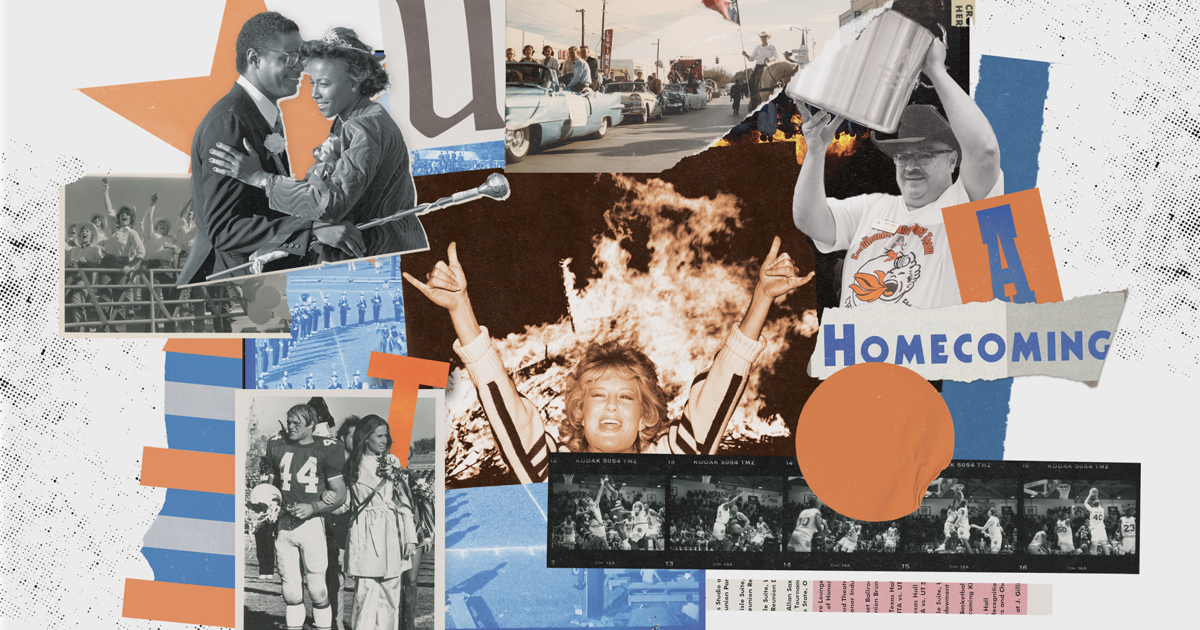


Photos courtesy of Special Collections / Photo illustration by Jordan Johnson
Homecoming has been a tradition at UTA since 1967, when the university got its current name, but the tradition goes back to the early 20th century. One of the oldest remaining celebrations on campus, Homecoming has withstood the test of time for almost a century.
Similar to how the name of the university has changed over the years, so have the celebrations that come with the Homecoming tradition.
“Homecoming means a great deal to UTA because it’s one of the moments when the heart of our institution is on full display,” said Lowell Davis, vice president for Student Affairs, in a statement. “It connects our past, present, and future, reminding us of the impact we’ve had and the potential still ahead.”
The different concepts of Homecoming celebrations at the university date back to the 1920s, with a football game and gathering in 1925, according to previous Shorthorn reporting.
Before Homecoming got a name, there were celebrations similar to it and events that would later be synonymous with it. The first recorded court crowned dates back to the mid-1930s, according to UTA Libraries. According to previous Shorthorn reporting, one of the first documented campus bonfires was in 1921.
Bonfires
Bonfires generally occurred the day before Saturday Homecoming football games and could draw upwards of a few thousand people, even 10,000 in some cases. Bonfires were used as a celebratory tradition on and off throughout the 20th century at UTA.
In 1939, the annual game against John Tarleton Agricultural College, now Tarleton State University, was one of the causes for the first banning of the bonfires at the university. It became an annual tradition for both schools to try to burn each other’s bonfires prematurely, according to a Tarleton State University article.
Tarleton won the tradition in 1939, burning down UTA’s bonfire and cutting the fire hose, causing the wood to go up in a blaze, according to the article. However, UTA students came up with a plan to get back at the Tarleton students.
With two planes, UTA students flew to Stephenville, Texas. They armed themselves with phosphorus bombs, but Tarleton students caught on quickly and threw cans, sticks and stones at one of the planes, causing it to crash-land.
The two UTA students in the plane were uninjured, but their return to campus marked the end of the bonfire tradition until the late 1940s with Homecoming football games.
Football
Football was a major part of the university’s Homecoming history before the team’s disbandment. Parades, bonfires and the crowning of the Homecoming queen all revolved around football games.
Throughout the years, the football team had a Homecoming game every November against various opponents, including Tarleton State University, Arizona State University and Southwest Louisiana State.
In 1985, the football program had the lowest attendance in the Southland Conference, according to previous Shorthorn reporting. There was also a deficit in the athletic budget.
Former UTA President Wendell Nedderman said financial realities left no alternative but to end the football program that same year, according to previous Shorthorn reporting.
Basketball
With football gone, another sport took the mantle of Homecoming — basketball.
Once a fall tradition, Homecoming began taking place in the spring in 1990 to better align with the basketball schedule, centering around games played in Texas Hall.
In 2012, with the opening of College Park Center, the university made the decision to move Homecoming from the spring back to fall.
Golf cart parade
The golf cart parade was started in 2008 by student Timothy Brown, golf cart parade committee chair at the time, according to previous Shorthorn reporting. The carts circled around campus.
Around 2012, the university integrated floats into the parade and built upon it to include other activities like a street festival and the pep rally throughout the day.
This year is the first time the parade will be at 11 a.m. to help coordinate with the tailgate, a newer tradition that has gained a lot of popularity with students, said Patrick Kelly, director of Student Activities.
Chili cook-off
The chili cook-off began in 2005 and was held at different locations and days over the years, including various parking lots, like the one across from Texas Hall.
Now the cook-off is held inside the Palo Duro Lounge at the University Center.
It consists of around 20 teams competing for who has the best chili. Anyone can participate in the cook-off. Kelly said he has had many different types of chili over the years, from venison to vegetarian.
In 2025, Homecoming week is more than events or traditions; it’s a culmination of history and love for a place that gives students lifelong friends and memories. This year, UTA celebrates long-held traditions like the parade, the chili cook-off, the pep rally and the Homecoming Bash, alongside newer traditions like the National Pan-Hellenic Council Homecoming Step Show and the tailgate.
“For our students, it’s a time to feel a part of something bigger, a university with deep roots and bold ambition,” Davis said in his statement. “It’s about belonging, pride, and celebrating the Maverick experience. For our alumni, Homecoming brings back memories of where their journeys began and offers a chance to see how UTA continues to grow and evolve.”
“It’s a shared tradition that keeps the Maverick spirit alive across generations.”
@atclements03 @wall035203