
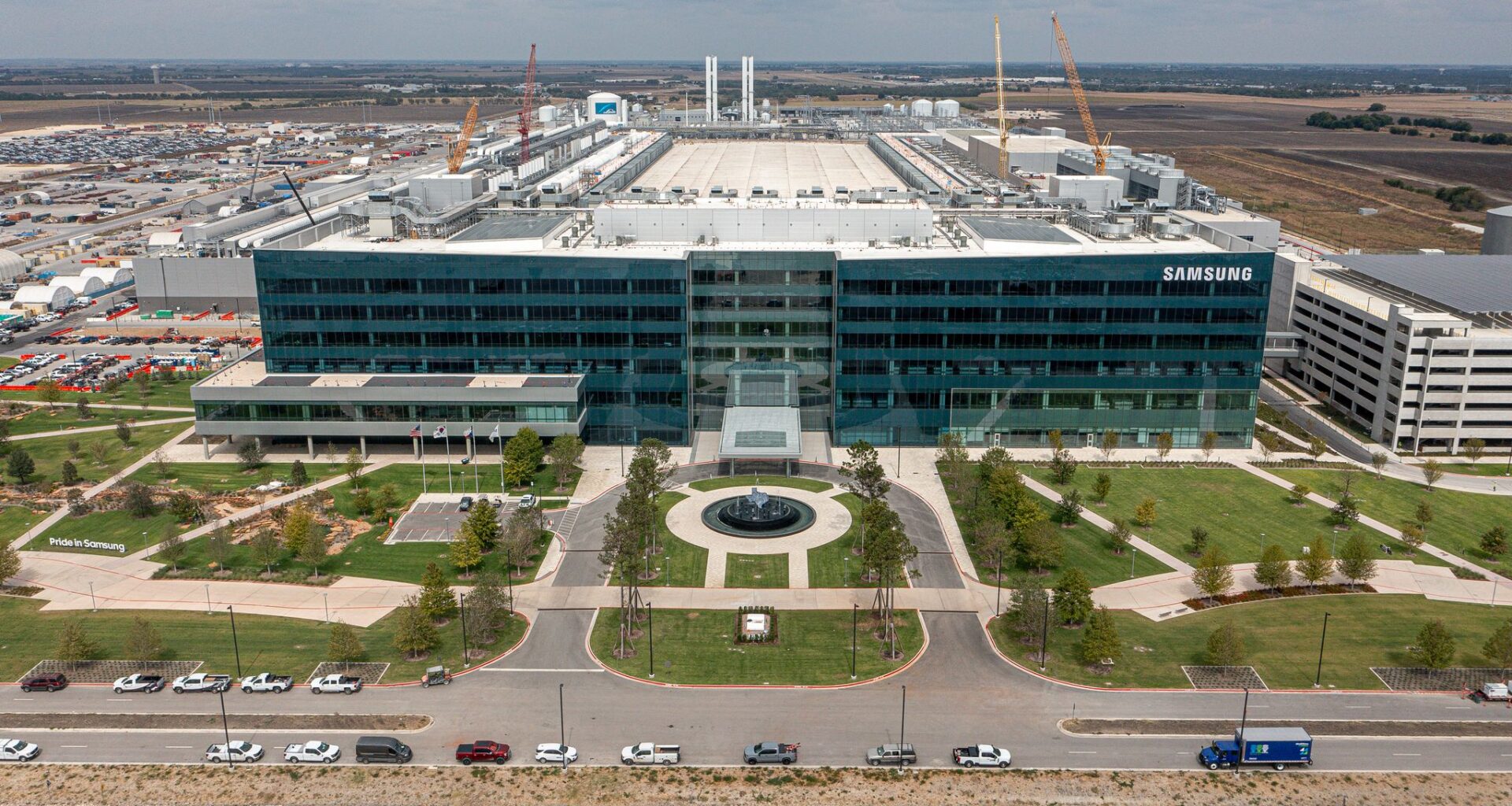
TAYLOR — Thirty miles northeast of Austin, farm fields and grazing land stretch into a distance broken only by fences, barns and an occasional grain silo. Rolling along FM 973 north of Manor, the view remains mostly rural — until the sprawling development looms on the horizon.

At night, glowing letters on one of the buildings cut through the darkness: SAMSUNG.
Construction continues on Samsung’s new plant near Taylor, Texas on Thursday, Oct. 16, 2025.
Aaron E. Martinez/Austin American-Statesman
Pickleball courts are available for residents at Murphy Park in Taylor, Texas on Thursday, Oct. 16, 2025.
Aaron E. Martinez/Austin American-Statesman
A for sale sign is displayed on a building in Downtown Taylor, Texas on Thursday, Oct. 16, 2025.
Aaron E. Martinez/Austin American-Statesman
Basketball courts are available for residents at Murphy Park in Taylor, Texas on Thursday, Oct. 16, 2025.
Aaron E. Martinez/Austin American-Statesman
A space available sign is displayed on a building in Downtown Taylor, Texas on Thursday, Oct. 16, 2025.
Aaron E. Martinez/Austin American-Statesman
Homes are built next to empty lots in the Spring Creek neighborhood in Taylor, Texas on Thursday, Oct. 16, 2025.
Aaron E. Martinez/Austin American-Statesman
A space available sign is displayed on a building in Downtown Taylor, Texas on Thursday, Oct. 16, 2025.
Aaron E. Martinez/Austin American-Statesman
Pickleball courts are available for residents at Murphy Park in Taylor, Texas on Thursday, Oct. 16, 2025.
Aaron E. Martinez/Austin American-Statesman
A shop is closed in Downtown Taylor, Texas on Thursday, Oct. 16, 2025.
Aaron E. Martinez/Austin American-Statesman
Tennis and pickleball courts are available for residents at Murphy Park in Taylor, Texas on Thursday, Oct. 16, 2025.
Aaron E. Martinez/Austin American-Statesman
Rising from what was once open farmland, Samsung Electronic Co.’s new semiconductor manufacturing complex has risen across more than 1,200 acres, its price tag adding up to one of the biggest private investments in Texas history.
Article continues below this ad
The world’s largest maker of memory chips and smartphones chose this corner of Williamson County to anchor what it hopes will become a long-term manufacturing hub, a fabrication facility producing the chips that will help power the artificial intelligence boom.
1996: Samsung Austin Semiconductor is established in Austin.
2021: Samsung Electronics announces plans to build a new semiconductor manufacturing plant in Taylor. The city of Taylor and Williamson County offer tax abatement agreements to support the development.
2022: President Joe Biden signs the 2022 CHIPS and Science Act, which incentivizes semiconductor manufacturing in the U.S., into law.
2024: Samsung awarded $4.7 billion in funding from the CHIPS Act.
2024: Samsung’s Taylor plant is expected to come online, but was postponed.
June 2025: City of Taylor unanimously passes first amendment to the 2021 tax abatement agreement.
July 2025: Samsung announces its first customer tied to the Taylor plant, a $16.5 billion deal to produce Tesla’s new AI chips.
September 2025: Samsung receives $250 million from the Texas Semiconductor Innovation Fund.
November 2025: Tesla CEO Elon Musk says TSMC in Arizona and Samsung’s manufacturing won’t be efficient enough to support the company’s goals and teases possible future fab of its own.
Late 2026: Samsung’s Taylor plant is projected to come partially online.
Late 2028: Samsung’s Taylor plant projected to be largely completed, per new agreements.
FROM SEPTEMBER: Texas awards record $250M semiconductor fund grant to Samsung’s Taylor chip plant
“Taylor has such a special charm to it, it’s what’s drawing people here,” said Jesse Tuscano, a Taylor resident and local business owner. “There’s a lot of excitement to it, bringing this company to a really dope city, but it’s not even up yet so who knows if it even changed this place.”
Article continues below this ad
Progress has been slower than expected, and so has the impact many of this city’s 18,000 residents were expecting.
The plant was originally scheduled to begin operations by the end of 2024, with construction to be substantially completed by the end of 2025.
But with full production now not expected until 2028 or later, Taylor officials — aiming to secure what’s still expected to easily become the area’s largest employer — have amended the city’s incentives deal with Samsung, easing deadlines and construction requirements in an effort to keep the multibillion-dollar project on track.
The updated agreement gives Samsung more time to complete the first phase of its massive complex while preserving the tax breaks and rebates that helped lure the South Korean company. City leaders say its eventual impact on jobs and revenue will be worth waiting a little longer.
Article continues below this ad
City spokesperson Daniel Seguin said Taylor is making a strategic bet on the future.
“Our community had a choice to make,” he said. “Do we want to become another bedroom community of Austin, just another suburb? Or do we maintain our identity as a hub of commerce for over 150 years — a place of innovation, manufacturing and diversity? We chose the latter, and that’s where Samsung was the trigger.”
Signs mark homes for sale in Taylor, Texas on Thursday, Oct. 16, 2025.
Aaron E. Martinez/Austin American-Statesman
Industry slowdown
Samsung is no newcomer to Central Texas. Its presence in the region began in 1996 with creation of Samsung Austin Semiconductor.
Article continues below this ad
That facility, which began operations the next year, marked the company’s first major chip manufacturing investment in the United States. It supported more than 5,300 jobs as of 2023, making it one of the largest foreign-owned employers in the region.
In 2021, Samsung began making moves to expand its footprint into nearby Williamson County.
In a news conference that fall, the company announced plans to build its newest semiconductor manufacturing fabrication plant, or fab, in Taylor. Its plan called for investing $17 billion in land, buildings, equipment and business property. The company purchased more than 1,000 acres — roughly 1.5 square miles — to construct a 6 million-square-foot facility.
The plant is expected to create about 1,800 permanent jobs once operational and from from 6,500 to 10,000 construction jobs during the build-out. The city of Taylor projected about $52.6 million in property-tax revenue over 30 years from the company’s presence.
Article continues below this ad
Samsung has also received billions in federal funds and millions from the state.
The project got about $4.75 billion through the CHIPS Act and Science Act, a federal program signed into law by President Joe Biden in 2022 to encourage semiconductor manufacturing in the U.S., and is expected to receive tax credits topping $9 billion. This fall, Samsung received $250 million in a grant through the Texas Semiconductor Innovation Fund, a program established by the state’s version of the CHIPS Act signed by Gov. Greg Abbott in 2023.
Under its initial tax abatement agreement, Samsung was exempted from certain city, county and sales taxes while paying a use tax directed to Taylor and Williamson County.
RELATED: Tesla taps Samsung in $16.5B AI chip deal tied to new Austin-area facility
Article continues below this ad
Amid increasing competition in the chip industry and a global economic downturn softening demand, Samsung didn’t sign its first customer tied to the new plant until late July. Tesla Inc., Elon Musk’s Austin-based automaker, penned a $16.5 billion deal to manufacture its new artificial intelligence chips in Taylor through 2033. Those chips haven’t even been fully designed yet, Musk told investors in late October.
An amended deal
With potential demand for its product lagging, Samsung reportedly slowed the pace of construction and investment at the site. So, with its deadlines to begin operations and complete construction passed or about to be, Taylor quietly amended Samsung’s deal.
Vehicles drive through Downtown Taylor, Texas on Thursday, Oct. 16, 2025.
Aaron E. Martinez/Austin American-Statesman
Now, instead of being required to come online by 2024 to reap the benefits, the site needs to be only partially online by the end of 2026. Samsung only needs to complete about 3 million square feet of occupiable space and “improve” 3 million square feet of non-occupiable space by the end of next year.
Article continues below this ad
An additional 1 million square feet of occupiable space must be completed by Dec. 31, 2028, along with total improvements on 7 million square feet combined occupiable and non-occupiable space by that year.
For its part, Tesla has already said it’s tired of waiting. Musk told shareholders his company could build its own chip fab because, “It’s still not going fast enough.” The terms of their agreement would still require Tesla to purchase chips made at Samsung’s plant, though.
As the completion delays became obvious, Samsung made repeated public statements that the plant would be partially operational by 2026.
It declined to comment about the delays or changes made to its incentives agreements.
Article continues below this ad
Taylor has updated the agreements publicly with City Council approval, but there was little community feedback — in part because many of the details are considered proprietary and weren’t made public.
“We really didn’t get a lot of community input about the amendments,” Seguin said. “But part of that is because the conversations aren’t happening out in the open, it happens behind closed doors.”
Mayor Dwayne Ariola declined to discuss the matter.
But the city has made clear it needs Samsung. Like many Austin suburbs, Taylor is growing — but not at the pace of cities like Bastrop, Cedar Park or Round Rock, all of which also are home to major technology corporations.
Article continues below this ad
City officials say Samsung could be the key to speeding growth and improving the city’s quality of life, especially if it someday decides to further expand in the area — a possibility officials say they are already planning for.
“The future is really bright, and Samsung, we could easily say, was the catalyst that’s sparking the rebirth of Taylor,” Seguin said.
‘Change takes time’
Signs direct visitors to shops in Downtown Taylor, Texas on Thursday, Oct. 16, 2025.
Aaron E. Martinez/Austin American-Statesman
Beyond Samsung’s giant project, though, the changes in the city aren’t readily apparent.
Article continues below this ad
Main Street still carries the same historic facades familiar to small towns across Texas — but some suggest more of them are vacant now.
Since Samsung announced its project, the city’s population has grown by about a thousand people — roughly in line with other Austin suburbs. Nearby Hutto, by comparison, has expanded far more rapidly.
Yet even without a surge in population or new development, city officials say the city’s continuing support for the development is already paying off in tangible ways.
National chains — Starbucks, Homes2Suites Hilton Hotel, Panda Express and Smoothie King — have built new locations. New housing developments are under construction near Samsung’s plant, with the city seeing nearly 2,000 new home listings between 2020 and the first half of 2025.
Article continues below this ad
Through the tax abatement agreement, the city receives use taxes for materials purchased elsewhere but used for construction at the Samsung site, with a quarter of all sales and use taxes going toward buying down the property tax rate.
While Taylor hasn’t disclosed the exact amount of sales and use taxes its receiving from Samsung, Taylor’s total collections in 2020 were $3.76 million. When construction officially began in 2023, the total jumped to $18.6 million. Last year, it reached $20.67 million.
Seguin said the new revenue, while perhaps directed toward less-than-glamorous efforts, has funded several projects improving quality of life in Taylor.
Roughly $5.56 million in sales and use taxes went toward recovery costs after a deadly 2021 winter storm. Another $2.3 million was spent on public works and street maintenance and nearly $1 million went to the police department. More than $337,500 funded park improvements and equipment, and $745,900 paid for cemetery maintenance and upgrades.
Article continues below this ad
As an example, Seguin said that before Samsung came to town, the city was using a backhoe to lay asphalt cold when it built and repaired streets. Since then, Taylor has purchased purpose-built equipment and added crews to operate it. The city has also recently added a new public works building thanks.
He said he understands that some residents might be frustrated with a pace that’s lagging original plans.
“Some people are frustrated that they don’t personally see the benefits right away,” Seguin said. “Here we are four years down the road and they thought Taylor would be completely transformed, property taxes would be zero and we would be the utopia of what Taylor once was.
“But that progress and change takes time and we already have $200 million in needs just for our streets, another estimated $150-$200 million in our water and wastewater systems. That has to be taken care of before growing.”
Article continues below this ad
Separate from its agreements, Samsung has donated $1.19 million to the city in 2022 and $1.3 million 2023, including more than $1.25 million to Taylor Independent School District.
The company’s investment in Taylor’s schools includes a new Career Technical Education wing at Taylor High School, new technology and STEM career programs to support a direct pipeline to working at Samsung’s facility, and support of about two dozen internships annually for high school students.
Seguin said the city is in talks to bring a satellite technology campus for the University of Texas at Austin that would be directly tied to career development for semiconductor production. A new downtown and tourism plan is nearing completion.
Small business still waiting
One area that hasn’t yet seen much benefit is Taylor’s small business community.
Article continues below this ad
A for lease sign is displayed on a building in Downtown Taylor, Texas on Thursday, Oct. 16, 2025.
Aaron E. Martinez/Austin American-Statesman
Tuscano, owner of Ripple and Rose Cafe downtown, said he came to the city because he wanted to leave Austin and open his own coffee shop. The original tenant in the shop at 109 W. Third St. operated the only coffee house in the city and was leaving, looking to cash in on the draw from out-of-towners opening businesses timed to Samsung’s arrival.
Tuscano said Samsung’s delayed rollout so far has mainly given him leverage to negotiate a lower rent.
“They originally tried to sell it to me way overpriced,” he said. “But with Samsung delaying, I asked if I’d be able to pay my loan back in two years? Pretty much, everybody said no, so I negotiated my rent down. I don’t think anybody else has been as lucky.”
Article continues below this ad
Coming out of the pandemic, development nationwide was stalled, so when Samsung announced it’d be investing in Taylor back in 2021, landlords and developers started buying up properties across town — especially along Main Street — at higher prices than had been seen previously.
In turn, property values increased, pushing up property taxes and rental rates. Eventually, the city had to step in to work with the state comptroller’s office to help bring taxes to a more manageable level. By then, many small businesses had been hit hard.
Downtown, once filled with antique stores and art shops, now features vacancy signs in empty storefronts.
“People can’t come into these buildings because they all need to be built out and the rent or lease will be too high, taxes won’t be manageable, and we haven’t seen any of this supposed influx of people,” Tuscano said. “It’s all pushing people out of downtown.”
Article continues below this ad
Though Samsung is a newcomer, Taylor is no stranger to the transformative effects of industry.
Named after railroad official Edward Moses Taylor, the city was founded in 1876 as the International–Great Northern Railroad was laying tracks through town. About six years later, the Missouri-Kansas-Texas Railroad arrived, turning the town then known as Taylorsville into a central shipping point for cattle and grain.
Now roughly 150 years later, another industry is promising to reshape the city, this time not with steel rails but silicon chips. And, like it did in its previous booms days, Taylor is working to manage the promises and pressures of growth.
Article continues below this ad
“I think everybody jumped the gun on the Samsung thing,” Tuscano said. “We’ll see when it finally opens up and it’s creating microchips or whatever and people will actually be living here and working here. I personally haven’t noticed a difference in people coming up here until then.”