
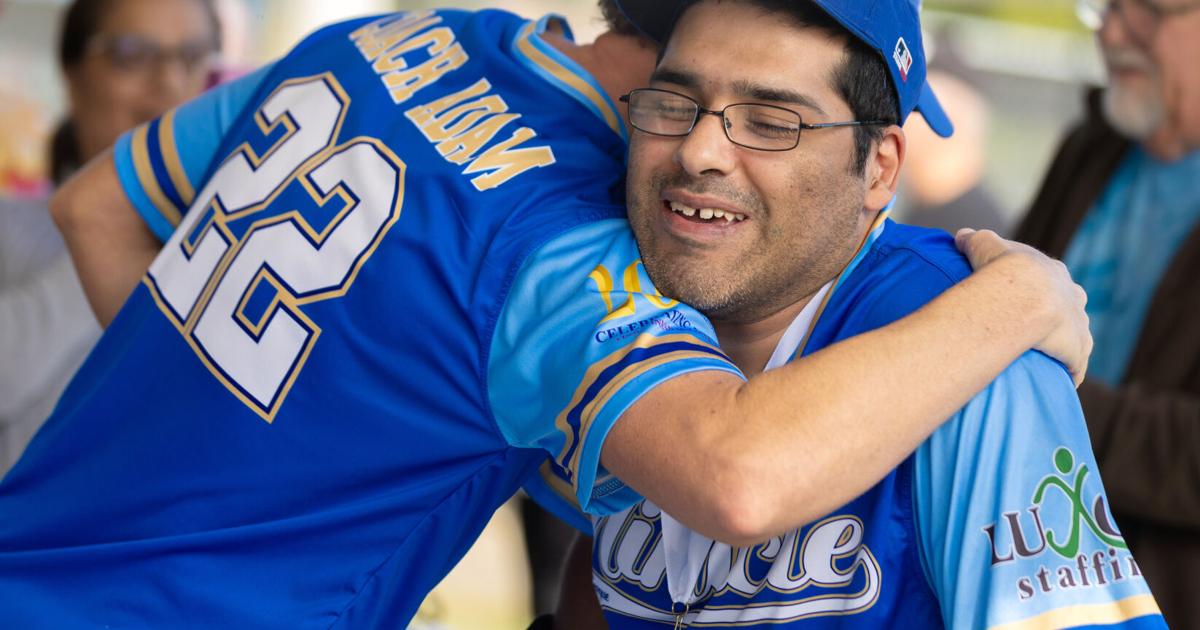

Miracle League coach Adam Smith, 41, left, hugs Pedro Mendez, Fort Worth, Texas, resident, 34, after earning a medal during a Miracle League baseball game Nov. 1 at Randol Mill Park. Founded in 2005 by Doug Inman, the league brings inclusivity to America’s pastime.
Photo by Elvis Martinez-Cartagena
For children and adults with disabilities, finding adaptive sports to compete in can feel impossible, leading to an overall decrease in activity compared with those without a disability, but the Miracle League of Arlington is doing its part to combat that issue.
The nonprofit, founded in 2005 by Doug Inman, is a baseball league that provides children and adults with disabilities the opportunity to play a sport, an experience many of the players otherwise may not have due to physical or developmental challenges.
For those with disabilities, playing sports and living an active lifestyle can lead to better mental health, physical fitness, emotional control and social well-being, but for many, access is the difference between an active or a sedentary lifestyle.
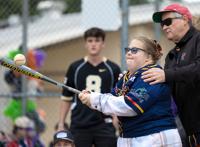
Mansfield, Texas, resident Cheyenne Kingsley, 34, left, hits a ball while Miracle League coach John Cottraux, 60, holds her during a baseball game Nov. 1 at Randol Mill Park. The Miracle League lets children and young adults with disabilities play baseball in an inclusive environment.
Photo by Elvis Martinez-Cartagena
Leidi Campos has a daughter with a visual impairment who plays in the league. She fought back tears when talking about the opportunity and hope the league has given her and her daughter.
“My daughter now knows that she is more than just capable, and not only just setting her mind to it, but knowing that there are no limitations, because nothing here is limited for them,” Campos said.
“Every moment is a wonderful moment, because just knowing that the barriers that she does have to face every day are immediately disappeared from the moment that she gets here,” Campos said.
In its 20 years, the Miracle League has given countless families a sense of inclusion, support and normalcy in a world that often overlooks those with disabilities.
In Texas, only 39.8% of children with disabilities have played sports at least once in their lives, compared to 53% of children without disabilities who have played sports at least once, according to the 2022-2023 National Survey of Children’s Health. Adults with disabilities are also almost twice as likely as people without disabilities to be physically inactive, according to a 2022-2023 survey by Sport England.
Volunteers like Tina Toups, a 67-year-old Poolville, Texas, resident have spent years of their lives making miracles happen for people like Campos and her daughter. Toups began volunteering 18 years ago as a way to get back on the field after an accident nearly cost her her foot, leaving her unable to play.
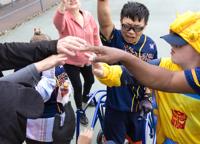
Burleson, Texas, resident Matias Castro, 18, celebrates with his team, the Senior Astros, during a Miracle League baseball game Nov. 1 at Randol Mill Park. Volunteers serve as “Buddies,” helping players at bat while in the field.
Photo by Elvis Martinez-Cartagena
Toups said she enjoys seeing the kids smile and the parents light up when they see progress from their kids they never thought was possible. She shared what she calls a success story of a kid they called Bubs, who always wanted to hit a home run and would melt down if he didn’t.
“The first time he hit his home run, to see a smile and see him progress from not being able to hit, but understand patience about hitting it over the fence, and he is now going to UNT.”
According to the Miracle League website, each game is two innings. Every player gets introduced by a play-by-play announcer before taking the plate. To ensure every player has fun and gets involved, the teams hit through the lineup with the last player hitting a home run. The game always ends in a tie, so each team wins.
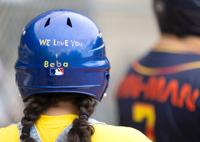
Garland, Texas, resident Janice Rosario, 26, waits to bat during a Miracle League baseball game Nov. 1 at Randol Mill Park. Each two-inning game lets every player bat, circle the bases and score.
Photo by Elvis Martinez-Cartagena
The league has different divisions divided by age and ability. Players with mobility issues play on the Miracle League field, an all-turf field that is accessible to walkers and wheelchairs, and players with no mobility issues play on a dirt field. Both fields are located in Randol Mill Park.
Mendi Schutte, executive director for the nonprofit, said the league had 22 teams made up of 301 players this fall, along with 67 volunteer coaches who undergo background checks to ensure player safety. Players range from 4 to 45 years old, with no limit on how old they can be.
The end of the fall season marked 20 years of inclusion, community and adaptive sports in Arlington, a milestone that was capped off when the league was awarded nonprofit of the year at the Greater Arlington Chamber’s 20th annual State of the City.
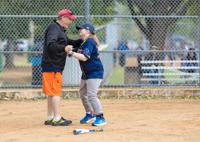
Miracle League coach John Cottraux, 60, left, and Arlington resident Logan McKechnie, 22, celebrate a home run during a Miracle League baseball game Nov. 1 at Randol Mill Park. The league reached 20 years of promoting inclusion through baseball.
Photo by Elvis Martinez-Cartagena
Schutte said the organization is honored to be named nonprofit of the year as it celebrates its 20th anniversary, but said it wouldn’t have been possible without the help of the community.
“We’re nonprofit of the year because the entire miracle family, from the board of directors to the players to the families to the sponsors,” she said. “It is just a wonderful recognition for everyone who makes Miracle League so special.”
Schutte said that safety and inclusion — both for the parents and players — are some of the organization’s top priorities, something they can achieve thanks in part to their volunteers. The volunteers allow parents to be present during the games and cheer their kids on without having to worry about whether their kids are safe or being tended to.
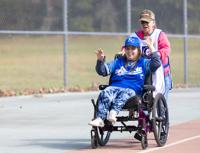
Arlington resident Mariah Young, 24, heads toward the home plate during a Miracle League baseball game Nov. 1 at Randol Mill Park. Nicknames are encouraged when the game-day announcer introduces the players.
Photo by Elvis Martinez-Cartagena
Looking ahead, Schutte said her goal is to make the Miracle League into a year-round community, not just a spring and fall season of baseball. They’ve already implemented movie nights and invite different organizations, like college fraternities and sororities, to socialize with the players.
After two decades, the Miracle League of Arlington remains a place where every player, coach and volunteer can make a real change and a place where everyone wins.
@diegocllazo