
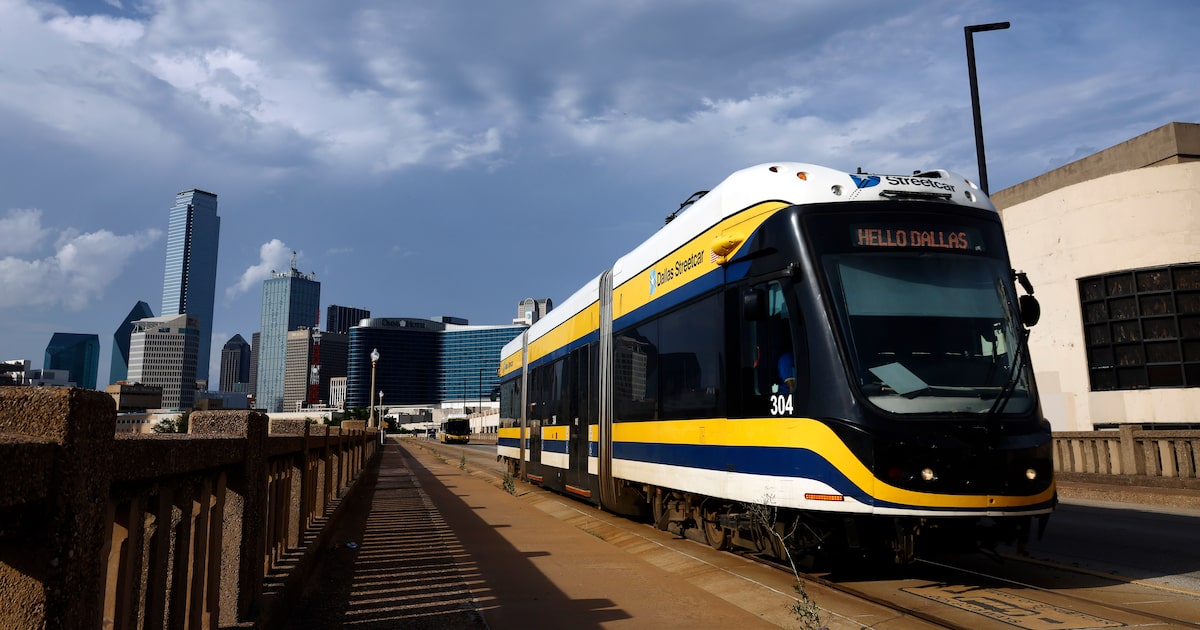

It’s been a few years since I last rode the streetcar from downtown Dallas to Bishop Arts — probably, oh, since The Dallas Morning News moved out of the Young Street building at the end of 2017. On Monday, I met a regular rider who hadn’t even known the decade-old streetcar existed until she moved to Oak Cliff from Farmers Branch a year ago. And she thinks it’s great — most days, anyway, until it breaks down and she has to pile into a “broken-down DART van” for the short ride to the Eddie Bernice Johnson Union Station.
“But it gets you to where you want to go,” Jarriett Franklin said as we crossed over the Houston Street Viaduct. Franklin, a 17-year veteran of the Air Force and Navy, was on her way to the Dallas VA Medical Center.
My excuse for Monday’s streetcar sojourn was a document I found on the city’s procurement website provocatively titled “Reimagining Downtown Dallas.” It resurrects something I thought dead, buried and tossed into the Trinity: connecting Dallas Area Rapid Transit’s Oak Cliff streetcar with the McKinney Avenue Transit Authority’s trolley line stretching from the West Village to downtown.
The document, which seeks proposals from planners and engineers who can figure out how to put the two trains on the one track, was posted at the end of October by the city’s Department of Transportation and Public Works, which touted an anticipated $5 billion in “major infrastructure investments in and around downtown.” That includes the long-proposed Interstate 30 redo, the longer-discussed trenching and decking of Interstate 345 and the new convention center.
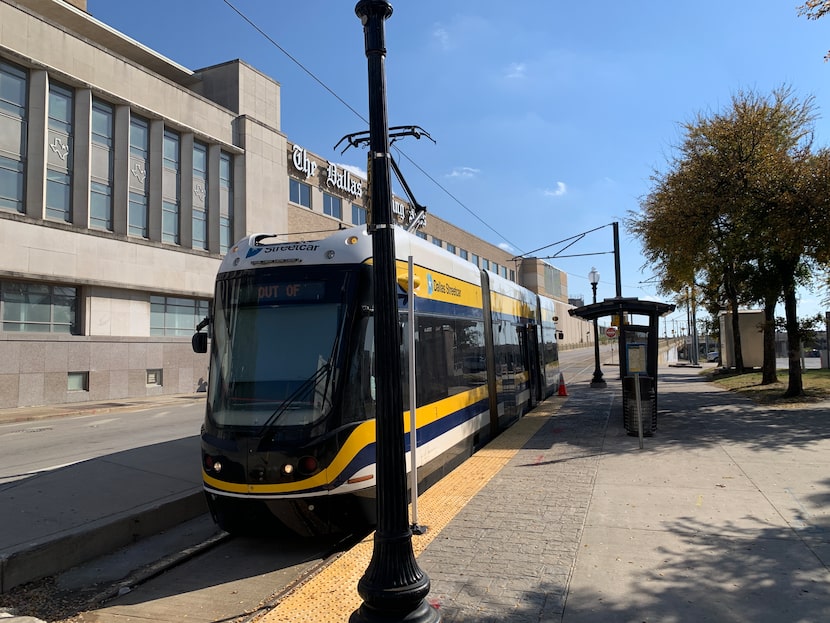
The Oak Cliff streetcar warned that it was “Out of Service” Monday afternoon. It was not, in fact, out of service.
Robert Wilonsky
In the midst of that fever dream, the city is “examining options to enhance its transportation mobility choices to include the modern streetcar option that would connect” the Oak Cliff and Uptown trolleys. Which might elicit a raised eyebrow only because the City Council already made the $92 million decision to use Elm and Commerce streets as the connecting routes … on Sept. 13, 2017, the first or third or eighth time we reinvented downtown.
Opinion
At the time, this newspaper reported that “the streetcar is projected to be completed by 2023.” Our apologies to those who made plans accordingly. But there’s certainly no timeline now, other than “it can’t be open-ended,” said Ghassan “Gus” Khankarli, director of the city’s Transportation and Public Works Department.
Khankarli arrived at City Hall three years after that council vote, at which point, he told me Monday, the initial plan got sidelined in part because of the city’s interest in building a new convention center. He said the transportation staff needed to make sure its $3.7 billion (and counting) footprint didn’t interfere with a long-hoped-for streetcar extension to the city-owned Omni Hotel.
“If you don’t get that piece correct, everything else doesn’t matter,” Khankarli said Monday. “This is where your first connection happens.”
Ultimately, officials determined they could still extend the line from the Union Station stop, an awkward island on a dead corner adorned by a graffiti-covered Reunion Tower sign in the shadow of the lifeless former Dallas Morning News building, to the hotel. But in the interim, Khankarli and his staff applied for a $2 million federal grant to fund downtown planning studies. That money is paying for this latest streetcar study, which the city’s transportation director said will determine whether the route chosen by the council eight years ago still works.
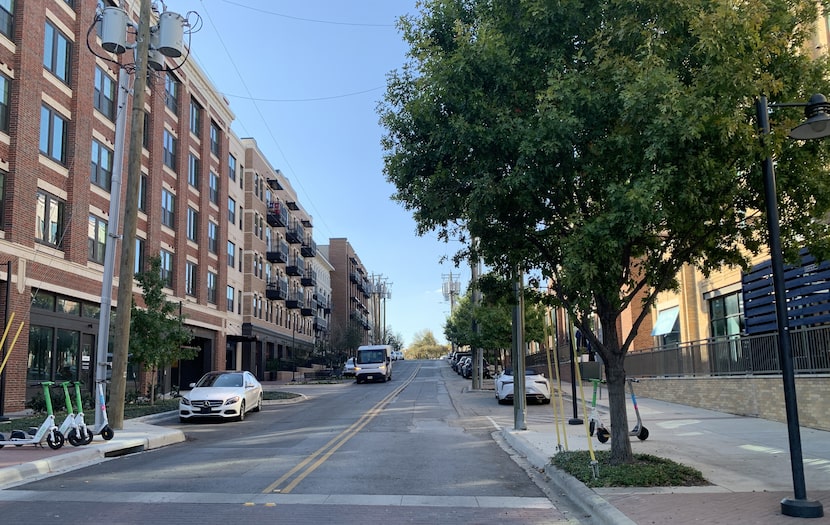
The view along West Seventh Street as you make your way from the streetcar’s Bishop Arts Station to, you know, Bishop Arts.
Robert Wilonsky
“We all agreed it was productive for us to reevaluate the changes in downtown, such as the reconfiguration of buildings from office to residential,” Khankarli said.
Alas, Khankarli, a very thoughtful and thorough city official, would not entertain my conspiracy theory that this is just a roundabout way of rolling out light rail in front of the forthcoming Adelson Arena & House of Gambling where City Hall now sits.
There were only a handful of people on the streetcar to Oak Cliff Monday at 1:30 p.m., among them a woman who rides it daily, to and from her job at the Corner Bakery in the West End. She and I exited at the Bishop Arts Station — a dull concrete plaza at the foot of those apartments clogging up West Davis Street and North Zang Boulevard — and walked up West Seventh Street, past apartments with darkened storefronts.
She headed off toward home near Jefferson Boulevard while I headed toward Bishop Arts. There, the first person I saw was — how fortuitous — Jason Roberts, visiting with people on the patio of his Trades Delicatessen.
Roberts and the Oak Cliff Transit Authority pushed the city, DART and the North Central Texas Council of Governments toward the feds’ $23 million Transportation Investment Generating Economic Recovery (TIGER) grant that helped get the streetcar over the Trinity. So he has a lot of thoughts on what they got right and where things went wrong, beginning with not extending the downtown end a few blocks further to Dealey Plaza, or the Oak Cliff end closer to Bishop Arts.
“A lot of people talk about how streetcar ridership is low,” Roberts said. “Well, yeah — because we didn’t properly connect the segments. At the time we were hoping at the very least it would connect people to the DART lines at Union Station, but you’re still four blocks from where people actually want to be in the downtown area, so it’s out of sight, out of mind. If you are not putting it where people are, you’re creating another obstacle to its success.”
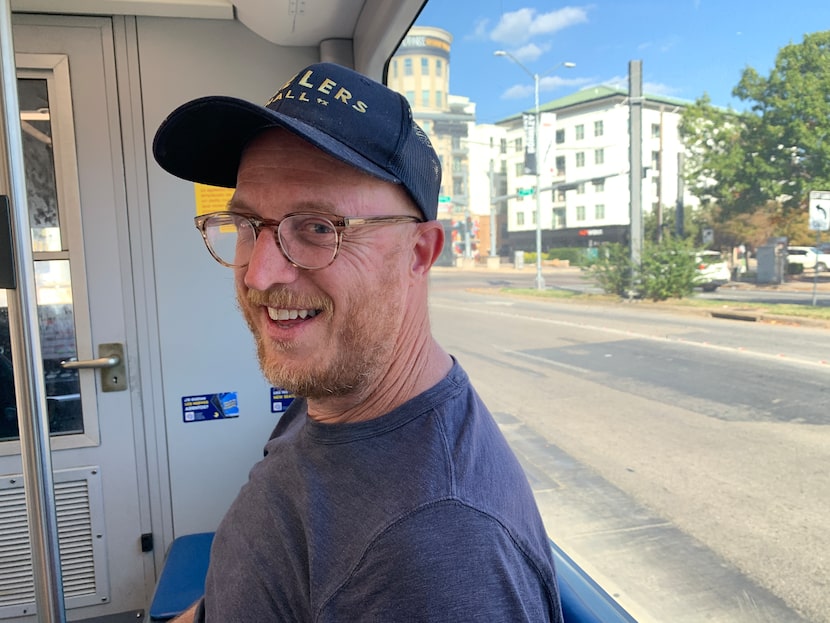
Jason Roberts’ Oak Cliff Transit Authority pushed Dallas Area Rapid Transit, Dallas City Hall and the North Central Texas Council of Governments to pursue the federal transportation grant that led to the opening of the Oak Cliff-to-downtown streetcar line in April 2015.
Robert Wilonsky
I actually hadn’t thought about the streetcar until last week, when Downtown Dallas Inc. President and CEO Jennifer Scripps brought it up during a visit to the paper to discuss the future of downtown. She mentioned that her organization has been convening meetings with the city about how to pay for operations and maintenance if and when the Oak Cliff and McKinney lines eventually hook up.
Khankarli told me Monday that “we have to be fiscally responsible and do what’s best for the city,” and reminded me that in April he’d presented several options to the council’s transportation committee — from naming rights to property tax assessments — with the promise he’d come back soon with a shortlist of options. That briefing also discussed the possibility of extending the Oak Cliff line all the way to the Dallas Zoo and Halperin Park, and taking the downtown line all the way to Fair Park, where the streetcars ran until 1956.
Never let it be said Dallas doesn’t do the same thing over and over and over. But just remember: No matter how hard some on the council push for parking the Oak Cliff streetcar, that’s impossible. To do so would mean refunding that TIGER grant money to the feds. So somebody has to make this thing work.
“We’re the only city that built an arm — to McKinney — and a leg — to Oak Cliff — but no spine through downtown,” Scripps said. “If you could get on a streetcar at whatever hotel you’re staying in and know that you could get to the Arts District or Klyde Warren or Uptown over to Lower Greenville or Fair Park on a trolley, that would be a game changer.”
Would be. Might be. Should have been, a long time ago.