
This time of year, families are gathering up recipes and dusting off dishes, getting ready for a holiday of food and good memories. But for some who’ve lost so much, thoughts of Thanksgiving and Christmas are filled with dread. Some of the families of Heaven’s 27, the 27 girls who lost their lives in the floods in Kerr County this summer at Camp Mystic, have turned to a little-known therapy that is helping them push past the trauma.
Carrie Hanna of Dallas lost her daughter, Hadley, in the floods at Camp Mystic. She says in the wake of her death on July Fourth, she’s lost memories of Hadley, the middle of three daughters, and an ability to dream. Even looking at pictures and videos, she says, is hard because many memories have faded.
“She was a great friend. She was a wonderful sister. She was the best sister,” Hanna says.
But until now, speaking about her late daughter has been hard to do, all while trying to hold it together for her other two girls. “We are all struggling in different ways at different times, sometimes the same time, and every day is a struggle. We have to keep going for them, there’s no other option.”
Hanna’s older daughter, Harper, was at Camp Mystic when the flood came and Hanna says she is dealing with her own trauma.
“It’s a whole other layer. There’s a lot of guilt she has about not going to help her or surviving. There’s the trauma of the night and the water and the storms that they experienced and the unknown, and not being in control or having any idea what was happening and just being in a really bad storm. And your sister was not there with you and she didn’t know where she was. It’s a lot.”
Hanna says she and her family sought therapy at the Housson Center in Dallas. There, she and her oldest daughter were introduced to the RTM Protocol, a little-known therapy used to treat PTSD in veterans.
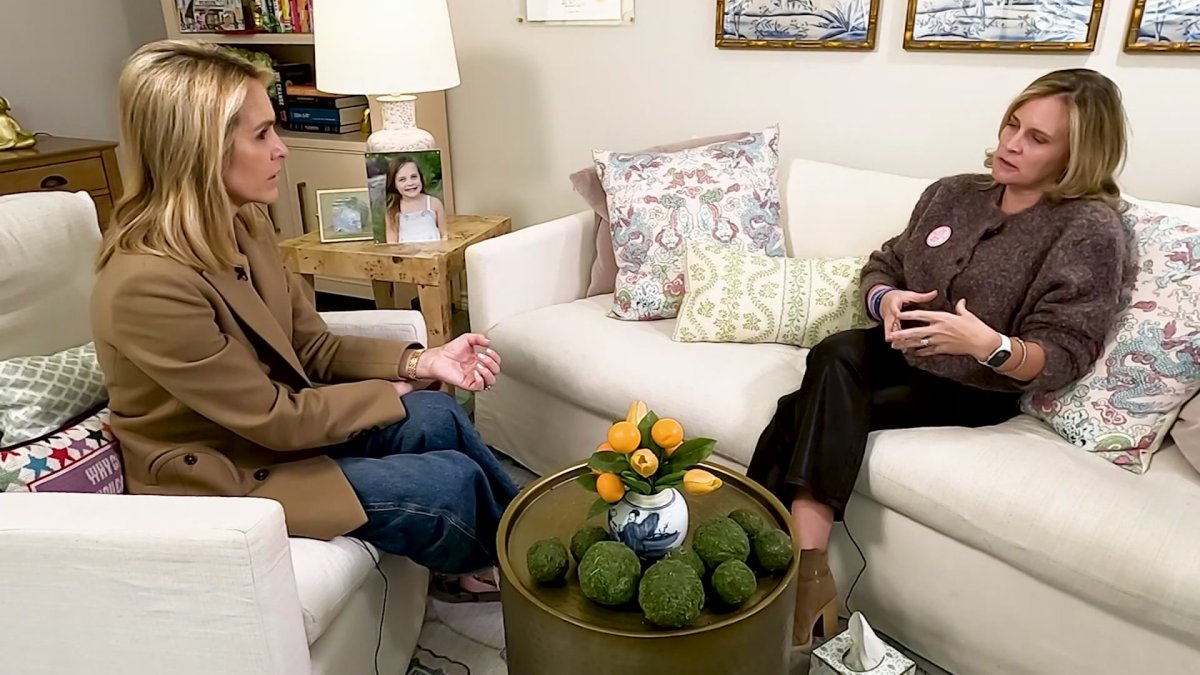
“It’s you and the therapist sitting like this, my therapist facing me, and it’s hour-long at a time, and it’s grueling. It’s recalling events, trigger points over and over and over,” Hanna said. “You take something that you’re fixating on and work through it. Any time I was awake (it was) an obsession. That’s all I could see in my head was these two things, that night (that she died) and something else after, that is more private and harder for me. I don’t like to talk about it because it’s very private and hard, but it was all I thought about. All that kept running through my brain. Nothing else,” Hanna said.
Eve Wiley, the clinical director at the Housson Center and a licensed professional counselor, has worked extensively with families experiencing PTSD.
“RTM Protocol is the Reconsolidation of Traumatic Memories. So when something traumatic happens, that memory gets stored alongside the fear response. So the amygdala in the brain lights up and the body reacts. Then they feel like they are experiencing this all over again,” Wiley said. “So RTM, it’s not erasing the memory. It’s just allowing these people to recall it in a way that doesn’t physically cause distress or doesn’t cause them to disassociate or have physical symptoms associated with their trauma.”
A group of families who lost daughters in the floods at Camp Mystic this summer are finding new hope for healing in a fairly new therapy. NBC 5’s Meredith Land sat down with Carrie Hanna, four months after losing her daughter, Hadley.
Wiley says most patients need three 60- 90 minute sessions to experience relief. Hanna recalls that after three sessions, the fixation on those traumatic thoughts started to lift and she began to find her voice again.
“It’s made it to where I can discuss it and not just hold it in and not have that fight or flight response to it and the helplessness,” she said.
She also says her daughter Harper is making great strides with the RTM Protocol.
“I think it’s helped her some, especially when it comes to storms. I think it’s helped her tremendously.”
Hanna’s hope is to dream again about Hadley. “The girls are (also) praying that she’ll come to them too because they want to see her too. So that’s one of the things we pray about is that we can dream about her.”
“That is one of the biggest things that we hear, is people say, ‘I can dream again,'” Wiley said. “Or, ‘I can talk about a memory without crying or shutting down or having a physical response and ruining my day. That’s really powerful to have, to be able to honor that person’s memory and to be able to go out there and speak that testimony and that legacy and keep their memory alive.”
The Housson Center will be offering RTM Protocol to more patients starting the second week of December.
They have also set up a therapy fund for the families of Heaven’s 27 and others affected by the central Texas floods that the public can donate to.