
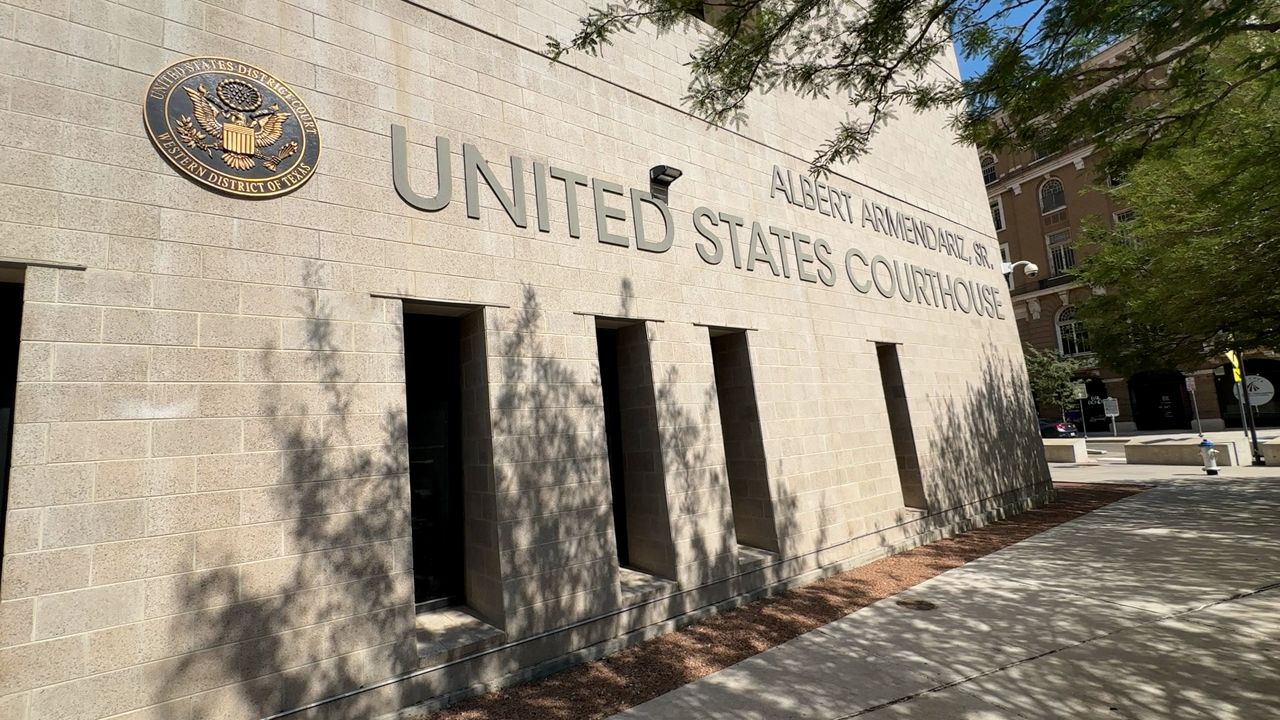
EL PASO, Texas — A federal court in El Paso ruled on Tuesday that Texas cannot use the new congressional maps redrawn this summer.
What You Need To Know
A three-judge panel enjoined the state from using the updated maps and said that Texas should instead use the previous maps created in 2021 following the 2020 census
The 160-page ruling was a blow to President Donald Trump’s efforts to have GOP lawmakers in multiple states redraw their maps to help the party preserve its slim House majority in the potentially difficult 2026 midterm elections
The ruling argues that the Trump administration’s request to redistrict targeted only majority-non-white districts, and because Texas Gov. Greg Abbott agreed to resolve the administration’s concerns, he “directed the Legislature to redistrict based on race”
The 2-1 decision followed a nearly two-week trial in El Paso, Texas. Texas’ expected appeal would be directly to the U.S. Supreme Court, under a federal law dealing with redistricting lawsuits
A three-judge panel enjoined the state from using the updated maps and said that Texas should instead use the previous maps created in 2021 following the 2020 census.
The 160-page ruling was a blow to President Donald Trump’s efforts to have GOP lawmakers in multiple states redraw their maps to help the party preserve its slim House majority in the potentially difficult 2026 midterm elections.
“The public perception of this case is that it’s about politics. To be sure, politics played a role in drawing the 2025 Map. But it was much more than just politics. Substantial evidence shows that Texas racially gerrymandered the 2025 Map,” the ruling states.
The ruling argues that the Trump administration’s request to redistrict targeted only majority-non-white districts, and because Texas Gov. Greg Abbott agreed to resolve the administration’s concerns, he “directed the Legislature to redistrict based on race.”
Abbott said in a statement that the “Legislature redrew our congressional maps to better reflect Texans’ conservative voting preferences – and for no other reason. Any claim that these maps are discriminatory is absurd and unsupported by the testimony offered during ten days of hearings. This ruling is clearly erroneous and undermines the authority the U.S. Constitution assigns to the Texas Legislature by imposing a different map by judicial edict. The State of Texas will swiftly appeal to the United States Supreme Court.”
Texas House Speaker Dustin Burrows said simply that he disagreed with the court’s decision, and he anticipates that the U.S. Supreme Court will “strike it down in short order.”
Texas House Minority Leader Gene Wu said in a statement that the court “stopped one of the most brazen attempts to steal our democracy that Texas has ever seen.”
“Greg Abbott and his Republican cronies tried to silence Texans’ voices to placate Donald Trump, but now have delivered him absolutely nothing,” the statement said. “Today, a federal court saw through Greg Abbott’s lies, and Texas families won. We expect Republicans to appeal today’s ruling, and we will be ready at every level.”
Wu was one of the many state Democratic lawmakers that left the state in order to delay the redistricting vote. State Rep. James Talarico, D-Austin, was also part of that group. He is currently running for U.S. Senate.
“My fellow Texas Democrats and I broke quorum to shine a national spotlight on Trump’s redistricting power grab,” Talarico said in a post on X. “We inspired other states and millions of Americans to join the fight. Moments ago a federal court struck down his rigged map. This is why we fight back.”
Harris County Attorney Christian D. Menefee, who is also running to represent Congressional District 18, said in a post on X, “Judges from both parties agreed: this Trump-backed plan was designed to silence Black and Brown voters.”
State Rep. Briscoe Cain, R-Deer Park—who is running in the redrawn 9th Congressional District—said that he will continue to run under the 2025 map.
“We are running under the lines lawfully passed by the Big Beautiful map and the courts will not thwart the will of Texas voters and their Representatives. We are confident this temporary court obstruction will be swiftly overcome,” Cain said in a statement. “Our campaign is moving full steam ahead, and we will not be deterred by judicial overreach that seeks to undermine the democratic process.”
Texas this summer was the first state to meet Trump’s demands in what has become an expanding national battle over redistricting. Republicans drew the state’s new map to give the GOP five additional seats, and Missouri and North Carolina followed with new maps adding an additional Republican seat each. To counter those moves, California voters approved a ballot initiative to give Democrats an additional five seats there.
California Gov. Gavin Newsom posted on X, “Donald Trump and Greg Abbott played with fire, got burned — and democracy won. This ruling is a win for Texas and for every American who fights for free and fair elections.”
The 2-1 decision followed a nearly two-week trial in El Paso, Texas. Texas’ expected appeal would be directly to the U.S. Supreme Court, under a federal law dealing with redistricting lawsuits.
A coalition of civil rights groups representing Black and Hispanic voters argued the map reduced the influence of minority voters, making it a racial gerrymander that violates the federal Voting Rights Act and the U.S. Constitution.
They sought an order blocking Texas from using the map while their case proceeded, which would force the state to use the map drawn by the GOP-controlled Legislature in 2021 for next year’s elections.
The panel of judges granted the critics’ request, signaling that they think those critics have a substantial chance of winning their case at trial. One judge was appointed by Trump, another by Republican President Ronald Reagan, and one by Democratic President Barack Obama.
“Without an injunction, the racial minorities the Plaintiff Groups represent will be forced to be represented in Congress based on likely unconstitutional racial classifications for at least two years,” the ruling said.
Texas Attorney General Ken Paxton said in a statement that the 2025 map is “entirely legal and passed for partisan purposes to better represent the political affiliations of Texas.”
“For years, Democrats have engaged in partisan redistricting intended to eliminate Republican representation. Democratic states across the country, from California to Illinois to New York, have systematically reduced representation of Republican voters in their congressional delegations. But when Republicans respond in kind, Democrats rely on false accusations of racism to secure a partisan advantage,” said Paxton. “I will be appealing this decision to the Supreme Court of the United States, and I fully expect the Court to uphold Texas’s sovereign right to engage in partisan redistricting.”
Republicans in Texas said repeatedly during the Legislature’s debates this summer and after that they were redrawing districts solely to help Republicans win more seats. The U.S. Supreme Court gave states the go-ahead to pursue partisan gerrymandering by ruling in 2019 that it’s a political issue beyond the reach of the federal courts.
Republicans hold 25 of Texas’ 38 congressional seats, with Democrats holding two of their 13 seats in districts that Trump carried in 2024. Had the new map been in place last year, Trump would have carried 30 congressional districts by 10 percentage points or more, making it likely that the GOP would have won that many seats as well.
Democrats across the U.S. have described the redistricting in Texas and other states as a power grab by Trump designed to prevent a congressional check on him, regardless of voter anger. Republicans are keen to avoid a repeat of the 2018 midterms, when they lost the majority and the Democratic-controlled House twice impeached Trump.
The new map decreased from 16 to 14 the number of congressional districts where minorities comprise a majority of voting-age citizens.
In doing so, they eliminated what had been five of nine “coalition” districts, where no racial or ethnic minority has a majority but together minorities outnumber non-Hispanic whites in the voting-age population. Five of the six Democratic lawmakers drawn into districts with other incumbents are Black or Hispanic.
Yet Republicans argued the map is better for minority voters. While five “coalition” districts are eliminated, there’s a new, eighth Hispanic-majority district, and two new Black-majority districts.
Critics consider each of those new districts a sham, arguing that the majority is so slim that white voters, who tend to turn out in larger numbers, will control election results.
This is a developing story.