
AUSTIN — U.S. 5th Circuit Court of Appeals Judge Jerry Smith blasted Tuesday’s preliminary injunction issued by a federal panel blocking Texas’ revised congressional maps, writing in his dissent that the majority opinion would be a “prime candidate” for a Nobel Prize for fiction.
The 104-page dissent criticized U.S. District Judge Jeffrey Brown’s 160-page ruling, and at times mocked his legal acumen. At one point, Smith wrote that Judge Brown is an “unskilled magician.”
Smith, who was appointed by President Ronald Reagan, wrote the winners from Judge Brown’s opinion are George Soros and California Gov. Gavin Newsom. Neither individual was a party in the lawsuit.
“The obvious losers are the People of Texas and the Rule of Law,” Smith wrote.
Political Points
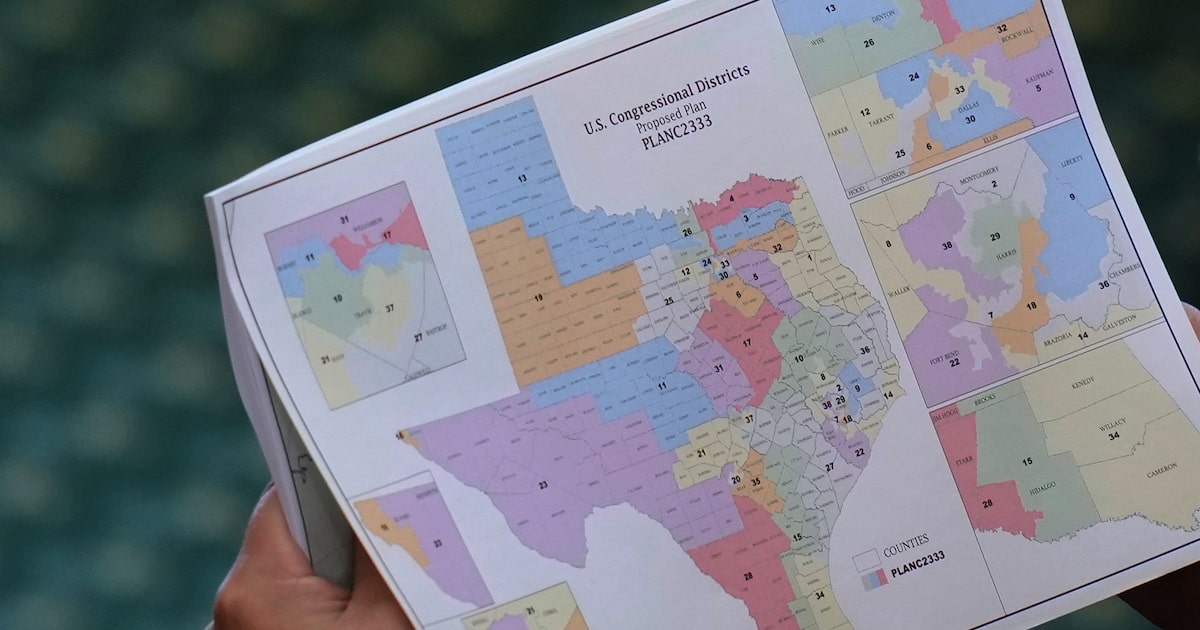
Tuesday’s 2-1 opinion ordered that Texas use its 2021 Congressional map in next year’s elections instead of the map the Republican-controlled Legislature passed this summer. President Donald Trump asked Texas Republicans to redistrict mid-decade to flip five seats and give the GOP a better chance at maintaining control of Congress in the 2026 midterm elections.
Days before Gov. Greg Abbott called the overtime session to take up redistricting, U.S. Assistant Attorney General Harmeet Dhillon wrote a letter to Abbott and Attorney General Ken Paxton, writing that four congressional districts in Texas violated the Voting Rights Act and the Constitution because they were drawn as “coalition districts” composed of majority nonwhite residents.
Abbott cited the Justice Department’s letter when he added redistricting to the special legislative session agenda.
Related
However, Judge Brown, who was appointed by Trump, used the letter, and comments Abbott made in media interviews, to make the determination race was a factor in the drawing of the map.
“The map ultimately passed by the Legislature and signed by the Governor—the 2025 Map—achieved all but one of the racial objectives that DOJ demanded,” Brown wrote. “The Legislature dismantled and left unrecognizable not only all of the districts DOJ identified in the letter, but also several other ‘coalition districts’ around the State. For these and other reasons, the Plaintiff Groups are likely to prove at trial that Texas racially gerrymandered the 2025 Map.
The map Abbott signed in August, was designed to flip five seats held by Democrats – one each in Dallas-Fort Worth, the Houston area, Central Texas, South Texas and the Rio Grande Valley.
In his dissenting opinion, Smith writes that this case is “the most blatant exercise of judicial activism that I have ever witnessed.”
Smith also disagrees with Brown’s opinion that Texas’ new map was a direct response to the Justice Department’s letter.
“If Texas had been responding to DOJ’s threat, why would they have left one coalition district on the table still subjecting them to liability?,” he wrote. “That doesn’t make sense.”
In his dissent, Smith described the political operative who drew the new map, Adam Kincaid of Virginia, as the trial’s star witness.
Smith described as “credible and irrefutable” Kincaid’s testimony detailing his process of drawing each individual district, starting in the Panhandle and moving clockwise.
Related
Smith cites testimony Kincaid drew a race-blind map based on partisan results.
“Kincaid used traditional redistricting criteria,” Smith wrote. “His top priority was to protect incumbents and improve or maintain existing Republican districts.”
Smith detailed various ways, in his view, Brown brushed past evidence the Legislature’s motive was much more likely partisan than racial.
Smith wrote that overcoming a presumption of legislative good faith requires a stronger basis than Brown used in his opinion, even at such a preliminary stage.
“Here, the evidence can and does support alternate theories, including theories that make far more sense than Judge Brown’s reading of the tea leaves,” Smith wrote.
One of those more likely theories, he wrote, would be the Legislature had no real concern for case law regarding racial gerrymandering.
Instead, some Republican lawmakers were probably “paying lip service” to it so they could avoid focusing on partisan gerrymandering because it’s politically unpopular, Smith suggested.