
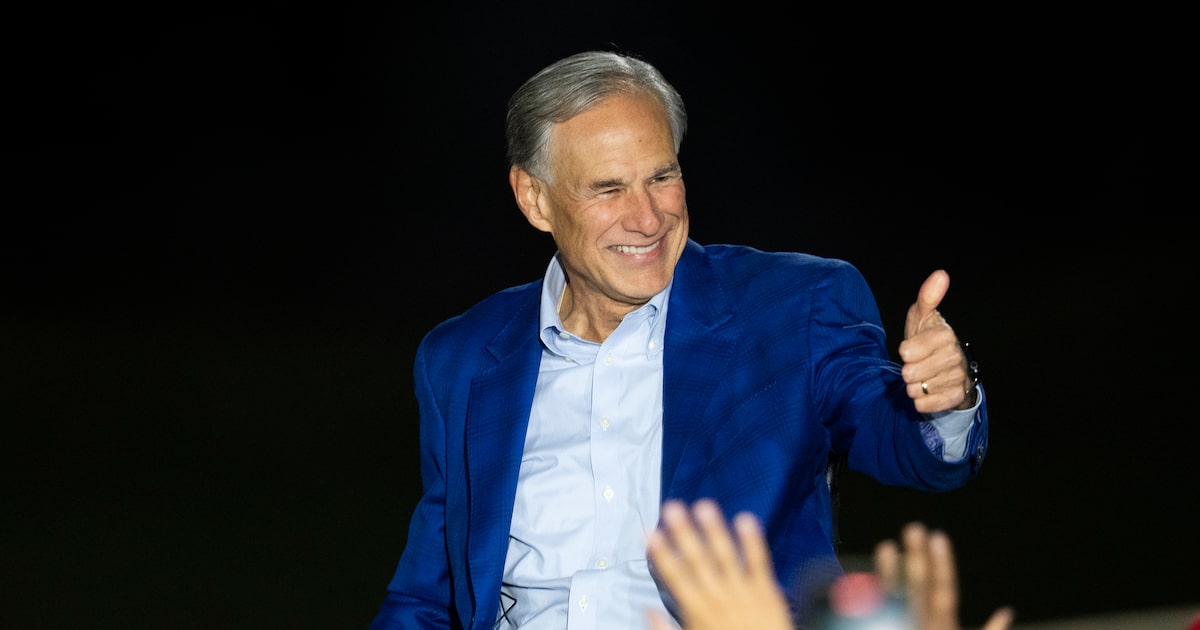
Gov. Greg Abbott has asked North Texas district attorneys and Attorney General Ken Paxton to investigate what Abbott called “Sharia tribunals masquerading as legal courts.”
Related

In a letter sent to the officials on Wednesday, Abbott pointed to the Islamic Tribunal, which launched in Dallas in 2014. He said the group had set up a rival court system to illegally enforce Sharia, moral rules laid out in Muslim scriptures.
“The Constitution’s religious protections provide no authority for religious courts to skirt state and federal laws simply by donning robes and pronouncing positions inconsistent with western civilization,” Abbott’s letter said.
Breaking News
The tribunal’s founder, Taher El-badawi, referred a request for comment to local attorney Khalid Hamideh.
“It is important to remind the Governor that religious courts have been a part of this republic since its founding,” Hamideh said in a statement. “Their existence and operation are fully protected by the First Amendment of the U.S. Constitution.”
The statement said the tribunal’s judges only handle mediation and arbitration in family law disputes, like divorces. A judge’s decision is referred to Texas courts for a final ruling and for enforcement, according to the statement.
Related

Abbott’s letter said religious organizations were permitted under Texas law to “adjudicate ecclesiastical questions” but not to set up separate courts to “evade neutral and generally applicable laws,” as he said the Islamic Tribunal had done.
“Despite suggesting that submission to its jurisdiction is voluntary, the Tribunal commands that all ‘Muslims here in American are obligated to find a way to solve conflicts and disputes according to the principles of Islamic Law’ and it steers them away from ‘[t]he courts of the United States of America [which] are costly and consist of ineffective lawyers,’” according to Abbott’s letter, which quoted from the tribunal’s website.
The Council on American-Islamic Relations, or CAIR, which Abbott declared a foreign terrorist organization this week, released a statement Wednesday calling Abbott’s new directive an attack on religious freedom.
“Greg Abbott appears to understand the law as well as he understands Texas Muslims — not at all,” CAIR’s statement said. “If Abbott is referring to private arbitration that businesses, religious communities, and others sometimes choose to engage in, every American has the right to engage in voluntary arbitration, only official courts can enforce private arbitration decisions, and such decisions must not violate public policy or the law.”
Related

Edward Ahmed Mitchell, CAIR’s national deputy director, said in an interview that people of many faiths use religiously based arbitration as an alternative to filing a lawsuit.
Organizations that offer such a service include The Institute for Christian Conciliation, which says online it resolves disputes in a “biblical manner,” and The Beth Din of America, which describes itself as a rabbinical court “firmly anchored in the principles of halacha (Jewish law)”.
Muslim scriptures, like other religious texts, do at times call for violent punishments for certain offenses. Abbott’s letter highlighted that Muslim scriptures call for stoning as a punishment for adultery.
Mitchell said that U.S. law already prevents a religious organization from ordering any punishment, like stoning, which would violate existing laws. “There are safeguards already in place to make sure that private arbitrators don’t end up engaging or sanctioning conduct that would violate the law,” he said.
Private religious arbitration, he said, is an alternative to civil courts, not criminal courts. Civil courts handle things like divorces, employment contracts and business disputes.