
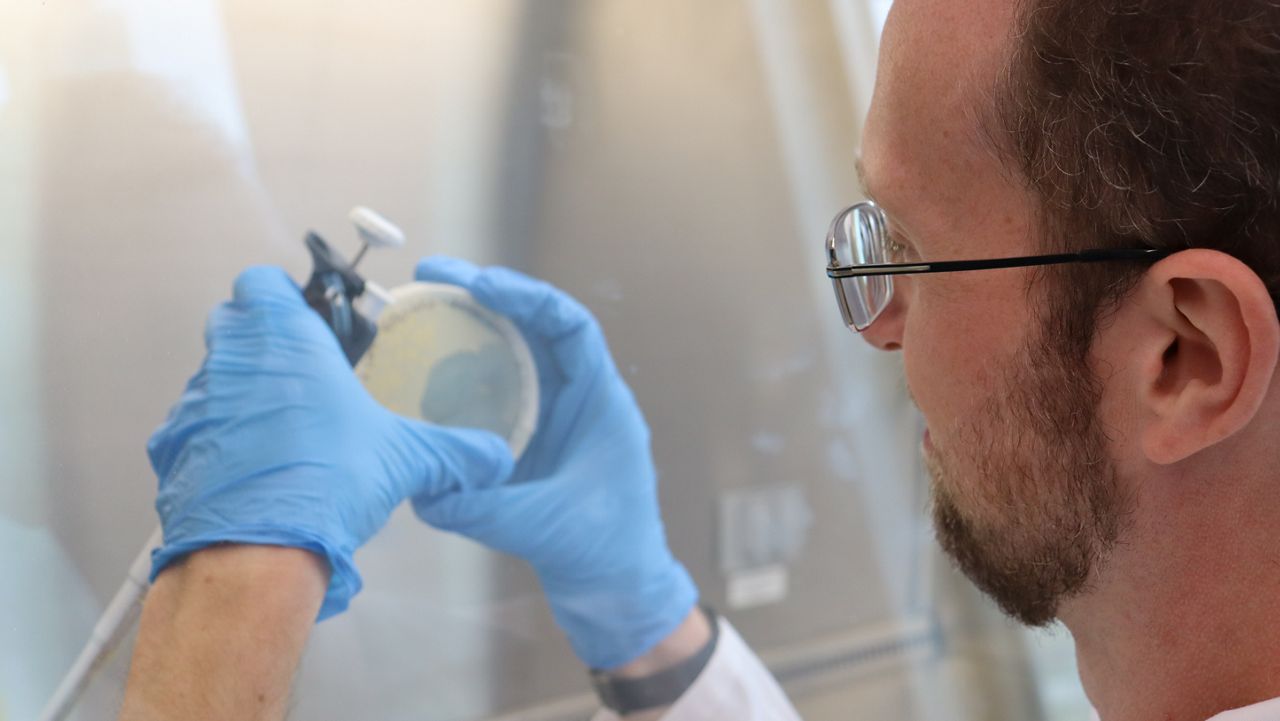
TEXAS — The University of Texas at Austin opened the Discovery to Impact Innovation Labs, a space for startups in life sciences to develop research in tangible technologies.
These startups and their teams do not have to be associated with UT to utilize the facility.
“What we’re trying to build here is a community of life science innovation startups in Austin,” said Mark Arnold, associate vice president of Discovery to Impact.
“We have tenants here already from Austin, across Texas and across the country,” he said.
One such startup, Nucleostream, has been working out of the lab for two months. Chief Technology Officer Max Berry says he enjoys the community the lab is building.
“We are here in Austin, which does not have a huge biotech scene/community compared to Massachusetts or California, but there are quite a few of us, so it’s essential we have some sort of incubator space locally where we can set up to do our work,” Berry said.
The startups working in UT’s Innovation Labs are focused on three main areas.
“Bio[tech], pharma and med-tech devices. So, if you’re within that kind of sphere or category of life science, this could be the perfect home for you,” Arnold said.
In his workspace, Berry and others from his team are focused on lowering the cost and time it takes to write DNA sequences to help others in their project development.
“Advance faster, develop more therapeutics, medicines, discoveries, that kind of thing. That’s our mission,” he said.
Workspaces are provided through a “space utilization agreement,” with pricing varying depending on a startup’s space needs.
Companies that work within the UT Innovation Labs also have access to all the equipment in the facility.
“You have something like an ultra-low temperature freezer that’s like minus 80 Celsius, large centrifuges — being able to share the equipment between labs brings down the capital expenditures for a startup lab,” Berry said.
Access to UT’s wide network of resources is also included in the agreement.
“[You get] the assistance and support of our group, Discovery to Impact, to help the startups to continue to develop with business development,” Arnold said. He also noted that startups get access to research journals, which is a cost-saving measure for people like Berry and other companies in the lab.
“If you bought the subscriptions yourself, you’d be spending hundreds of thousands of dollars,” Berry said.