
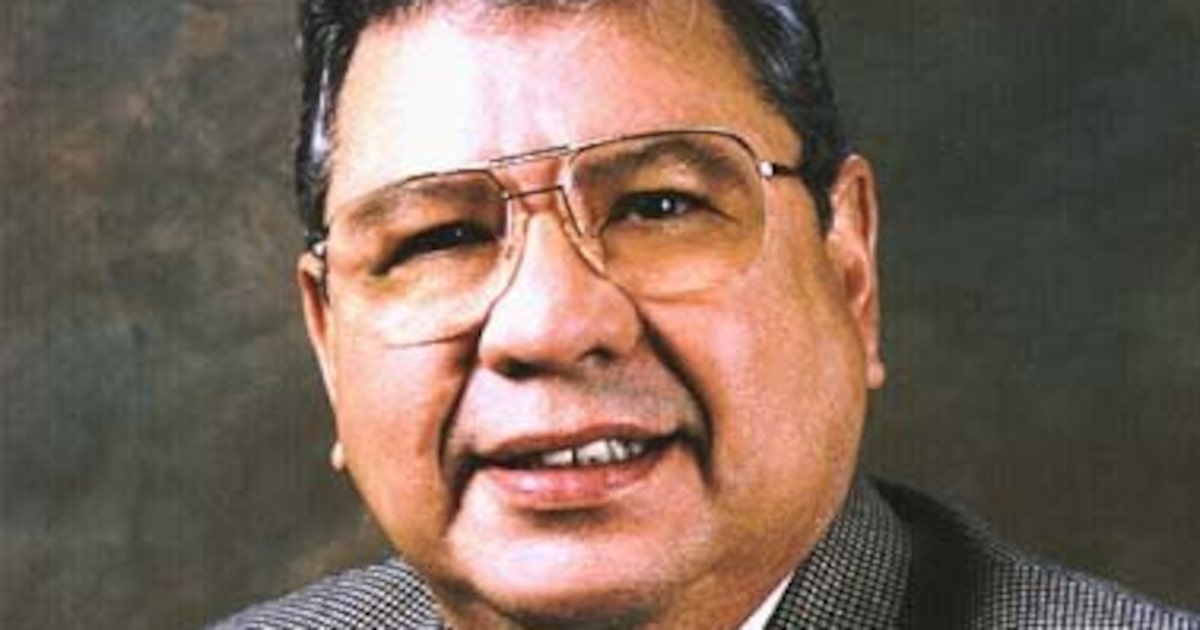
Pedro Aguirre Jr., well-known architect and one of the first Mexican Americans to be elected for Dallas City Council, died at 92.
Aguirre, known to some as Pete, died last month and his funeral was Wednesday at St. Rita Catholic Church, according to his obituary.
The businessman and trailblazer remembered for his kindness and “can do” spirit was a part of the Commission on Mexican-American Affairs, known in the Dallas barrios at the “The Dirty Dozen.” The group of mostly Mexican-American professionals in Dallas worked to remove racial roadblocks and open channels for for Mexican Americans to enter local government.
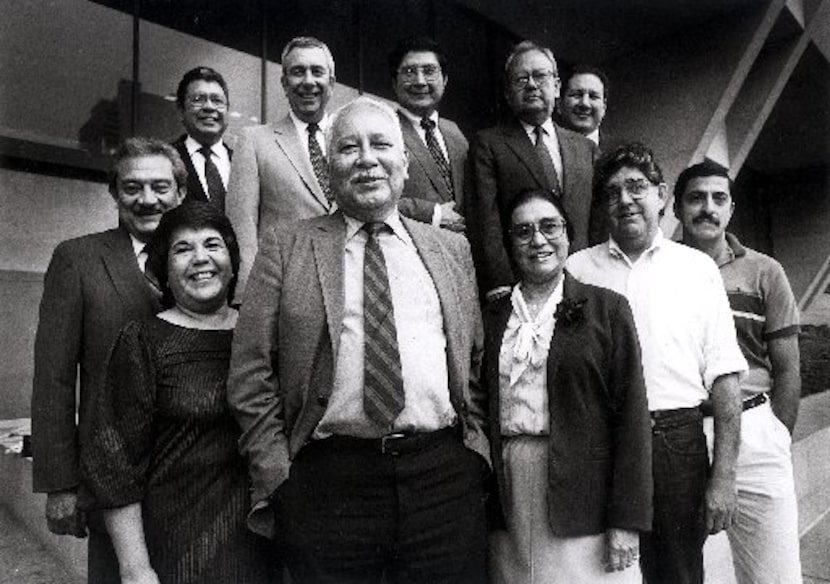
Eleven members of Dallas’ Hispanic “Dirty Dozen” — formally known as the Commission on Mexican-American Affairs, a group that, from the late ‘60s through mid-‘70s, championed the removal of racial roadblocks in Dallas — stand outside City Hall: (back row, from left) Pedro Aguirre, Bill Callejo, Trini Garza, Sam Moreno and Gilbert Hernandez; (front row, from left) Joe Montemayor, Mary Frances Caldwell, Onesimo Hernandez, Adelfa Callejo, Frank Hernandez and Rene Martinez.
DMN Archives
News Roundups
“He opened the door for many people,” said Fernando Andrade, president and CEO of GSR Andrade Architects. “He always offered advice and was a good-hearted guy. He was always there.”
Andrade met Aguirre more than 20 years ago and said Aguirre was a constant mentor and motivator.
“He loved architecture and architecture is a passion,” Andrade said. “It’s not just being good, though, it’s who you know and who do you have connections with. Pedro was successful because he was good but also learned to play the game and how to get there.”
In a 2006 interview with the Dallas Business Journal, Aguirre said he learned the importance of hard work at a young age.
Born and raised at 2812 McKinnon St., Aguirre said when he was 9, his father insisted he work in the cotton and onion fields to understand the significance of getting an education. He also spent hot summer days helping his father install roofs.
Aguirre was 9 when he realized he wanted to be an architect. He told the Business Journal he was working on a roof with his father when a man drove up in a suit and tie to talk to him.
“I asked my dad who he was, and he told me the man was an architect,” Aguirre said. “I knew from then on that I wanted to be an architect; I wanted to be the one standing under the tree in the shade, not on the roof.”
Aguirre went on to earn a bachelor’s degree in architecture from Texas A&M University in 1955 and served as a captain in the U.S. Army before founding his own design and construction business in 1960. The firm grew over the decades with Aguirre at the helm more than 60 years.
Aguirre was 39 when he was elected to Dallas City Council in 1973. He made history as the second Hispanic city councilmember after Anita N. Martinez was elected in 1969.
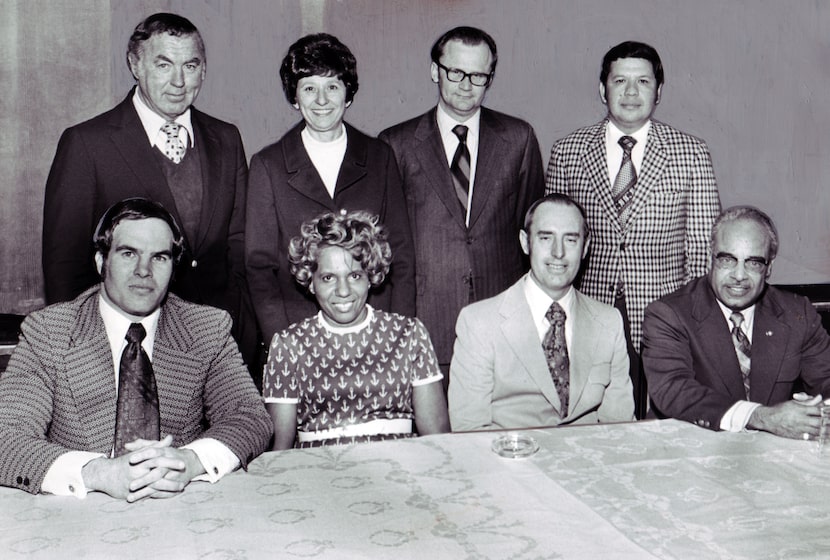
Dallas Morning News article published February 25, 1973. Citizens Charter Association candidates for City Council: (seated) Charles Terrell, Lucy Patterson, L. A. Murr, and George Allen; and (standing) Fred Zeder, Adlene Harrison, Russell Smith and Pedro Aguirre. Dallas News Staff Photo by Jack Beers.
Jack Beers
“Involvement in his community was a way of life for Pedro,” his obituary reads. “He was a leader in the Dallas Hispanic arena during a time when it took courage to step forward and be outspoken.”
Years after his tenure on city council, Aguirre remained active in the civic realm.
A 1986 article from D Magazine titled “The Forgotten Minority” reported about “an emerging cadre of Hispanic activists” with plans to increase Mexican American’s influence in city affairs. Aguirre was among the leaders.
“[Aguirre] heads a successful architectural firm that bears his name and also manages banking interests and other business endeavors. Throughout the Metroplex, doors of corporate power open to him. By any measure, Aguirre is well fixed,” the article reads. “Because he has made it, and because he is one of the three Hispanics who have served on the city council here, white leaders trot out his name often.”
Aguirre didn’t agree with the hopeful rhetoric, though, saying he was a part of an earlier era in Dallas.
The group wanted a more concerted action to boost Hispanics into public office.
“Even Old Guard stalwarts like Aguirre, who soft-pedal ethnic differences and eschew confrontation, are fed up with the absence of representation,” the article said.
In his role as president and CEO of Aguirre Roden, Aguirre also influenced many major projects in the region.
In 2012, Aguirre spoke to The Dallas Morning News about one of his firm’s latest projects redeveloping 1025 Elm, once one of the grandest commercial buildings in Dallas’ old financial district.
“You have to have faith in your imagination,” he said. “It takes a little ingenuity and someone willing to take a risk.”
Throughout his life, Aguirre remained active in the community in a multitude of other ways.
His extensive amount of accolades include being honored as a fellow by the American Institute of Architects, being appointed as a Fulbright Scholar by President Ronald Reagan and by Gov. Ann Richards as chairman of the Texas Board of Architectural Examiners.
Aguirre served on the board of directors for numerous organizations, including DFW International Airport, Dallas Chamber, Dallas Together Forum, Dallas Citizen’s Council and Dallas Community College, and served as president of the National Bankers Association.
This reporting is part of the Future of North Texas, a community-funded journalism initiative supported by the Commit Partnership, Communities Foundation of Texas, The Dallas Foundation, the Dallas Mavericks, the Dallas Regional Chamber, Deedie Rose, Lisa and Charles Siegel, the McCune-Losinger Family Fund, The Meadows Foundation, the Perot Foundation, the United Way of Metropolitan Dallas and the University of Texas at Dallas. The News retains full editorial control of this coverage.