
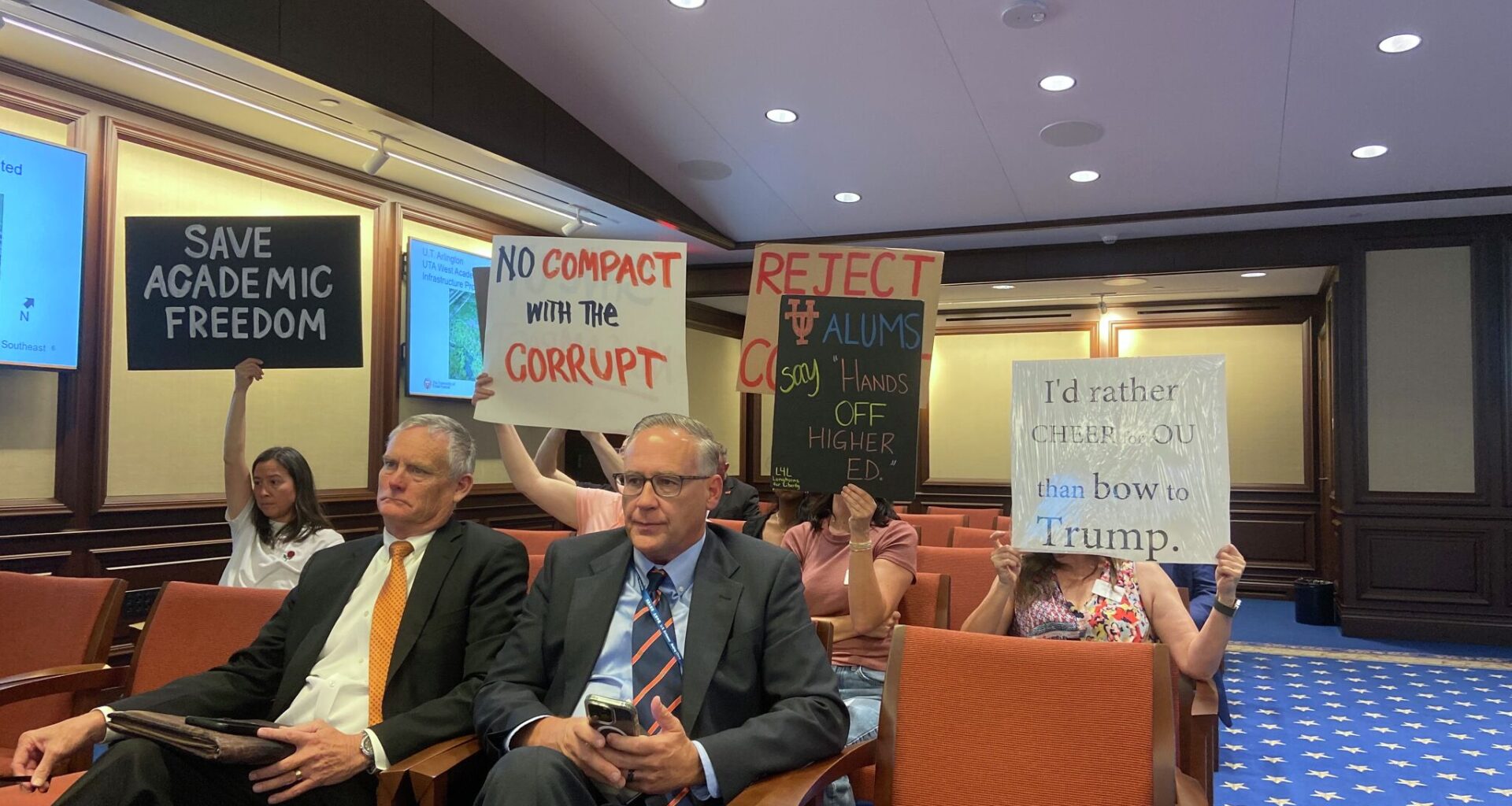
Silent protesters urge University of Texas System Board of Regents to reject the compact offer the President Donald Trump Administration sent the system’s flagship school at the Nov. 19 board meeting.
Lily Kepner/Austin American-Statesman
The University of Texas System Board of Regents — a board comprised of governor appointees — will now have “ultimate” power over its universities’ hiring, curriculum and degree offerings, in compliance with a new state law. Previously these decisions were made by institution presidents and often crafted with input from faculty.

The board’s approval of new policies comes as Texas students urge the system to reject conservative-backed reforms — such as Texas A&M University’s recent ban on classes that advocate for race or gender ideology — and as the university remains silent on a looming offer from President Donald Trump.
Article continues below this ad
The changes approved this week align system policy with Senate Bill 37, the higher education reform bill passed in the last legislative session that gives regents explicit control over key academic choices while restricting faculty’s role in shared governance. It further codifies the regents’ authority over policy implementation and financial stewardship.
Institution presidents “must make decisions in a manner that promotes efficiency, accountability, and responsiveness to state priorities, workforce needs, and the institution’s institutional mission” and annually review senior leaders who oversee curriculum or student affairs, including deans and the provost, under the policy changes.
SB 37, which will be in full effect Jan. 1, was meant to check faculty authority amid conservative concerns that liberal faculty had too much power over hiring and curriculum. But student critics worried that weakening faculty governance could hurt university decisions, weaken transparency and hurt faculty and student morale.
DEEPER DIVE: As UT pivots from Faculty Senate, members mourn forum that guaranteed their input
Article continues below this ad
This fall, UT has seen significant turnover — the senior provost leader was dismissed over “ideological differences,” a college of education dean who expressed interest in staying was non-renewed and the Dean of Students was removed suddenly in late October. University officials declined to comment on each case, citing individual personnel matters.
“I know the university likes to tout that they would like to have an open dialogue with students and faculty, however, this is obviously a very flagrant representation of how the university does not care to hear from us,” Kayla Reballosa, a UT student with Students for a Democratic Society, said in response to the system’s elimination of faculty councils across its institutions.
REWIND: ‘Inflection point’: leadership shakeups over ideological differences continue at UT
In response, Chairman Kevin Eltife said the system has a student, faculty and staff council and values student voices.
Article continues below this ad
In line with SB 37, Davis appointed William Inboden as sole provost without a faculty search committee, and the university system already cut all faculty senates. UT Austin President Jim Davis announced two new faculty bodies with appointed members this semester, but Reballosa said not having elected members is not “democratic.”
Trump’s offer to UT
Texas’ flagship university still faces a pending offer from the administration of President Donald Trump to implement conservative priorities in exchange for exclusive federal benefits.
MORE: UT Austin refuses to say if it will make a deal with Trump to get more funding
Article continues below this ad
The Trump Administration’s “Compact of Higher Education Excellence” lists a number of demands — from freezing tuition to only teaching the existence of two genders and outlawing departments that “belittle” conservative voices.
UT has already met many of its priorities due to state legislation and priorities, including a limiting the enrollment of international students at 15%, a ban on diversity, equity and inclusion programs or hiring practices and a commitment to civil discourse and free speech.
DEEPER DIVE: As UT, Texas face political pressure, experts warn: We’ve seen this before
Several students urged regents to ensure the flagship school rejects the compact and stops the potential consolidation of ethnic studies departments in the College of Liberal Arts after news broke that a committee to consider department reorganization had formed.
Article continues below this ad
“You can count on students to stand up, to protect our academic freedom and freedom for speech on campus, which is so fundamental to the university system,” Devon May, another student with Students for a Democratic Society, said. “It is for the same reasons that UT Austin must reject the compact for academic excellence in higher education.”
UT System Chairman Kevin Eltife said in October he is “honored” to receive the compact, but UT was the only flagship to not publicly comment on whether it would accept the offer. He did not comment on the compact at the annual meeting, despite the deadline to accept or reject it being Friday.
Seven out of nine universities extended the offer refused the compact outright, saying they believe research funding should be based on merit alone. Vanderbilt University said it is open to discussion but will not accept it in its current form.
The three students who testified at the UT Regents meeting Wednesday said they feel unheard and don’t believe university leaders are listening to students — nor have the same obligation to listen now that faculty’s shared governance is weakened under SB 37. Faculty council meetings were public, and featured a Q&A with leaders and elected leaders.
Article continues below this ad
The UT chapter of Austin Students for a Democratic Society have held multiple protests against the compact and feared consolidation of ethnic studies departments, demanding the university protect the studies of different ethnicities and cultures, refuse the compact and commit to transparency in decisions.
“I would like to make it clear that we have a lack of dialogue right now between students, faculty and administration at our university,” Reballosa added. “It’s really important that the administration listens to students and takes their thoughts into account. And right now, I don’t feel that that is the case.”