
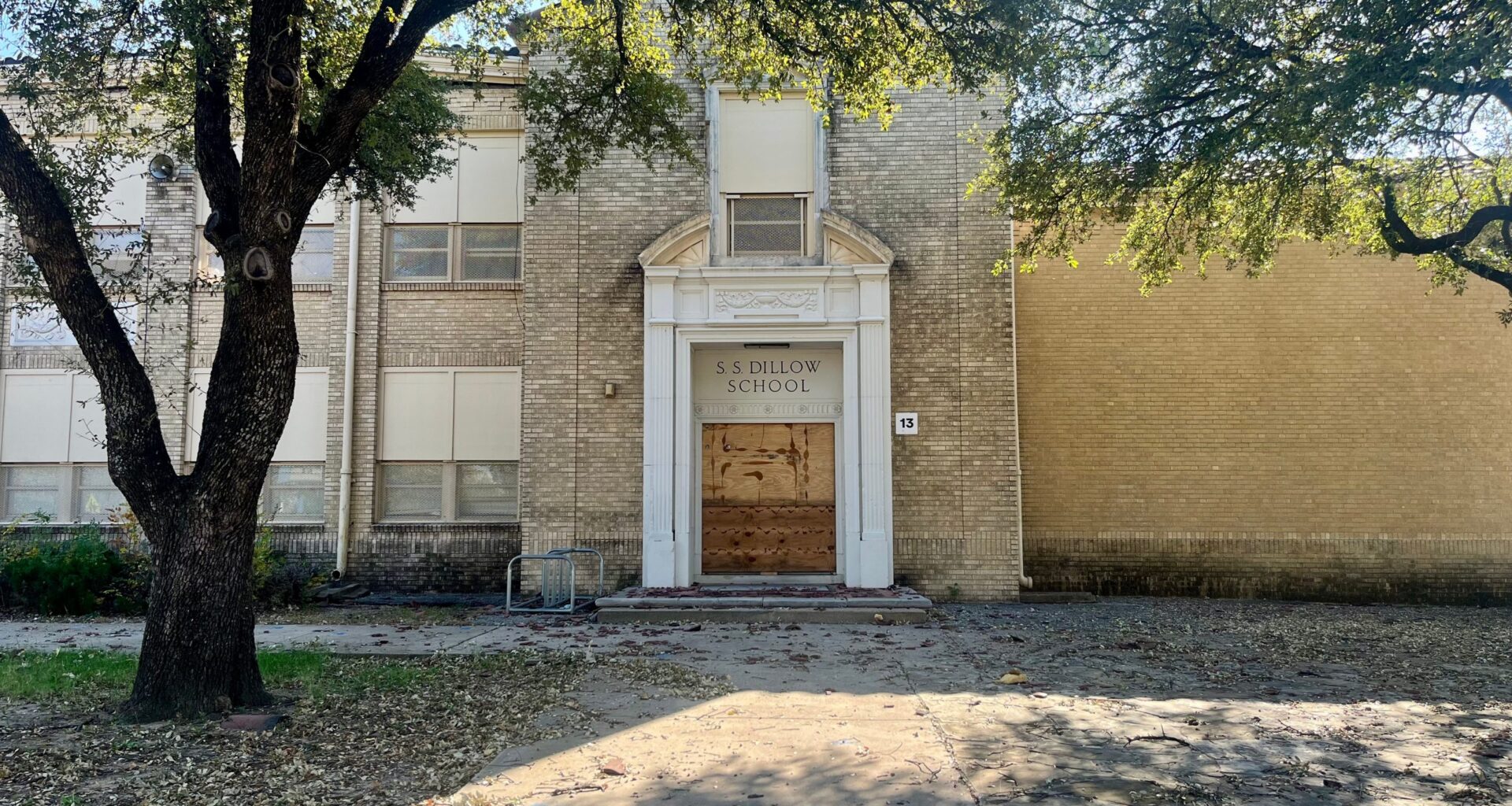
Rising Star Baptist Church sits just a block from the former S.S. Dillow Elementary campus, close enough that members could watch the 87-year-old school catch fire in September.
Soon, the church will watch as the FWISD school is demolished and a new city park pops up.
The school district and the city are transforming the 6.7 acres in southeast Fort Worth, where municipal officials say parkland is scarce, as part of a new 10-year partnership to create more parks and green spaces across Fort Worth. Together, they are also opening select schoolyards to the community after school hours.
Pastor Ralph Emerson said his congregation wrestles with both sides of the change: the loss of Dillow Elementary and the potential benefits of a park.
“A park in some sense can be good, right, if we create a safe space,” he said. “How do we make sure it’s an actual safe space, development space for kids and families?”
Though many campuses are already open informally outside of school hours, the agreement “transforms schoolyards into after-hours neighborhood parks,” city and district officials said in a joint statement. The change is among the first steps toward carrying out the city’s long-range parks and open space plan, officials said.
“I believe wholeheartedly that every Fort Worth resident should have easy access to a park or open space,” Mayor Mattie Parker said in a news release. “This partnership with FWISD builds on our Good Natured initiative to continue to grow green space opportunities to better serve the community.”
Superintendent Karen Molinar said the agreement builds on the role schools already play in their neighborhoods.
“Fort Worth ISD schools are at the heart of Fort Worth neighborhoods,” Molinar said. “We are thrilled to partner with the city of Fort Worth to open our schoolyards after hours, offering welcoming and safe spaces that support healthy communities.”
The agreement does not limit the district’s ability to sell or repurpose campuses slated for closure, city officials said.
Emerson said the demolition vote that followed feels “layered.”
“It has historical representation,” Emerson said. “What do you do with those families being displaced? What does that do for classroom size? What is this saying in regards to Fort Worth ISD’s ability to educate our kids?”
A formal framework for schoolyards as parks
FWISD will designate outdoor recreation areas — such as playgrounds, fields and tracks — on specific campuses for community use outside of school hours. A list of participating schools is posted on the city’s website.
Traditional high school campuses and athletic stadiums are excluded to avoid conflicts with games and events, according to board documents. The initial list focuses on elementary and middle school sites within city limits.
The agreement gives the city a clearer role in access and improvements. Both organizations will collaborate on maintenance, security and future upgrades, such as gates, sidewalks and signage that make it easier for neighbors to use schoolyards as parks.
“When we asked residents what they wanted most … the No. 1 answer was more access to safe, nearby parks and open spaces,” Dave Lewis, director of the Fort Worth Park & Recreation Department, said in a statement.
The district will maintain the schoolyards, but the city will monitor how weekend use affects trash and upkeep, Joel McElhany, assistant park and recreation director, said. After six months, district and city staff will review conditions and decide where the city should step in with additional maintenance or small upgrades.
“We want to do this trial run,” McElhany said. “If there’s some of those schools that they feel need additional maintenance from the city, then we can discuss that.”
Just as important, he said, the agreement allows the city to publicly promote schoolyards as part of its park network, so residents searching for the closest park can see nearby campuses that are open after hours.
The Trust for Public Land’s latest ParkScore index ranked Fort Worth as 72nd in park access among the 100 most populous U.S. cities, with 69% of residents living within a 10-minute walk of a park — up from 61% in 2022, when the city ranked 87th.
What happens to Dillow?
McElhany said the district will remove the building but preserve some existing outdoor features neighbors already use.
“We met with them out on-site and identified some of the school facilities we’d like to keep, like the basketball courts and the playgrounds,” he said. “After demolition of the building … with those existing facilities (it) can function as a park.”
In April, trustees voted to close Dillow at the end of the 2024-25 school year over structural concerns as part of a plan to close 18 schools through 2029. A September fire further damaged the vacant facility. Trustees approved more than $1 million for asbestos abatement and demolition Oct. 28.
Park’s staff plan to hold a neighborhood meeting to hear what residents want in a park at the site, then seek funding and council approval for larger improvements.
“We want to work with the neighborhood to identify some park improvements, and we want to find some funding and get it done,” McElhany said. “It will be a high priority for us.”
The Dillow property will be leased to the city. However, the district-owned land could revert to a school if enrollment trends ever warrant reopening a school in the area, according to FWISD documents.
McElhany said the term will depend on how much capital funding the city invests, but staff expect a long-term agreement. Leases tied to major park projects are often for 20 to 30 years, he said.
As for the after-hours schoolyards, the agreement does not prevent FWISD from selling or repurposing a campus on the list, McElhany said.
If the district closes a school and wants to move forward with selling the land, both agencies would amend the agreement to remove that site. City officials have asked FWISD for the first right of refusal to evaluate whether the property should become parkland.
District leaders have told the city they want to keep their closed properties for potential future school use, McElhany said.
Earlier this year, Historic Fort Worth placed Dillow on its 2025 Most Endangered Places list, citing the school’s 1937 design and role as a neighborhood landmark.
In an email to the Report, John Roberts with Historic Fort Worth said he appreciates that the campus will remain a public space but questioned whether demolition of the building was the best outcome.
“Although I think it is great that the FWISD is trying to open up the campus into a more public use, I don’t see this as the most positive example of adaptive re-use,” Roberts wrote. “It would have been nice to repurpose the actual building.”
Before the fire, he added, demolition “definitely would have been a missed opportunity for historic preservation.” After the damage, he said, it is harder to assess what might have been possible.
For Emerson, the core question stretches beyond a single site.
“I just know, when I look at the city and community as a whole, I think all people deserve equal opportunity for excellent education, obviously, and healthy living,” he said. “They should have access to proper facilities for life advancement … equal opportunity and access to a healthy, responsible, equitable life.”
Participating schools
Metro Opportunity HS
Jo Kelly School
Daggett, E.M. MS
Elder, J.P. MS
Forest Oak MS – LA
William James MS
Kirkpatrick MS
McLean, W.P. MS
Meacham, W.A. MS
Meadowbrook MS
William Monnig MS
Morningside MS
Applied Learning Academy
Riverside MS
Rosemont MS
Stripling, W.C. MS
Jacquet, J. Martin MS
Wedgwood MS
Leonard MS – LA
International Newcomer Academy
McLean 6th Grade
Jean McClung MS
World Languages Institute
VPA/STEM I.M. Terrell HS
Alice Carlson ES
Boulevard Heights
West Handley ES
Burton Hill ES
Carroll Peak ES
Lily B. Clayton ES
Hazel Harvey Peace ES
Daggett, E.M. ES
Rufino Mendoza ES
De Zavala ES
Maude I. Logan ES – LA
East Handley ES
Christene C. Moss ES
John T. White ES – LA
W.M. Green ES
Hubbard Heights ES
H.V. Helbing ES
Milton L. Kirkpatrick ES
Meadowbrook ES
Mitchell Blvd ES – LA
M.H. Moore ES
Morningside ES
Charles E. Nash ES
North Hi Mount ES
Natha Howell ES
A.M. Pate ES
Mary Louise Phillips ES
Ridglea Hills ES
Maudrie M. Walton ES
Bruce Shulkey ES
South Hills ES
Springdale ES
Sunrise-McMillan ES
Tanglewood ES
W.J. Turner ES
Washington Heights ES
Westcreek ES
Worth Heights ES
J.T. Stevens ES
Atwood McDonald ES
Riverside ALC
Daggett Montessori
Bill J. Elliott ES
Edward J. Briscoe ES
Woodway ES
Lowery Road ES
Alice D. Contreras ES
Cesar Chavez ES
MG Ellis Building
Bonnie Brae ES
Dolores Huerta ES
Overton Park ES
Rolling Hills ES
Matthew Sgroi is an education reporter for the Fort Worth Report. Contact him at matthew.sgroi@fortworthreport.org or @matthewsgroi1.
At the Fort Worth Report, news decisions are made independently of our board members and financial supporters. Read more about our editorial independence policy here.
Related
Fort Worth Report is certified by the Journalism Trust Initiative for adhering to standards for ethical journalism.
Republish This Story

Republishing is free for noncommercial entities. Commercial entities are prohibited without a licensing agreement. Contact us for details.