
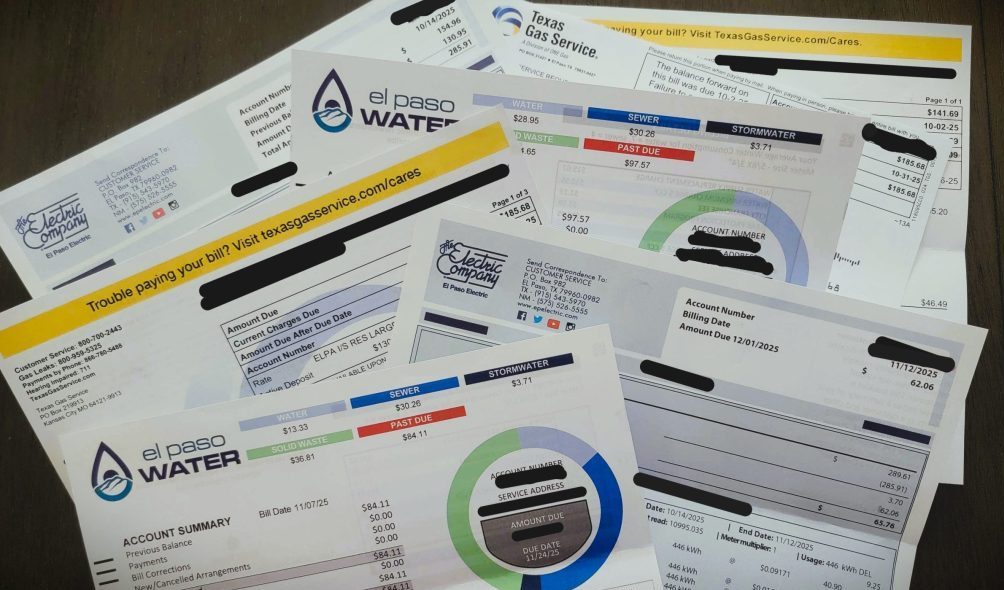
Monthly utility bills for the average El Paso household could go up by about $45 a month – or 18% – in early 2026 as the electric, gas and water utilities that serve the city are seeking rate increases.
That’s about $540 a year more over this year amid a broader slowdown in the U.S. economy. Utility bills are outpacing wages in El Paso, which increased about 8% on average over the last year, according to the U.S. Bureau of Labor Statistics.
“The cost of living is eating away at our American dream,” said Felipe Acuña, 68, a retired railroad worker who lives in the Lower Valley. “It feels like these utility companies are trying to squeeze every drop, like from a sponge … until nothing drops. And then, squeeze again.”
El Paso Water bill increase
El Paso Water on Thursday requested a rate increase from the seven-member Public Service Board that would increase average household bills to $92.07 next year – up from $82.08 on average currently.
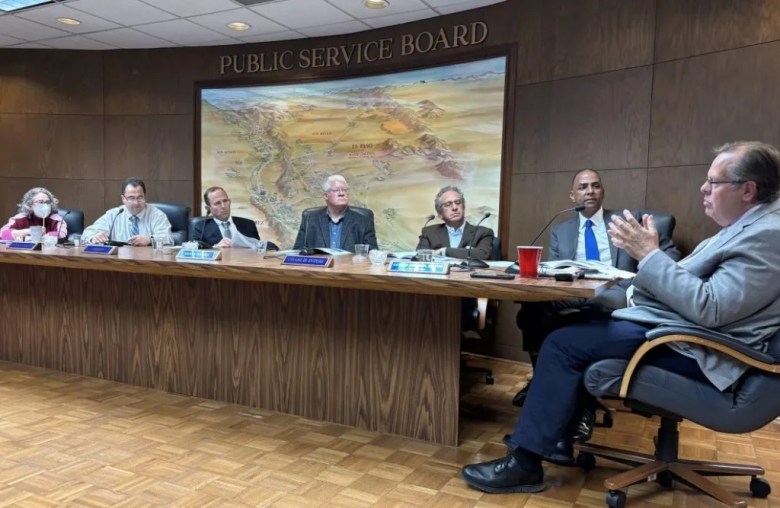 El Paso Water CEO John Balliew, right, speaks about the utility’s proposed rate increase with members of the Public Service Board, which governs El Paso Water. (Diego Mendoza-Moyers / El Paso Matters)
The PSB, which governs El Paso Water, will take a final vote on the utility’s budget and proposed rate increase Jan. 14, although the board in recent years has typically approved the utility’s budget requests with few, if any, modifications.
El Paso Water requested a $1.2 billion budget for the upcoming year. The city-owned utility is in the midst of a multi-year, multi-billion dollar plan, including spending a record $770 million on capital projects in the coming year. Most of that is driven by the ongoing rehabilitation and expansion of the Bustamante Wastewater Treatment Plant in the Lower Valley that’s estimated to cost $1.2 billion.
LISTEN: Podcast: We talk about El Paso’s water future with a top executive from city’s water utility
Other big-ticket items for El Paso Water include the $300 million Pure Water Center that broke ground earlier this year. The plant will treat wastewater from the nearby Bustamante facility to drinkable standards and re-insert as much as 10 million gallons per day back into the city’s water supply.
El Paso Water is entering the last phase of its expansion of the Kay Bailey Hutchison Desalination Plant, in which the utility is increasing production capacity to 33.5 million gallons daily from 27 million currently.
Over the next five years, the utility plans to spend $3.3 billion on capital projects.
If the PSB approves the budget as is, the average bill would include a $45 sewer charge, $39.66 for water, plus the $7.42 stormwater fee to fund flood prevention projects. That doesn’t include other city charges that are tacked onto water bills, including a franchise fee of $6, a charge for a gray curbside trash bin of $21.50 and an environmental fee of $6.50 plus sales tax.
When the city of El Paso this fall adopted its budget for the current fiscal year, it increased the trash bin fee by 50 cents and raised the environmental fee by $1.50. The city previously raised the trash bin fee from $19 to $21 just over a year ago.
El Paso Water is not increasing the $7.42 stormwater fee for most residential customers, although the utility is seeking to reduce the fee on small homes and increasing the monthly fee on large homes.
Homes that are 900 square feet or smaller will see the stormwater fee cut to $3 per month. And the utility is requesting to increase the stormwater charge on homes over 4,000 square feet to $18.55 per month, a nearly $4-per-month increase.
John Balliew, El Paso Water’s chief executive, said some of the utility’s flood prevention projects – such as the huge Will Ruth Pond that’s under construction near Dyer and Will Ruth avenues – have temporarily stalled for various reasons, such as issues with easements and construction methods at some projects. So, the stormwater unit doesn’t anticipate spending as much as previously expected.
“We have a lot of things that are going on,” Balliew said. “The issue is protecting the people on the bottom end of the (income) spectrum.”
El Paso Electric rate increase
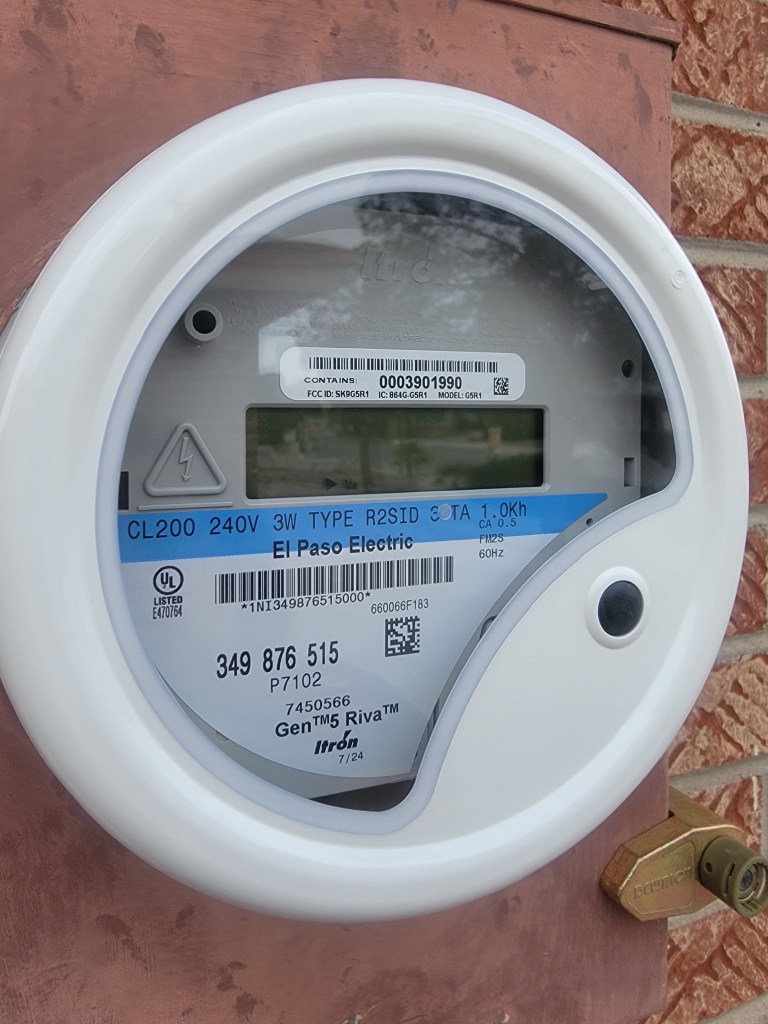 El Paso Electric last year began replacing its meters with “smart meters” such as this one. The smart meters track energy use in real time and sends the data directly to the utility through a secure communication network. Installations will continue through 2025. (Cindy Ramirez / El Paso Matters)
The Public Utility Commission of Texas is expected to issue a decision on El Paso Electric’s rate increase Dec. 9, and new rates may take effect sometime in early 2026.
The rate increase El Paso Electric proposed in January would increase average electric bills to about $118 monthly compared with average bills of $96 currently, although bills fluctuate significantly throughout the year.
El Paso Electric said it needs to collect an additional $85 million from customers annually to pay off $1.55 billion in capital investments it’s made since its last rate hike in 2021 – in addition to its requested profit margin. The utility’s capital investments include its $217 million Newman 6 natural gas power plant in Northeast El Paso, $560 million in improvements to its distribution system, and $180 million in enhancements to its transmission system.
Texas Gas Service rate increase
Texas Gas Service over the summer requested a rate increase from the Railroad Commission, which is the state’s oil and gas industry regulator.
The gas utility said it needs to collect $41 million more annually from its roughly 700,000 customers spread across different parts of Texas. The request would translate into an average bill increase in El Paso of $10 to $15 per month, depending on the customers’ usage.
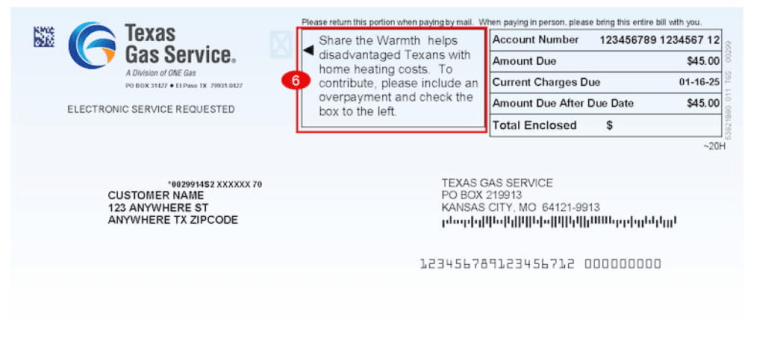 A sample residential customer bill from Texas Gas Service
While bills will increase in El Paso if the rate request is approved, rates would decline for residential customers in the Rio Grande Valley as well as in other parts of Texas. That’s because Texas Gas Service is seeking to consolidate its three noncontiguous service areas across the state, including El Paso, segments of the Panhandle and North Texas, a region near Austin and the Rio Grande Valley.
Texas Gas Service said it needs to bring in more cash to cover higher operational costs resulting from economywide inflation, as well as to cover the utility’s debt-related interest expenses and to provide a return in the form of dividends to stockholders.
The utility’s executives have also said consolidating service areas will help to “spread risks.” If a natural disaster strikes one part of the state and destroys gas infrastructure, the cost of repairs would be spread among all of the utility’s customers statewide, instead of just among ratepayers in a lone service area.
“Consolidation is not new. It’s just difficult to talk about,” said Stacey McTaggart, director of rates and regulatory affairs for Texas Gas Service. “But we’ve proven, time and time again, that the impacts, if there are some, they are minimal. And it benefits the customer base and the system overall.”
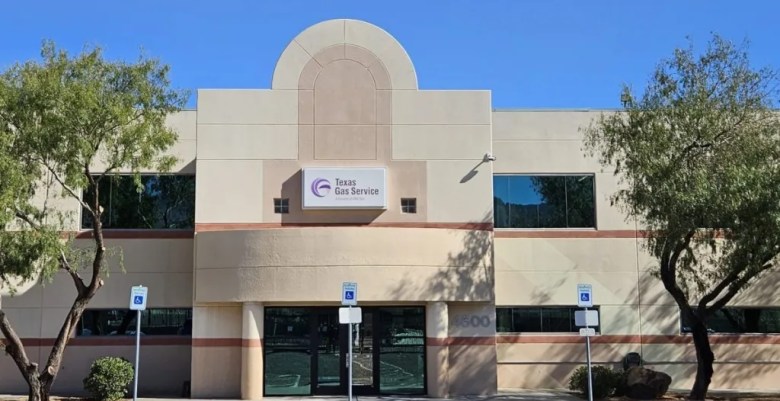 Texas Gas Service offices in Northeast El Paso (Daniel Perez / El Paso Matters)
The Railroad Commission is expected to issue a decision on the gas rate hike in late January. RRC staffers, who issue opinions to the commissioners, support the utility’s service area consolidation and recommend approval – a signal the RRC may be likely to OK merging the service areas.
Texas Gas Service is a subsidiary of Tulsa, Oklahoma-based ONE Gas, a publicly traded gas utility valued at $5 billion that also serves customers in Kansas and Oklahoma. Over the first nine months of this year, ONE Gas paid out $120 million in dividends to shareholders.
Profit margin in gas, electric rate increases
Among the most contentious issues in the rate cases filed by El Paso Electric and Texas Gas Service are the increased profit margins both utilities are requesting.
Monopoly utilities can’t set their own prices, so regulators approve the amount of money a utility can charge customers and also authorize an allowed shareholder profit margin.
Since Texas Gas Service last raised rates in El Paso nearly three years ago, it has been authorized to earn a 9.6% shareholder profit margin in its El Paso service area. The utility is now requesting a 10.4% profit margin for shareholders.
“Our rates have to include some money for interest to pay the bondholders. And then, stockholders expect dividends, and they expect price appreciation in the stock,” McTaggart said. “Our prices need to include some money to cover that expectation for the stockholders.”
Since its last rate case in 2021, El Paso Electric has been authorized to earn a 9.35% shareholder profit. But the utility now is requesting a 10.7% return on equity, or shareholder return.
Rate cases are part quasi-legal proceedings and part negotiations. Executives with both El Paso Electric and Texas Gas Service have acknowledged they’re unlikely to win approval of their increased profit margins. Still, it’s possible regulators will approve profit margins higher than they are now.
“They’re asking for profits that are higher than the norm,” said Alex Mayer, a professor of civil engineering at the University of Texas at El Paso who has studied utility affordability challenges. “The shareholders should be absorbing some of these issues.”
El Paso Water, meanwhile, is nonprofit and city-owned. So, the utility charges customers what it costs to provide them water and sewer service without a profit margin included.
Affordability crisis looming?
The general threshold to gauge if utilities are affordable is whether bills for water, electricity and gas exceed 10.5% of the household’s income, said Josiah Heyman, a professor of anthropology at the University of Texas at El Paso who has co-authored papers with Mayer on utility costs in the borderland.
 Josiah Heyman, a professor of anthropology at the University of Texas El Paso, speaks to reporters about the impact of El Paso Electric’s proposed rate increase on low-income residents in the city. (Diego Mendoza-Moyers / El Paso Matters)
The median annual household income in El Paso is just shy of $60,000, according to the U.S. Census Bureau. So, for households at that income level, even if all three rate increases are approved as is, about 6% of the household’s income would go toward paying utility bills.
However, the higher bills for lower-income households in El Paso could push them further over the affordability threshold and strain budgets.
“All three (rate increases) hitting at the same time is a problem,” Heyman said.
One out of every five households in El Paso earns less than $24,000 annually, according to the Census Bureau. So, 20% of the city’s residents will see utility bills eat up anywhere from 15% to 30% of their income – which means relatively little income leftover to pay for housing and other necessities.
“When you average things out, you really erase some of the people that are struggling the most,” said Veronica Carbajal, an attorney who heads the Sembrando Esperanza Coalition that represents neighborhoods mostly in South-Central El Paso.
“People will find a way to pay for the water and the electricity, but at what cost?” she said. “If it means that they’re using the bare minimum, or they’re exposing themselves to extreme weather, that they’re taking on risky behavior like using a propane gas tank inside without proper installation, that’s what we need to really be looking into.”
“The averages make that suffering invisible,” Carbajal said.
Balliew said about 3,000 of El Paso Water’s residential ratepayers are past-due on their water bills, or roughly 1.5% of the utility’s 203,000 household customers.
“That bill comes in, and then what the heck do you do?” Mayer said. “Can you rely on your family members within the household? Do you have to reach out further and further into the family and friends?”
As part of its rate case, Texas Gas Service requested approval of an affordability program in which customers eligible for federal benefits such as SNAP can apply for a 25% discount on their gas bills. However, the program would be open only to 30,000 customers – out of the utility’s 700,000 customers statewide. Railroad Commission staffers have recommended RRC commissioners not approve that program.
El Paso Water is seeking to tweak its rates so that households that use little water get a break on their water bill. Customers that use 4 CCFs (one CCF equals about 748 gallons) or less would experience a $1.39 per month rate increase, while customers that use just one CCF per month would see a small bill decrease next year.
That’s El Paso Water’s way of trying to limit bill increases on lower-income households in El Paso. In the last state legislative session, the utility sought to get a bill passed that would have allowed El Paso Water to bill customers differently based on income – a method of billing that’s currently illegal.
El Paso Water over the next five years plans to invest $3.3 billion into the city’s water, sewer and flood control systems, so annual rate increases will likely continue in the coming years.
And with longer-term plans for other costly projects such as piping in water from Dell City, Balliew said the utility must be able to bill based on household income to some extent. That’s how the utility could avoid charging water bills that are unaffordable in El Paso on a big scale, especially for seniors and residents living on a fixed income.
“That’s the reason why we have tried for that sort of income-based affordability bill,” Balliew said. “And at some point in time, we have to have that. We can’t do without it.”
Related
LISTEN: EL PASO MATTERS PODCAST