
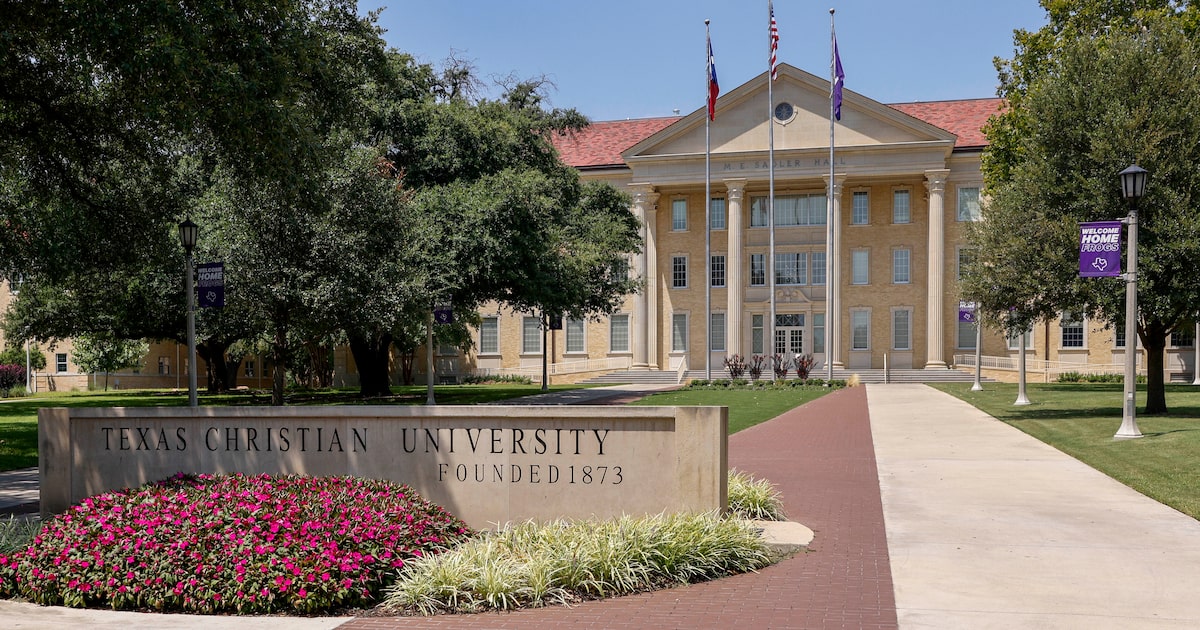
Texas Christian University will close departments for comparative race and ethnic studies and women and gender studies next year, consolidating the programs into the English department.
University officials cited financial reasons and low numbers of students majoring in the programs. Students will be able to continue taking classes and graduating with degrees in the two fields under the consolidation.
Some professors see the decision as an effort by university officials to align the private school, which is not subject to state oversight, with state and federal Republican leaders’ priorities for higher education.
“It feels like a lot of what is happening is to potentially stay in the good graces of this political moment,” said Brandon Manning, an associate English professor and affiliate faculty in the two impacted departments.
The Education Lab
University officials say the change was driven by academic demand. The changes go into effect June 1, 2026.
Over the past year, state officials have pressured public universities to limit how gender and race content can be taught and mandated low-enrollment programs be reviewed for consolidation. In their bid to remake higher education, Republican lawmakers have said they want to roll back liberal bias on campuses and equip students with more “degrees of value.”
Related

Manning said one of his students, who is Black, told him the decision “feels like TCU doesn’t care about its Black students anymore.”
“While the classes are there, the sense of erasure feels ever present,” he said. “Not having a department and an intellectual home, it doesn’t allow students to both physically congregate, be in a particular space and see in really accessible ways what is being offered. Now it will be extremely obscure.”
University officials say the closure of the programs is necessary to “fulfill our obligation to ensure institutional fiscal sustainability, and to ensure a more efficient and effective use of faculty and administrative resources,” according to an October email from Provost Floyd Wormley Jr. to faculty.
Enrollment numbers in the two departments have trailed behind some other fields. The comparative race and ethnic studies department, which was created in 2017 as part of an effort to draw in more students of color, has nine students majoring in the program this fall, according to institutional enrollment data. The women and gender studies program, which began as a program in 1994 and became a standalone department in 2018, has two.
Since its founding, the women and gender studies department has moved across colleges and struggled to “find an administrative niche” at TCU due to its interdisciplinary nature, said Rebecca Sharpless, a history professor and chair of TCU’s faculty senate.
TCU spokesperson Greg Staley said the university began reviewing its academic programs more than two years ago, with an eye toward class sizes, course demand and program enrollment. The school is also combining its Spanish and modern languages departments and geology and environmental sciences departments.
“TCU is growing and will need more faculty and staff — not less — to ensure that we meet the academic needs of students and demand for a TCU education,” Staley said in a statement. “Decisions are not based on academic content nor on external pressure, but on data.”
Related

Consolidating departments can free up office space or money spent on multiple administrative positions, said Sondra Barringer, a professor at Southern Methodist University who studies how academic programs are structured.
TCU is not alone in closing or consolidating departments, Barringer said, noting schools across the country are grappling with changing industry needs and financial uncertainty.
“It absolutely could be enrollment pressures. You can have declining enrollments in some areas, growth in another area, and a university can decide to strategically shift resources into the growth areas,” Barringer said. “But with the complexity [of the higher education landscape], it’s one of those things where it’s open to interpretation, unless administrators and decision makers are really clear about why they’re doing what they’re doing.”
Manning said financial strain doesn’t sufficiently explain the decision to him at a time when TCU, which has an operating budget of $780 million this year, is planning to boost enrollment and expand its campus presence.
“We’re in a growth mindset right now … We’ve had moments where we’ve been like, ‘Okay, we need to be a little bit more frugal,’” he said. “But that is not the moment that the institution is presently in. So it feels very directed.”
For Sharpless, the history professor, the move seems to be a protective measure against potential federal intervention.
In the past year, North Texas’ private schools have felt the impact of President Donald Trump’s administration, which has placed political and financial pressure on higher education institutions to adopt a vision similar to that of Texas leaders.
Related

TCU shuttered its diversity, equity and inclusion office in April amid federal research funding threats. SMU, a private school in Dallas, is temporarily pausing its diversity course requirements after guidance from the Department of Education. SMU has no plans at this time to consolidate any of its academic programs, according to spokesperson Anthony de Bruyn.
“If the university were firing faculty, if the university were saying, ‘No, we can’t teach these classes,’ if the university were doing the kind of curriculum review that they’re doing at Texas A&M, then I would be worried sick,” Sharpless said. “What I see is an attempt to be nimble in a landscape that has changed dramatically in the last year … I think it’s the university trying to maintain the integrity of its curriculum.”
Related

Manning said he feels like he’s waiting for the “next shoe to fall” as pressure from local conservative leaders ramps up to eliminate race and gender courses altogether. Professors were not consulted before the consolidation announcement, he said, a departure from the typical collaborative process between faculty and administrators around teaching that echoes faculty’s shrinking power at public schools.
Staley, the TCU spokesperson, did not respond to a question regarding whether TCU has plans to review gender and race identity content in its courses.
Related

“It’s indicative of where we are at this moment: the real assault on higher education over the past year and how we do work …,” Manning said. “TCU is grasping to try and figure out where it is in this new landscape.”
The DMN Education Lab deepens the coverage and conversation about urgent education issues critical to the future of North Texas.
The DMN Education Lab is a community-funded journalism initiative, with support from Bobby and Lottye Lyle, Communities Foundation of Texas, The Dallas Foundation, Dallas Regional Chamber, Deedie Rose, Garrett and Cecilia Boone, Judy and Jim Gibbs, The Meadows Foundation, The Murrell Foundation, Ron and Phyllis Steinhart, Solutions Journalism Network, Southern Methodist University, Sydney Smith Hicks, and the University of Texas at Dallas. The Dallas Morning News retains full editorial control of the Education Lab’s journalism.