
Stepping into the lobby of Presidio Petroleum’s downtown Fort Worth office, a bookshelf immediately catches my attention.
A title jumps out at me — The Prize: The Epic Quest for Oil, Money & Power.
“Have you heard of that book?” Will Ulrich, picking up on my distraction, says to me. “This is basically the whole history of the oil and gas space, essentially up until the shale revolution. Do you want it?”
Perceiving my reluctance, he insists I take it, assuring me he has more copies. Once upon a time, Ulrich continues, he gave out Daniel Yergin’s epic narrative like candy on Halloween. The story — blending history, political drama, and biography — of the role oil played in shaping the modern world is clearly one he wants conveyed to any willing listeners.
However, the reason I’m here at the company’s headquarters isn’t for a book club meeting. It’s to hear Presidio’s story, a tale it’s adding to the book on Fort Worth’s imprint in the oil industry.
This chapter is probably best titled “The Contrarians.”
In an era when many independents have been absorbed by larger producers or private equity firms, Presidio Petroleum represents something rare — a Fort Worth–based oil and gas company determined to grow by doing things differently.
The Fort Worth–based company is positioning itself to become one of the only small-to-mid-cap public exploration and production firms with a distinctive model focused not on drilling but on disciplined operations and value creation.
Rather than chase high-decline drilling programs, Presidio specializes in acquiring and optimizing mature, long-life wells others overlook — properties with predictable production and decades of remaining potential — and applying a data-driven operational model to extract more value from those assets.
The company has been successful.
Founded in 2017, Presidio built its footprint in the Western Anadarko Basin, spanning western Oklahoma and the Texas Panhandle. The company operates more than 3,000 maturing wells and expects to average 26,000 barrels of oil equivalent per day this year. Presidio is the second-largest operator in that area.
“We’re firmly positioned on the yield side,” Ulrich says, rather than wildcatting and drilling new wells. “All the assets that we bought were all basically just focused on acquiring existing cashflow, cutting operating expenses, expanding margins, so we create more cash and then hand out dividends to investors. If you look at the world today, that was the contrarian view.”
And now, as the company prepares to go public through a SPAC merger, its leaders see not only an opportunity to scale but also to restore Fort Worth’s standing as a center of energy innovation and independence.
Presidio announced this summer a merger with EQV Ventures Acquisition Corp. (NYSE: EQV), a special purpose acquisition company, which will result in the formation of a new public entity, Presidio Production Company.
It will list on the New York Stock Exchange under the ticker, appropriately enough, “FTW.”
The public markets are where Presidio belongs, Ulrich says, even though the recent record of public oil companies has been something akin to the 1972 Texas Rangers.
“As we think about where the long-term best place for our strategy to live, it’s with the public markets because though we’re starting now with almost 100% institutional investors, as we mature as a public company, this is going to be owned by retail investors.
“And, so, again, I say we’re contrarian because we’ve lost, like, 30% of public oil and gas companies over the last five years through mergers, consolidation, et cetera. There really haven’t been many new ones to replace it, less than five. So, it’s kind of continuing with that contrarian philosophy of we want to be where others aren’t. And in this case, it’s the public markets.”
The oil and gas industry is undergoing what analysts at Ernst & Young call a “seismic transformation,” driven by a surge in mergers and acquisitions that have reshaped the competitive landscape.
According to EY’s latest benchmarking study, the number of top publicly traded exploration and production companies in the U.S. has shrunk from 50 to just 40, a group now responsible for roughly 41% of national production. Deal activity soared to nearly $207 billion last year — up 331% from 2023 — fueled by megadeals exceeding $10 billion in value.
EY analysts say the sector’s next chapter will favor companies that pair operational efficiency with capital discipline as they navigate shifting prices, tariffs, and geopolitical pressures.
Presidio plans to initiate a $1.35/share annual dividend, representing an industry-leading 13.5% yield at $10.00/share, supported by stable, hedged production and minimal capital reinvestment. With expected net production of 26,000 barrels of oil equivalent per day (Mboe/d) in 2025 across over 2,000 wells in Texas, Oklahoma, and Kansas, Presidio projects strong cash flows with just a 3% reinvestment rate.
Presidio sees a rare opening in an industry where consolidation has left few independent players. They are clearly inspired by Fort Worth’s history of can-do oil-and-gas entrepreneurs.
The company’s first acquisitions in 2018 were backed by Morgan Stanley Energy Partners, followed by a major deal with APA Corp. (the parent of Apache) the next year.
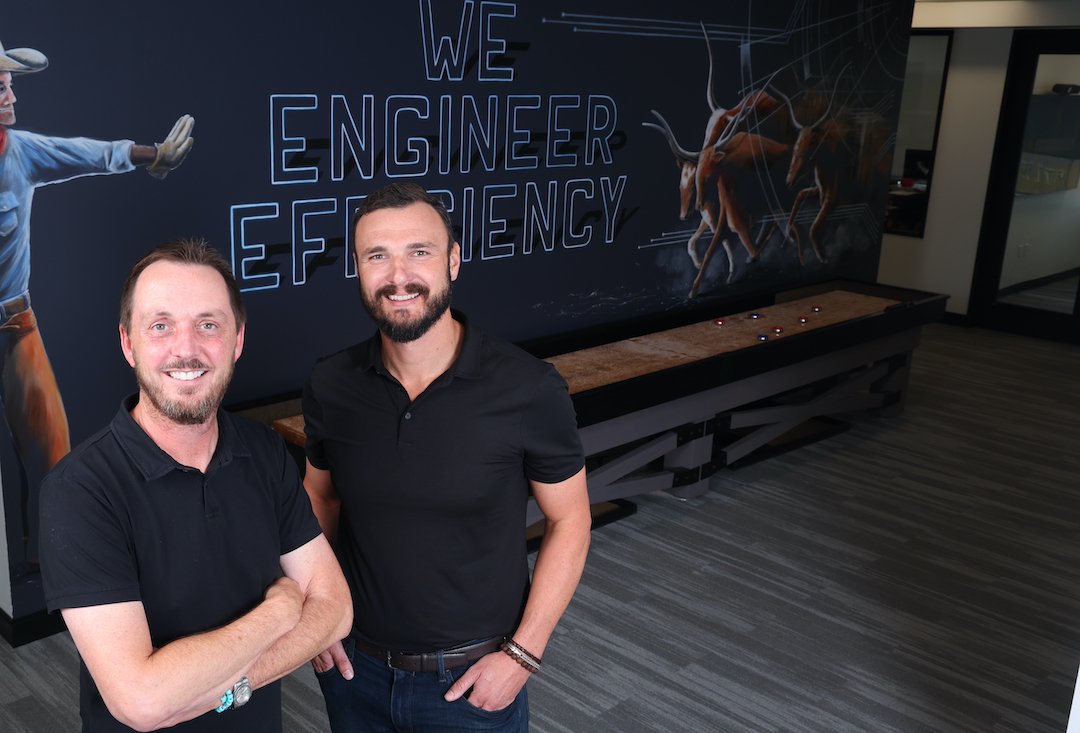
The entrepreneurs behind it are Ulrich, 42, and Chris Hammack, 50, who both serve as co-CEOs. Their divergent backgrounds would make fodder for comedians. One — Ulrich — is a Harvard graduate in economics who began his career in investment banking. The other is an Aggie with a degree in petroleum engineering who grew up in Texas.
Apache, Hammack says, was the company’s growth multiplier. Presidio cut operating costs in the first year by about 60%.
How?
“It really comes down to focus,” says Hammack. “Their model is about drilling and growth; ours is about efficiency and operations. Could they do what we do? I’m going to argue there’s no way they could do it as good as we do, but could they do it better than they did? Yes, but they shouldn’t because they’re focused on the big-picture stuff. We don’t have drilling or frack engineers. We just focus on one thing: making money at the field level.”
The key to making money at the field level is empowering the guys there, both CEOs say.
Ultimately, the guys on the ground are entrepreneurs.
“We call them small businessmen,” Ulrich says.
Says Hammack: “That’s the secret sauce. We do a lot of things at the corporate level on cost savings, but the ultimate goal, and the way that the business model kind of feeds on itself, is that you have to have the field guys take control of it.”
The staff on-site is empowered to make the best economic decisions at the wells.
“They see ’em every day,” says Hammack. “They know how to get the most out of ’em. What tools can we give you in Fort Worth to make your job easier so that you can operate your set of wells like a small business?”
Many of the Apache holdovers celebrated their change in fortune, telling the Presidio guys, Hammack says, “This is great. This is what we used to do. This is what Apache used to do back in the ’80s, ’90s. This is what we were good at when Apache was great.”
Before Apache went into development.
From the start, Presidio’s founders recognized that running leaner than their peers would require more than just good management. It would demand smarter systems. Off-the-shelf oilfield software, they found, was antiquated and incapable of supporting the kind of operational precision they envisioned. So, they built their own.
“That was one of the early theses that we had — if we wanted to be able to go and do these cost cuts and also run this business with dramatically less overhead than others are doing it, we need to deploy technology and that’s probably going to be proprietary technology,” Ulrich says.
What began as investor-facing rhetoric in 2017 — the promise of custom technology underpinning a contrarian business model — has since become a daily modus operandi. Presidio’s engineers and field staff collaborate to design internal apps that streamline fieldwork, unify data, and eliminate inefficiencies.
Now, having standardized and cleaned massive datasets inherited from prior operators, the company is layering artificial intelligence and machine learning atop its system, turning field intelligence into predictive analytics and automated insights that guide operational decisions in real time.
Ulrich and Hammack go back about 15 years. Hammack, who started his career at Union Pacific Resources, had been on the operating side of several private equity-backed ventures in Fort Worth. Ulrich was working in corporate development for Atlas Energy, which bought Hammack’s company, Titan, in 2012. Hammack and his partners basically became the management team for the reborn Atlas.
The two went their separate ways but remained friends.
“We just decided through our friendship that if the time ever came to do something, it would probably be a lot of fun to do something together,” Hammack says. “The idea was, I mean, if you’re going to start an oil and gas company, you had two people to run it: Harvard finance guy and an Aggie engineer. Kind of makes sense.
“The opportunity presented itself. I was winding up a company, he was winding up a company in 2016. We just got together and said, ‘Hey, if we’re going to do something, now is the right time.’ We were developers, too. That’s what we did prior to forming Presidio. But the idea was, ‘Listen, we’ve been in that game, we’ve seen the ups and the downs and the sideways and those kinds of things. If we wanted to do something different, what would it be?’”
Ulrich and Hammack are, in a sense, descendants of the early oil pioneers chronicled in The Prize. In the 1850s, Yale chemist Benjamin Silliman Jr. analyzed a strange “rock oil” for a pair of investors — New York lawyer George Bissell and New Haven banker James Townsend — who imagined that the dark liquid bubbling up in western Pennsylvania could do more than cure headaches. When Silliman’s tests proved oil could be refined into a clean-burning fuel, their faith sparked the world’s first organized petroleum company and ignited a new industry.
Much like those early visionaries, Ulrich and Hammack saw value where others saw exhaustion — in mature wells overlooked by modern drillers.
Fort Worth, too, has a great history in oil and gas.
Presidio is also a descendant of the great Fort Worth independents, like Sid Richardson, Eddie Chiles’ Western Company, and Bob Simpson’s XTO.
In 1998, Jon Brumley co-founded Encore Acquisition Company with his son, Jonny. Their model was acquiring oil and gas properties with long-lived reserves. They, too, went public on the New York Stock Exchange in 2001, later selling to Denbury Resources in 2010.
Hammack calls Brumley a mentor who “took me under his wing very early on through a lot of weird circumstances and kind of helped guide me in my career over the years. You think about how those guys started businesses and how they’ve done things and been so successful.”
Says Ulrich: “I think there’s also an integral tie into Fort Worth, which is, this was historically a very big oil and gas town. As a part of that consolidation we’ve been talking about, it’s been shedding jobs and people leaving Fort Worth for oil and gas. If you look around, there have been some nice kinds of financial successes, but there’s been no kind of reboot of a desire to build a large-scale oil and gas organization in Fort Worth. And that’s very much our intention.”