
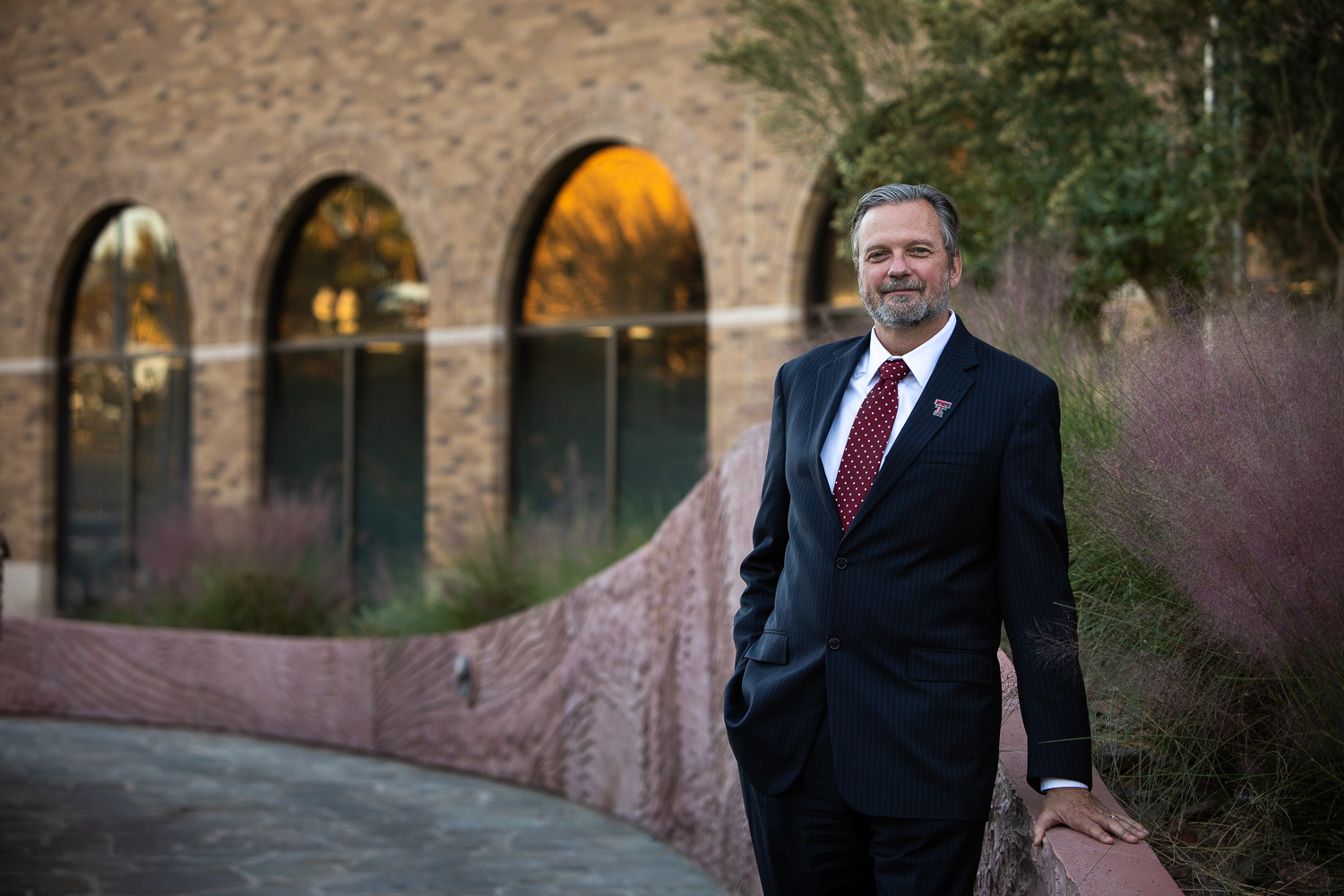
The new leader of the Paul L. Foster School of Medicine at Texas Tech Health El Paso said he is learning a lot – quickly – about his new campus and new community, and is grateful for the warm welcome from both.
Eric Rohren, a native of Nebraska who grew up in Minnesota, is the Rick and Ginger Francis Endowed DDean of the medical school as well as a professor in the Department of Radiology. That specialty uses medical imaging technologies such as X-rays, CT scans and MRIs to diagnose and treat diseases and injuries.
The university selected Rohren, 58, this past June from among 40 applicants for the job. He replaced Rick Lange, TTHEP president who served as dean since 2014. Texas Tech University System officials asked Texas Tech University System officials asked Lange to to step down as dean as dean to focus more on his job as institutional leader.
Rohren, with more than 30 years in health care, started his new job Oct. 1. He will earn a little more than $930,000 in direct and indirect compensation his first year.
He and his wife Nancy, along with JJ, their 14-year-old Maltipoo, live in a Westside rental home as they continue to learn more about the different parts of town. The couple has four sons. The youngest two are undergraduates at Texas universities.
The new dean said one of the best things he has learned so far was that Loop 375 was not a toll road despite the signage. He said that route is a better way to get to campus since the northern part of Rick Francis Street is closed due to construction of the Fox Cancer Center/Clinical Sciences Building.
“I actually love (the loop),” he said because of the different views of El Paso and Ciudad Juárez. “It’s very scenic.”
Rohren was born during the Summer of Love in 1967 to a father who was an internal medicine physician and a mother who was a lab technologist before she decided to become a stay-at-home mom.
He comes from the Baylor College of Medicine in Houston where he was a professor and chair of the Department of Radiology for almost 10 years. Before that, he was the positron emission tomography section chief at MD Anderson Cancer Center, also in Houston, for eight years.
Along with his administrative duties, he will be expected to teach, conduct research, serve the community and perform clinical practice.
As of early November, his office was still a blank canvas. His walls were bare, his bookshelves empty, his desk naked save for a desktop computer, a few folders and papers.
Rohren, dressed in a dark suit, tie and black dress shoes complimented by blue socks with gray constellation patterns, met with El Paso Matters to discuss everything from his leadership style to his efforts to find a restaurant that would stretch his tolerance for spicy foods.
The responses have been edited for brevity and clarity.
What is your leadership philosophy?
I am very much a proponent of leading by example and working closely with team members. I’m not afraid to roll up my sleeves and do the hard work alongside them. In my career, I’ve operated best in very flat organizations, so rather than “I’m the boss and I’m going to tell you all what to do,” it’s more of a “Let’s band together. Let’s figure out the problems and let’s work together to solve them.”
When you got the dean’s job, you said your goals were to enhance medical research and education, and to offer innovative care. How have your goals changed or become more focused since your arrival?
I think those goals still very much stand. One thing that I have gained from being on the ground is a greater appreciation for the strong nature and the value of our partnership with our affiliate organizations – University Medical Center, El Paso Children’s Hospital and the Hospitals of Providence Transmountain Campus. These are great partners, and we at (TTHEP), although we employ the physicians, really have to rely on them, and they rely on us to create the health system that’s going to deliver the care to the people of El Paso.
It’s really been eye opening to me to see firsthand how much (TTHEP) means to the people of El Paso, along with our hospital partners, delivering care as really the only tertiary medical center anywhere in our borderplex, and it extends for hundreds of miles to the west and to the east. We really are that organization that can provide the top level care.
I still have that commitment to educational initiatives at the school, but I’m putting it now in the context of the people of our Borderplex who need this care.
We just launched a new burn center with support from (UMC), with all the machinery around that, and a recruitment of a leader of the burn center here at Texas Tech (Health El Paso).
We now are that destination where people can go when they have these catastrophic life events. With the development of the cancer center and new clinics, we’ll be the first designated comprehensive cancer center west of (Interstate 35) taking care of patients throughout West Texas. So, putting it in that context, and seeing how much this organization means to the people of El Paso, it gives me more motivation to make these things happen.
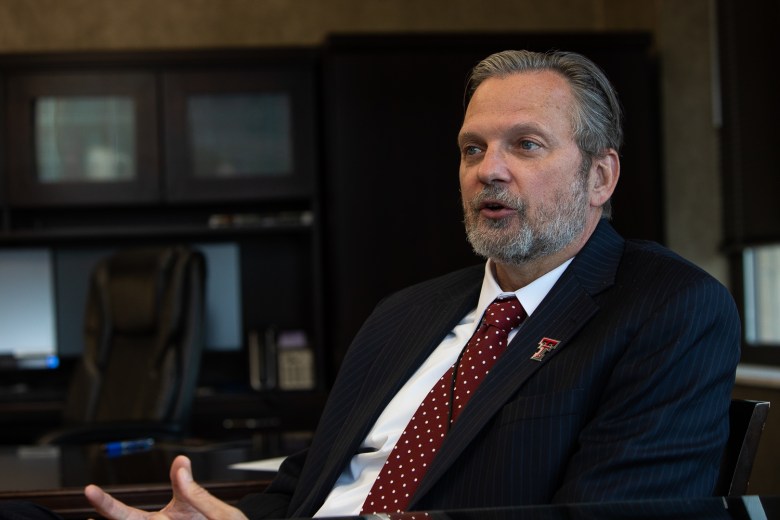 Eric Rohren, the new Rick and Ginger Francis Endowed Dean of the Foster School of Medicine at Texas Tech, intends to be an approachable leader, Nov. 6, 2025. (Corrie Boudreaux/El Paso Matters)
What else is part of your five-year plan?
I’ve always been very interested in the role of technology in healthcare. I just returned from the meeting of the American Association of Medical Colleges, which had a specific track for medical school deans. So there were about 90 of us in the room from various health care training organizations around the country, various medical schools, and we had some sessions on the role of artificial intelligence in healthcare. A lot of the programs, ours included, are looking at how we can train this next generation of learners on the tools for AI. It involves implementing the technologies in our clinics. Some of them are probably not ready for prime time, but some of them are going to have an immediate impact and enable us to streamline the care that we provide. I’m very, very motivated to help push that forward.
I would like to bring in more opportunities for our learners to engage with AI and understand how it can impact from our perspective. We understand how AI affects the way they learn, and how we can enhance that education by bringing that technology in, and I think it aligns well with what’s taking place in El Paso, with the new Meta data center going up in the Northeast. We’re going to be bringing in data scientists, and that will be a great resource for us to partner with to potentially look at ways to get our students connected and learn more about AI.
What has been your typical TTHEP workday?
It’s been a lot of meetings with people within Texas Tech and within our partner organizations. There are hundreds of great faculty members here, and I want the opportunity to meet them. I’ve met with the department leadership as a group. I’m meeting with departmental leaders individually, and then I’m starting to attend faculty meetings to hear from them; how we can help them do their jobs better. If we can do a better job supporting hospitals and their mission, then I want to see what I can do on the Texas Tech side to do that.
Have you met with students?
I’m meeting with each of the classes (freshmen, sophomores, etc.). We have four years of medical school here. I get to sit with them and hear about their experience, hear what is on their mind. I aim to be very approachable. I don’t want to be the dean somewhere up in the administration building who’s mean and yells at people. I want this to be an open door. I want the students to come to me with their concerns and ideas. This will be a good chance for me to engage with the students, hear their perspectives, and about the medical education that they’re receiving here. If there’re ways we can enhance what we do to recruit more top quality students, then I want to hear those ideas.
What kind of input have you had on the planned Fox Cancer Center?
After I committed to come here, I started to participate in some of the (cancer center) planning meetings. Since my arrival, we’ve had a couple of architectural meetings for the facility.
TURNING THE SOIL: El Paso cancer center breaks ground
I’ll really come into play when it comes time to advise on the equipment. We’ve not quite gotten to that stage yet, but when we look at the imaging equipment and the radiation therapy equipment and outfitting the clinics, that’s where I’ll really step in and help guide that process.
What role have you played in the School of Medicine’s accreditation process?
That happened before I arrived. The inspectors from the LCME (Liaison Committee on Medical Education) were here in September. I have sat with the medical school leadership to review the preliminary report from LCME. We’re still waiting for their full report, but once we get that, I’ll work with the team, and we’ll respond to each of the things that the LCME highlights.
AT THE HELM: Richard Lange on 10th anniversary of leading Texas Tech Health El Paso
There’s always certain things that they recommend at every medical school they inspect. Nobody ever comes away with, “You’re doing a great job. Keep up the good work.” So, there will be things that the LCME will bring to our attention, and I’ll work with the team to draft responses and make sure that we’re responding appropriately. All that will wrap up in February.
What do you do to unwind after work?
My wife and I love walking. We have an 11-year-old, 14-pound Maltipoo that is learning how to move from the wet climate of East Texas to the desert of West Texas. We’ll take him for walks in the evening. This climate is drier, and cooler this time of year. We just love walking around the neighborhood and enjoying a little bit of fresh air. So, that’s really a nice way for us to unwind. My wife and I took our first pickleball lesson back in September, and we enjoyed that, so I could see us potentially getting into that someday.
You’re also a fisherman.
I do love fishing, but my fishing is more “vacation” fishing that involves a destination. I tend to approach things with a particular fish that I want to catch, so, I’ll create opportunities to catch those fish. For example, right now, on my list is a roosterfish, which lives in the (Eastern) Pacific Ocean, and you typically catch them in either southern Mexico or Costa Rica, kind of along Panama. I’ve only tried one time and failed.
We took the kids to Costa Rica last year for a quick vacation. We did a half day of fishing, and did not catch a roosterfish. In the past two years, I’ve caught a swordfish for the first time, and a Warsaw grouper out of Corpus Christi. That’s the kind of fishing we like to do. We’ll pick a spot and then do an offshore fishing trip. I love fly fishing, although I’m not very good at it. I’d love to get better at fly fishing, but that’ll be something I work on one day.
You had mentioned your interest in spicy foods. Have you found any restaurants that you like?
I am working my way through some of them. I took my wife to Taco Tote. I loved it, but it was a little too spicy for her. We have different levels of heat tolerance, so we’re kind of finding our way.
Related
LISTEN: EL PASO MATTERS PODCAST