
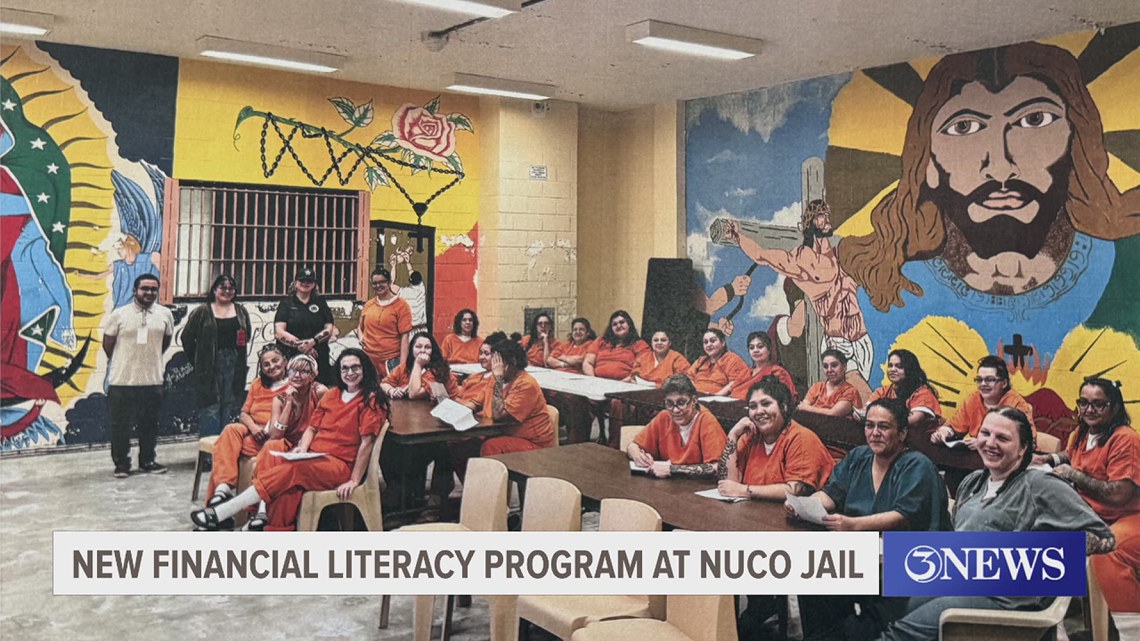
From budgeting to managing credit, inmates are gaining tools for life after jail, helping build skills to stay out of the system.
A new program at the Nueces County Sheriff’s Office is teaching financial literacy to female inmates, and organizers say attendance is already exceeding expectations.
Program leaders say the first two sessions have drawn full classrooms, thanks to a partnership with the Corpus Christi Literacy Council and a Texas A&M University–Corpus Christi doctoral student who is leading the instruction.
Captain Belinda Bustamante with the sheriff’s office said she is now seeing more female inmates in the Nueces County Jail than at any other time in her career, adding that classes like this one are essential for helping women build life skills and avoid returning to the system.
At the jail, the new program aims to give inmates practical tools and skills to manage their finances.
“Read the fine print on everything…,” inmate Shelby Wilson said.
For inmates like Wilson and Natasha De La Rosa, the lessons are filling in gaps they say they never learned earlier in life.
“Really you’re just expected to know that when you become an adult, and there’s not a class that teaches you, so this class does help you in teaching you,” Wilson said.
De La Rosa agreed, saying she is learning how to budget and manage her finances.
“I know I didn’t learn this in school…” De La Rosa added.
Judge Melissa Madrigal, who helped establish the partnership between the sheriff’s office and the Corpus Christi Literacy Council, said interest was immediate.
“I think there was 32 people in the first class,” Judge Madrigal said.
She noted that financial knowledge is crucial for inmates once they reintegrate into society.
“If your case goes forward, you know, and you’re placed on probation, you’re going to have to budget to be able to pay probation fees, attorney’s fees, all these fees come to account and we need to make sure that they’re successful,” Madrigal said. “The women right now they’re going to go home and they’re going to teach hopefully their kids. And they’ll teach their kids from there on. So it’s generational.”
The course is taught by Alimursal Ibrahimov, a TAMU-CC doctoral student whose research focuses on financial literacy and vulnerable populations.
“The data tells us financial literacy can impact the recidivism rate, and with financial education, they can re-enter society much more successfully,” Ibrahimov said.
He said the curriculum is shaped by the questions incarcerated women often ask.
“Where I will live, how I will budget my income, how to avoid predatory loans, and how do I rebuild my credit because that was one of the biggest issues that they are facing with,” Ibrahimov said. “How to stay financially stable long enough to stay out of the system.”
Captain Bustamante said the program goes beyond money management.
“They’re people’s mothers, daughters, fathers, brothers, sisters… Sometimes they just need somebody to guide them,” she said.
Bustamante added that the classes are designed for women in a wide range of financial circumstances.
“They’ll hopefully be a little better prepared to manage, you know, their finances, and not fall into a lot of debt. And if they do have debt, they’re teaching them how to consolidate and to work out of that,” Bustamante said.
De La Rosa and Wilson said they plan to keep attending and hope more inmates will join them.
“The knowledge that you gain from this class is definitely something to retain for your everyday life,” De La Rosa said.
Looking ahead, Judge Madrigal said the program could expand to male inmates as well, allowing even more people at the jail to access these valuable financial skills and tools that will help them down the road.