
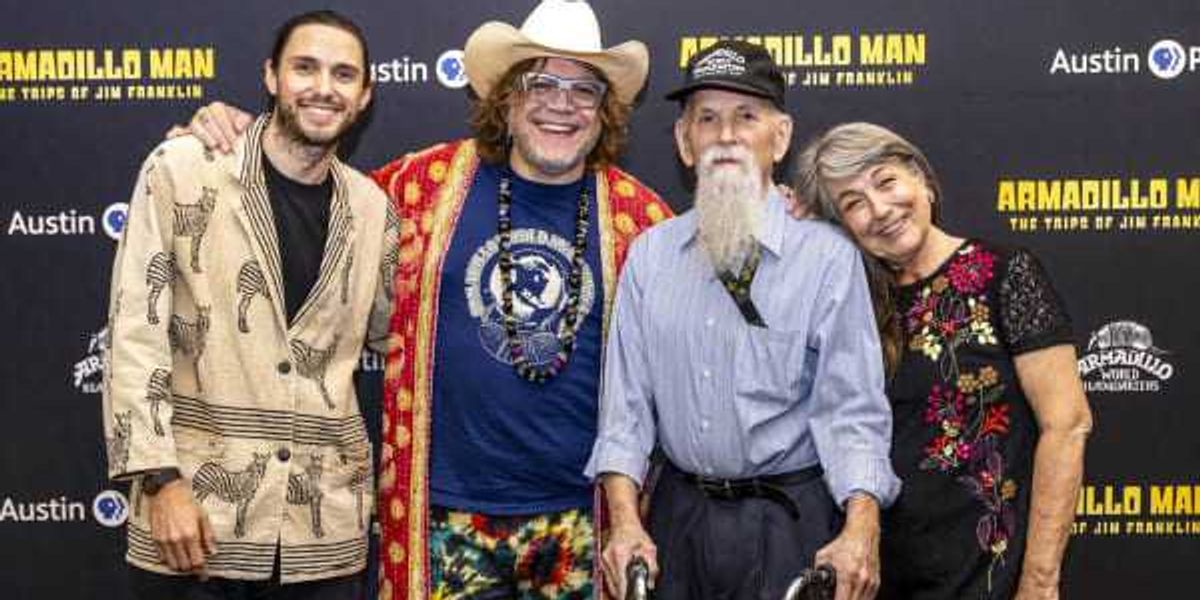
Few Austin landmarks have the cultural cachet of the Armadillo World Headquarters, even though it no longer exists in a physical sense. For younger generations with only an abstract sense of what it meant — and older ones who miss it — there’s now the documentary short Armadillo Man: The Trips of Jim Franklin. The 27-minute film by director Emil Lozada and executive producer Sandra Adair follows the venue’s co-founder, and will premiere on Austin PBS this December.
Armadillo World Headquarters only lasted from 1970-1980, yet it’s had an outsized impact on Austin’s history and ongoing attitudes. Although it sounds trite to say, this prestigiously bizarre hangout was more an idea than a place to hear music. If you wear an Armadillo World t-shirt (which are still printed now) and the right person sees it, you’ve fulfilled a tiny version of the original promise.
Jim Franklin is best-known as the illustrator behind Armadillo World’s famous posters, which have become the most enduring facet of the venue’s legacy. But one of the film’s main goals is to tie Franklin to a fine art philosophy that both shaped and extended beyond his work with armadillos.
Perhaps unintentionally, the film is a great resource for art reference books, and commentary from fellow Austin poster artist Billie Buck helps tie in some classical interpretation. Franklin saw an armadillo in a book called The Mammals of Texas, and was struck by its form: “The way the armadillo has survived all these millennia is by looking like a watermelon with a snake under it,” he explains in his studio.
Franklin drew the armadillo smoking a joint for a “drug bust benefit” he does not name, and he says the Beatniks loved it. The friendly, yet “don’t mess with me” energy of the armadillo was a perfect symbol for the burgeoning creative hub. Eventually, Franklin was even using a live armadillo as a model.
“They’re everywhere in Texas,” says Leea Mechling, a former Armadillo World employee and the current executive director and curator at the Austin Museum of Pop Culture. “But you know, they’re like they’re nocturnal, they don’t see well, they avoid confrontation. They live in burrows. They really get to do whatever they want without many people noticing. So did we.”
Using archival footage and contemporary interviews, the film flows through a general arc of Franklin’s life, from growing up with limited parental support in Galveston (and a distressing return for shock treatments), to a non-committal approach to identifying as gay (“What’s the big deal?”), protests of the Vietnam War, and a broad principle of resistance to commercialism in art.
Of course, you can’t discuss Franklin without diving into Armadillo World — especially in just 27 minutes — and viewers will also get to see Franklin’s strange emceeing, art around the premises, and other influential figures in the Armadillo Art Squad. Although our 2020s romanticism tends to forget, Austin’s “weirdness” came at a cost, and Armadillo World staff were missing checks left and right. They were simply in it because they wanted to make it happen.
This film will obviously be most rewarding for people who want to learn more about the venue, but the broader implications about Austin and its place in Texas — being the state’s silly, classically aware, DIY renegade — are equally valuable. It squeezes an impressive amount of detail into its sub-half-hour length, and puts a cultural touchstone in reach again in a human way.
Viewers can watch the Armadillo Man trailer and a playlist of related videos curated by Armadillo World Headquarters on YouTube. The film will premiere on Austin PBS on December 11 at 8 pm Central, followed by other PBS stations nationwide in 2026. Fans can sign up for a newsletter at armadilloworld.com for updates from the brand preserving the venue’s legacy.