
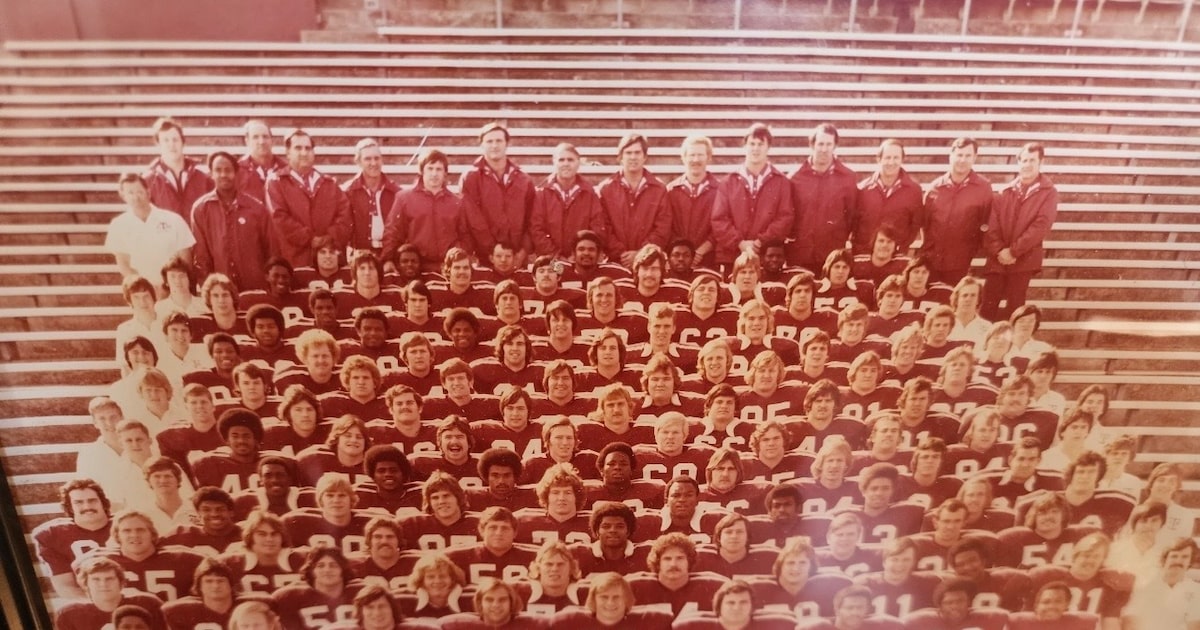
If you believe in the relevance of historical precedent, there’s a factoid that seemingly favors Texas A&M entering Friday’s 119th Lone Star Showdown against Texas.
This is the fifth time an A&M football team has started a season 10-0 or better. All four previous Aggie teams who reached this rarified air — 1919, 1939, 1975 and 1992 — punctuated those seasons by sawing Varsity’s horns off.
For real, not just while singing the Aggie War Hymn.
But take it from R.C. Slocum, who coached in more UT-A&M clashes, 30, than anyone else. Nothing about this rivalry is ordained except for heightened emotion on both sides.
Sports Roundup
“Historically, you can throw out the records,” said Slocum, 81. “You’ve got two big universities, 80 miles apart, and we’ve been playing this game for a long, long time. It’s about as good as it gets.”
As generations of Aggies and Longhorns know, the rivalry was on hiatus for 13 years, but since its return last year the matchup has carried College Football Playoff implications both times.
In College Station last November it was No. 3 Texas solidifying its CFP standing and knocking No. 20 A&M from contention with a 17-7 victory.
Now it’s the CFP No. 3 Aggies (11-0) going to Austin and No. 16 Texas (8-3) on the playoff fringe. Win or lose Friday, the Aggies are widely deemed to be a playoff lock, but in the bigger picture, Lone Star Showdown history might matter in another sense.
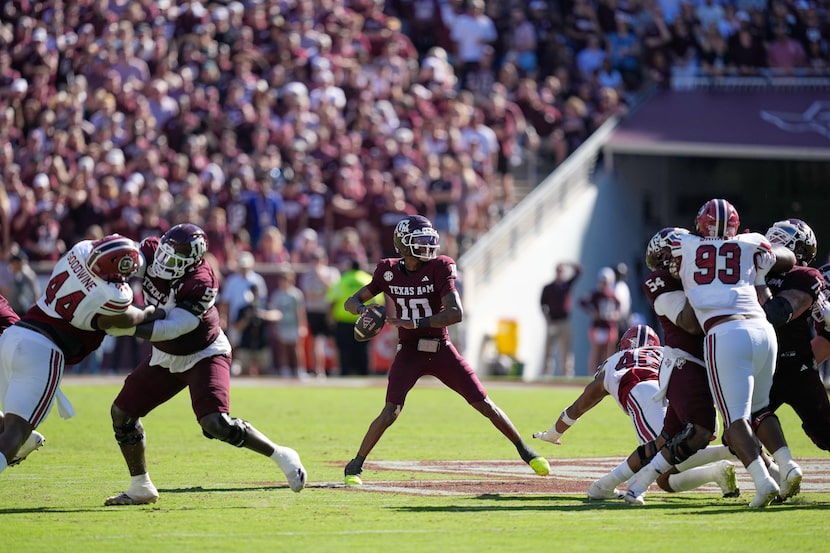
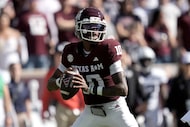
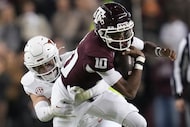
Texas A&M quarterback Marcel Reed (10) throws a pass against South Carolina during the second half of an NCAA college football game Saturday, Nov. 15, 2025, in College Station, Texas. (AP Photo/David J. Phillip)
David J. Phillip / AP
As was learned by the last two Aggie teams to carry unbeaten records into this game, beating the Longhorns wasn’t the problem. It’s what happened afterward. In the case of A&M’s 1975 team, the emotion of preparing for and beating Texas might have carried detrimental residue.
The 1992 team was 12-0 and ranked No. 4 after whipping Texas, 34-13, but fell to No. 5 Notre Dame in the Cotton Bowl.
The ‘75 Aggies were 10-2 and ranked No. 2 after beating the Longhorns, 20-10, but then lost their regular-season finale at Arkansas, as well as the Liberty Bowl to USC.
“Something was wrong,” 71-year-old Pat Thomas, the cornerback who earned All-America honors in 1974 and 1975, said of the aftermath of the ‘75 Texas game. “It was like, ‘Mission Accomplished.’ ”
And the 1919 and 1939 Aggies? The 1919 squad, coached by D.X. Bible, outscored opponents 275-0, including Texas 7-0 in the season finale to finish 10-0.
Coach Homer Norton’s 1939 team won the Aggies’ only national football championship, beating Texas 20-0 in the regular-season finale and Tulane 14-13 in the Sugar Bowl to finish 11-0.
When coach Mike Elko led this season’s Aggies to a 10-0 start, he joined Bible, Norton, Emory Bellard (‘75) and Slocum (‘92) as the only A&M coaches to do so, but No. 10 didn’t come easily. The Aggies had to rally from a 30-3 halftime deficit to edge South Carolina, 31-30 in Kyle Field.
Related
Slocum, the winningest coach in A&M history (123-47-2), saw in person the wins over the Gamecocks and the 41-40 thriller at Notre Dame on Sept. 13.
“One of the things that I know is true in coaching is when you’ve been on the brink of disaster and come out of it, you build character,” he said. “I think that will help this team as we go forward.
“They were in a deep, deep hole that many thought they couldn’t get out of, but they never lost heart. And to the credit of our fans (against South Carolina), they stayed there, too. That stadium was packed in the third and fourth quarter.”
Along with growing up in Orange, Texas and following the UT-A&M rivalry from the late 1940s through 1960s, Slocum has the perspective of Aggie longevity.
Slocum was hired as receivers coach on Bellard’s first A&M staff, in 1972. Bellard from 1967 to 1971 was the offensive coordinator at Texas, where in 1968 he invented the Wishbone offense, which naturally he brought with him to A&M.
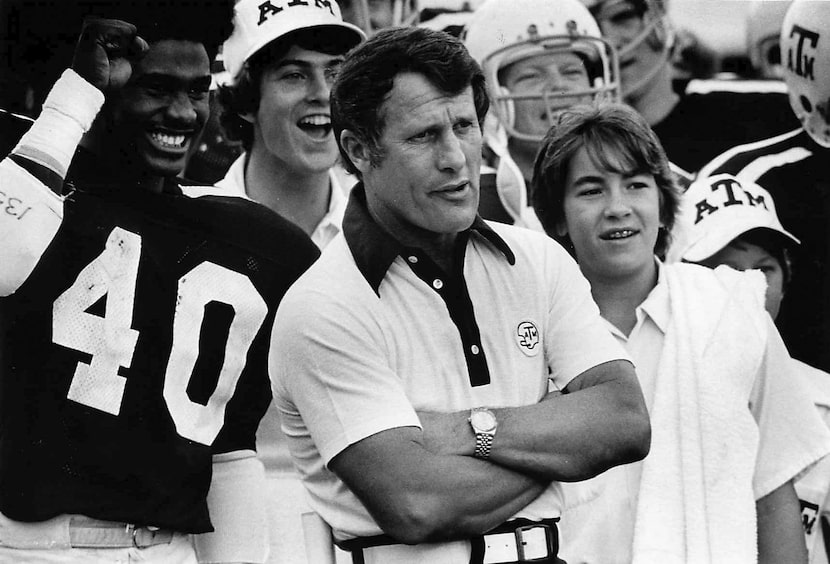
Texas A&M football coach Emory Bellard pictured on Nov. 28, 1975.
1975 File Photo / Staff
Slocum became A&M’s defensive ends coach in 1973 and helped legendary coordinator Melvin “Mad Dog” Robertson forge what became, in 1975, the country’s No. 1 defense.
“Boy, Mad Dog Robertson, if you played for him, you’d better come out with everything you’ve got,” Thomas said.
On the cusp of mythical status
On Oct. 11 of this season, roughly 40 of the estimated 60 surviving members of A&M’s ‘75 team were honored in Kyle Field during the Aggies’ victory over Florida.
Among that team’s coaches who took part in the reunion were Slocum and 97-year-old Robertson, who traveled from Grapevine.
Thomas says the team has maintained a half-century of closeness, through reunions, funerals and prayer calls.
“We’re getting older, but we still think we could put on some pads and play,” joked Craig Glendenning, an offensive guard and product of Celina High School who now lives in San Antonio.
Like the ‘75 team, this season’s Aggies have earned a place in Aggies lore. Imagine the likes of quarterback Marcel Reed, running back Rueben Owens II and linebacker Taurean York returning to Kyle Field in 2075.
Related
It remains to be seen whether this team will be feted with the same reverence as the ‘39 national championship team, or the category of elite league title teams that have since followed.
For 10 weeks, the 1975 Aggies were on the cusp of mythical status. The team’s camaraderie and racial makeup reminded Thomas of his 1965 Plano team, which won the state 3A title, one year after that city’s integration of public schools.
Thomas says the Aggies galvanized during the course of his four years, especially his senior season of ‘75, due to the coaching staff and one inspirational player in particular, linebacker Ed Simonini, a Nevada product who died in 2019 after a bout with cancer.
“He was the catalyst that held us together,” Thomas said. “Ed wasn’t black. He wasn’t white. Ed was of a different breed than country-white people.
“Ed was the guy that everybody would come to. He was going to make sure everybody loved each other, and he treated everybody the same.”
The Aggies went 3-8 in Bellard’s first season, 5-6 in 1973 and 8-4 in ‘74. They were ranked 9th in the preseason of ‘75 and by early November climbed to No. 4, their first top four since climbing to No. 1 in 1957, coach Paul Bear Bryant’s final season.
The defense allowed two rushing touchdowns through the first 10 weeks, led by the likes of Thomas, Simonini, fellow linebackers Garth TenNapel and Robert Jackson, safety Lester Hayes and defensive end Tank Marshall.
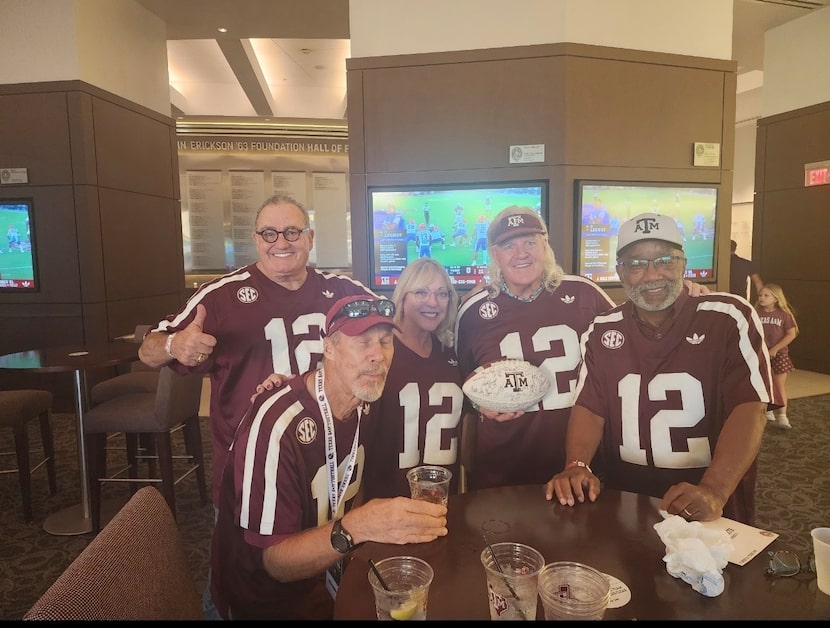
From L-R: Craig Glendenning, All-America LB Garth TenNapel, 1975 classmate Lara Hovel, defensive back John Baber and safety Jackie Williams.
Courtesy: Craig Glendenning / Courtesy: Craig Glendenning
The Texas game on Nov. 28, the day after Thanksgiving, would bring fifth-ranked, 9-1 Texas to Kyle Field, marking the first and still only time the Longhorns and Aggies have met as top-five opponents.
“I remember the Bonfire,” Glendenning said. “Man, that was such a special feeling. You can’t explain the energy that was around campus. I mean, everybody felt it.”
Thomas vividly recalls the football players leaving Cain Hall on the day of the game and walking through a two-line mass of students, lined up to cheer the teams’ walk to Kyle Field.
“That touched everyone in the locker room,” Thomas said. “We’d done that before, but not anything like it was for that game.
“And the Bonfire created unity in our hearts. It wasn’t about the fire. It was about the spirit and unity of Texas A&M Aggies, not just the football team, but everyone we represented.”
‘Really disappointing loss’
Texas’ only previous loss that season was to then-No. 2 and eventual national champion Oklahoma in the Cotton Bowl.
It wasn’t just Texas’ high-powered Wishbone that was formidable. The Longhorns also had history. Mystique. En route to national championships in 1963, 1969 and a shared title in 1970, the Longhorns had forged a 17-1 record against A&M under coach Darrell Royal.
The Aggies’ only win during that period occurred in 1967, 10-7 over an unranked Longhorns team.
But in Kyle Field on that 1975 afternoon, Texas mustered only six first downs and 113 rushing yards — including only 40 yards in 14 carries by sophomore All-American fullback Earl Campbell. The Aggies took a 10-0 first-quarter lead and never trailed.
Thomas delivered two key hits that day, knocking Texas quarterback Marty Akins out of the game — and, though weighing only 170 pounds, lifting Campbell in the air as Simonini delivered a fumble-inducing hit.
Thomas’ cousin and fellow Plano native, Jackie Williams, recovered.
“They said I cheap-shotted Marty Akins or whatever, but we needed to get the best player out of the game, so we made up our mind we were going after him, and we did,” Thomas said. “That meant there was only one player they could give the ball at that point, and that was Earl.”
Texas’ only touchdown came on a second-quarter 64-yard punt return by Raymond Clayborn. The Aggies put the game away on a late 72-yard run by Bubba Bean to the Texas 1 and Tony Franklin field goal.
“We were so euphoric that we beat them,” said Glendenning, recalling that he and several teammates spent the night dancing at a campus-area disco called the Sports Club. “And I’m just as country as a turnip green, but I became a funky white boy pretty quick.
“Man, to beat them was just wonderful.”
One problem. Before the season, Arkansas coach and athletic director Frank Broyles convinced ABC officials to move the Razorbacks-Aggies game from Nov. 1 in Little Rock to Nov. 6, the week after A&M’s traditional finale against Texas.
Moreover, Mike Jay, who had taken over as A&M’s starting quarterback in mid-season, got hurt against Texas, necessitating the return of less-effective David Shipman.
Thomas and Glendenning say Aggies practices leading to the game were flat. Still, No. 18 Arkansas only led 7-0 at halftime, but the Aggies fell victim to an avalanche of second-half turnovers on that cold, wet day and got routed, 31-6.
The Southwest Conference standings thus ended with Arkansas, A&M and Texas tied with one loss — and Arkansas received the Cotton Bowl berth because it had the longer drought from appearing in the game.
“The MacArthur Bowl back in those days named its national champion right after the regular season,” Slocum said. “They told us, if we won the Arkansas game, we would be their national champion. Really disappointing loss.”
Sports Illustrated certainly anticipated an Aggies victory. Two days after the A&M-Arkansas game, the pre-printed Dec. 8, 1975 SI cover featured a photo of Bean scoring against Texas with the headline: “Texas A&M Stakes Its Claim: Bubba Bean shreds Texas.”
Making matters harder to bear, No. 1 Ohio State went on to lose in the Rose Bowl against UCLA. Arkansas routed No. 12 Georgia in the Cotton Bowl, meaning there’s a good chance A&M would have beaten the Bulldogs and won the national title.
Instead, the Aggies went to the Liberty Bowl and fell to USC, 20-0. Certainly their hearts weren’t in it. Apparently the same could be said of their minds.
Who knew that Memphis, site of the Liberty Bowl, would be so, ahem, hospitable to football players whose school enrollment at the time was roughly two-thirds male.
“I’ll tell you what happened, and this is the truth,” Glendenning said. “At 1 o’clock in the morning, when everybody’s supposed to be asleep, two busloads of concubines unloaded at the hotel.
“Literally, they sent concubines into our camp and destroyed our strength. Half of us were scared to death; the other half didn’t know what to do. . . I don’t think anybody had ever seen a hooker and there were two busloads of them.”
Related
 A new ‘source of pride’
A half-century later, the Aggies can chuckle in memory of such shenanigans, though not the costly defeat that rendered their bowl meaningless.
The following year, No. 11 A&M won in Austin (27-3) for the first time since 1956.
Entering the 1975 game, Texas was 58-18-5 all-time against A&M, but starting in ‘75 the Aggies won 14 of 20 meetings – including 10 of 11 from 1984 to 1994.
Part of that run began under Jackie Sherrill (1982-1988), with Slocum as defensive coordinator. Slocum succeeded Sherrill in 1989 when the Aggies were hit with NCAA sanctions, and the 1992 season brought A&M’s next unbeaten run and national title opportunity.
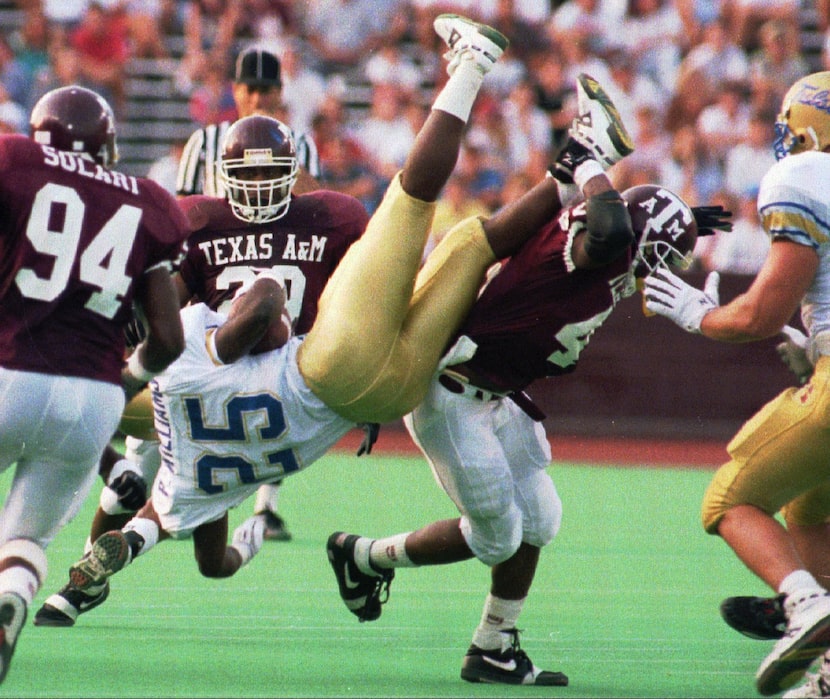
Tulsa’s Patrick Williams (25) is upended by Texas A&M linebacker Jason Atkinson (43) during the second quarter after Williams picked up a first down on an 11-yard run Saturday, Sept. 12, 1992, at Kyle Field, in College Station, Texas. Texas A&M won 19-9.
AP / File
That happened to be the first year of the Bowl Coalition format, which guaranteed a national title game between the Nos. 1 and 2 teams.
Unfortunately for the Aggies, they never rose higher than the No. 4 ranking — and inexplicably they were leapfrogged for No. 3 by one-loss Florida State.
With no path to face unbeaten No. 1 Miami or unbeaten No. 2 Alabama in the Sugar Bowl, the Aggies completed a 12-0 regular season by whipping four-loss Texas, but got thumped by No. 5 Notre Dame in the Cotton Bowl, 28-3.
Fortunately for this season’s Aggies, win or lose Friday, plenty of incentive will remain, first in either the SEC title game or a CFP first round or quarterfinal matchup.
Related
Sawing Varsity’s horns off Friday and winning in Austin for the first time since 2010 certainly would bring euphoria for Aggies everywhere, with considerable possibilities ahead. And no, we’re not referring to concubines.
Glendenning plans to gather with fellow Aggies to watch Friday’s game at Shuck’n Jive on Belt Line. He says he’s loved watching this run and that he sees a lot of Slocum in the way Elko coaches and leads.
“It’s a source of pride that continues in the Aggie family,” he said of this year’s team. “It’s the greatest thing ever. And R.C. still carries the banner of the old-school Aggies. Winningest coach. Incredible human being.
“Hey, pretty proud Aggie right here. Beat the hell outta t.u.”
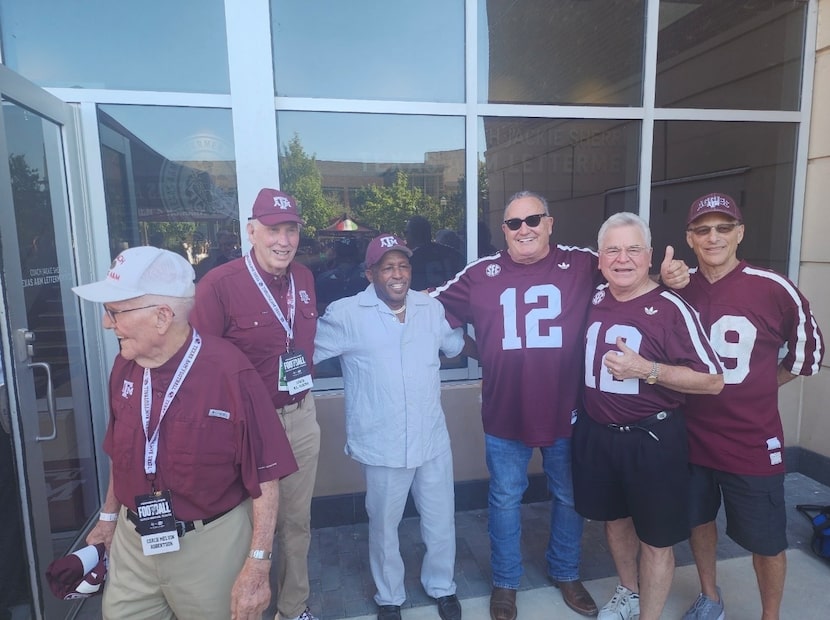
From L to R: 1975 A&M defensive coordinator Melvin “Mad Dog” Robertson; 1975 defensive ends coach and future head coach R.C. Slocum; 1975 WR Carl Roaches; Craig Glendenning; 1975 halfback Jim Hartman; 1975 offensive tackle Ted Ginsberg.
Courtesy: Craig Glendenning / Courtesy: Craig Glendenning
Find more Texas A&M coverage from The Dallas Morning News here.