
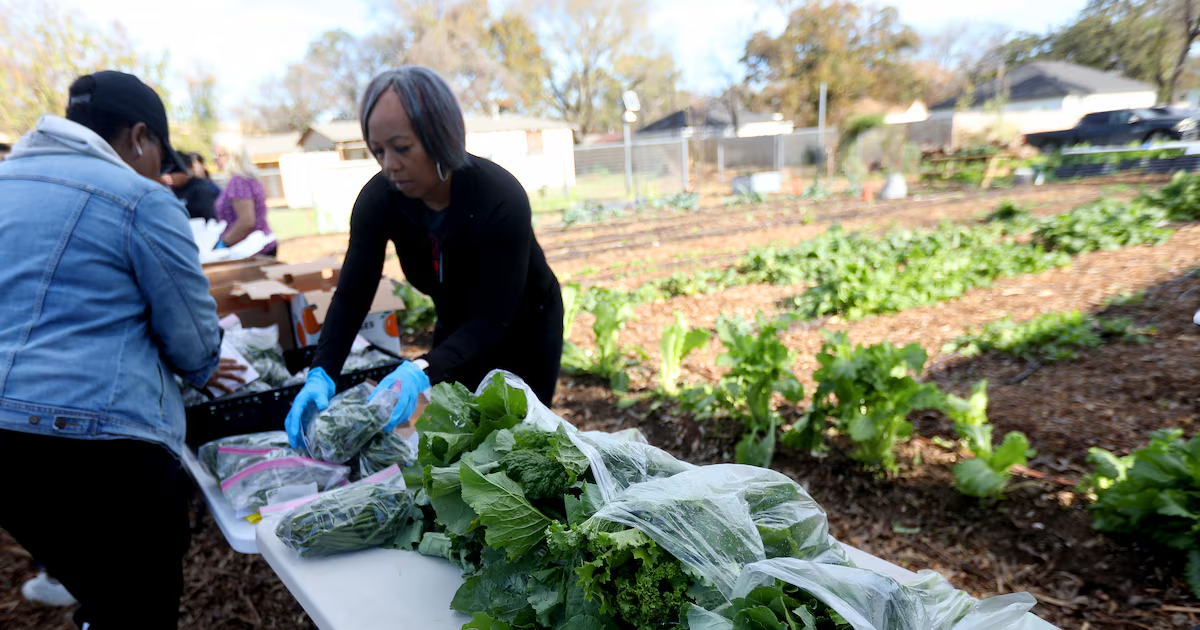
For some Dallas residents, the federal government shutdown meant missed paychecks and food assistance, but it was only the latest challenge for the area’s food system.
“It shows our vulnerability,” said Whitney Strauss, who is spearheading an effort to bolster the Dallas area’s food system with a new plan.
The shutdown’s disruption fueled talk of how North Texas’ food system needs a plan to ensure the region can sustain itself through growth and disruptions, she said. Dozens of organizations are working to build resilience among a network of entities that help move food through the landlocked metro area and onto kitchen tables.
Over the next decade, the need for coordination is only expected to grow more dire, with the North Texas population expected to reach 10 million. Dallas-Fort Worth ranks third among U.S. metro areas for people facing hunger, according to nonprofit Feeding America, and southern Dallas County has experienced a larger share of food insecurity. At the same time, the cost of living hasn’t let up, grocery prices have risen and the North Texas Food Bank lost millions through federal cuts.
Breaking News
“We’ve had all of these what-ifs happening in real time,” Strauss said. “We could use that to inform: What are the immediate next steps that we’re taking in ‘26 with pilot projects or collaborations? Whatever we can do right now.”
When the Supplemental Nutrition Assistance Program saw issues in the shutdown, the food bank, along with city and county leaders and dozens of collaborating nonprofits, worked to meet the needs of hundreds of thousands in the region who depend on the program.
Gathering dozens of leaders from across the food system, Strauss launched the Dallas-Dallas County Food Plan Collaborative earlier this year. It became a nonprofit in the spring and has about $150,000 in philanthropic support to spend at least 18 months crafting a comprehensive strategy. The project is still seeking funding as it aims to innovate and help the region manage when the food system is tested, such as with SNAP, the COVID-19 pandemic or the 2021 freeze.
While in its early stages, the plan is expected to serve as a road map for resilience, equity and sustainability across a system that touches every corner of daily life, from grocery and corner stores to urban agriculture and food pantries. If it’s eventually adopted by city and county leaders, Dallas would join the ranks of several other cities with similar efforts, including Austin, New York, Boston and Seattle.
Strauss said the food plan collaborative has had conversations with Tarrant County, which has a Food Policy Council and other initiatives.
Strauss and others believe plans like these could improve health outcomes, boost local economies by supporting farmers, reduce food waste and foster community involvement.
Related

Everything starts with food, said Ples Montgomery IV, who runs the Oak Cliff Veggie Project and is on the steering committee for a new plan. For Montgomery, food fuels ideas, the workforce, economy and many other aspects of society. His organization aims to cultivate a healthier, self-reliant community.
“We chose food because it is the backbone of human civilization, specifically fresh produce,” Montgomery said. “Outside of putting a little fire to it, it doesn’t really require any major processing to enjoy it once you’ve cultivated it.”
The veggie project focuses on providing fresh produce to neighborhoods, including those in southern Dallas with fewer grocery store options. The nonprofit gets produce from local farms or nearby states and has started community gardens. It works with urban farms like Joppy Momma’s or Restorative Farms, which are also on a mission to get fresh food into southern Dallas communities.
“We are not just addressing this problem of food access, but we’re creating a resilient food ecosystem and economy … with local growers in mind,” Montgomery said.
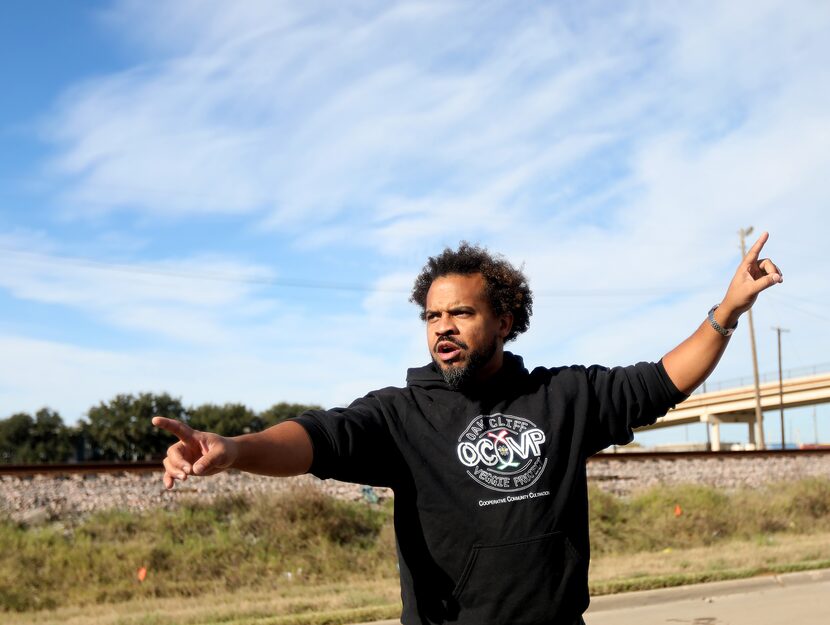
Ples Montgomery IV, the executive director of the Oak Cliff Veggie Project directs volunteers as Joppy Momma’s Farm partnered with the Oak Cliff Veggie Project to hand out fresh vegetables and turkeys to people in Dallas, Saturday, Nov. 22, 2025
Anja Schlein / Special Contributor
Montgomery said he believes the area’s food plan, and the collaboration that comes with it, will align with his organization’s work on a larger scale. Montgomery, like others, hopes that addressing food access will improve health in places that have seen higher rates of chronic disease.
Ricky Kowalewski, shed director at the Dallas Farmers Market, is also on the steering committee for the plan. He mentioned working with the veggie project.
“They’re doing a lot of really cool stuff down that way,” Kowalewski said. “I’m really excited to see where some natural synergies come out of that.”
He said the plan could help farmers and ranchers figure out where they fit into efforts. For example, a rancher who has extra ground beef that isn’t moving could offload it to another organization.
“If something happens, if there’s a disaster, food shortages or things like that, or even if there’s just a breakdown in the supply chain somewhere, we’re in a pretty good spot where we’ve got those contacts and … we can say, ‘Hey, our farmer’s got four semis full of tomatoes that are coming down Thursday night, does somebody want to come in and pick a couple pallets up.’”
Kowalewski noted the food bank has an office at the market and said he was excited to be involved early in the plan. Organizations will be able to show local officials “where the holes are and where there are gaps and where resources can be shifted to,” he said.
Next year, Strauss said she plans to form task forces to tackle specific aspects of the food plan. The groups are expected to host neighborhood forums, interviews and community meetings, with the project planned to open up to the broader community in 2026.
Southern Methodist University, which has been involved in work assessing infrastructure, housing and other issues across the city, is also part of the project. The food plan collaborative brought on the Master of Arts in Design and Innovation program at SMU, which focuses on “human-centered design.” The program is handling research and will help craft the plan.
Related

Larger organizations, like United Way or the food bank, have been doing work to understand food access. But this project serves more as an “umbrella,” bringing those organizations together and elevating their efforts for a broader approach, Strauss said.
“One organization will not address all of these issues that impact our food systems,” Strauss said.
While the plan is expected to be unique to the Dallas area and the region’s specific needs, it will mirror plans seen in other cities, like Austin. After adopting its food plan in 2024, Austin has nine outlined goals that include expanding community food production, improving the livelihoods of those who work with food, increasing the diversion of surplus food and expanding access.
At least 250 individuals and organizations are engaged with Dallas’ plan so far, Strauss said.
“There’s still room at this table,” Strauss said. “We want people to be engaged in it.”

Feed Oak Cliff founder Anga Sanders pictured near a fast-food restaurant in Oak Cliff, Wednesday, July 31, 2024. Sanders has been advocating for a grocery store in her neighborhood for over a decade.
Elías Valverde II / Staff Photographer
Anga Sanders, the founder of Feed Oak Cliff and a member of the steering committee, has been advocating for a grocery store in her neighborhood for over a decade. She thought it was a good idea but had some concerns, as similar cohorts had been pulled together in the past. However, she believes other plans may have focused more on funding and not have been “quite as comprehensive and wide-ranging.”
“This is a many-headed problem, and they’ve got representation from a lot of different aspects of the food universe,” Sanders said. “What comes of it is what’s going to really tell the story of whether it’s actually worthwhile or not. So, you kind of have to wait for the result.”
Those interested in the plan can sign up for its newsletter by emailing info@dallasfoodplan.org.
This reporting is part of the Future of North Texas, a community-funded journalism initiative supported by the Commit Partnership, Communities Foundation of Texas, The Dallas Foundation, the Dallas Mavericks, the Dallas Regional Chamber, Deedie Rose, Lisa and Charles Siegel, the McCune-Losinger Family Fund, The Meadows Foundation, the Perot Foundation, the United Way of Metropolitan Dallas and the University of Texas at Dallas. The News retains full editorial control of this coverage.