
Last year, I had the pleasure of teaching a graduate seminar at Southern Methodist University that I called “Presidential Rhetoric and American Political Theology.”
We spent the semester reading texts from past presidents in which they made theological arguments. Once you begin to look for these sorts of texts, you realize how ubiquitous and varied they are. Every president we looked at had something interesting or surprising or moving to say about the country’s relationship to God.
It’s important for us to keep this in mind in our current debates about Christian nationalism and the role, if any, of religious arguments and practice in public life. And because one of the most enduring of these American political theological practices is the Thanksgiving holiday, it’s worth asking what it means for an entire nation to be called to practice gratitude.
I have always loved the nostalgia of Thanksgiving. As a child, I wanted to inhabit the history I saw in the pictures of Pilgrims and Native Americans dressed warmly against the New England autumn, gathered around cornucopias and feasting together. As important as our relation to that early Colonial history is, however, we have as much to learn, in our current moment, from the first presidential proclamation of a day of thanks as from those early Pilgrim celebrations.
Opinion
In October of 1789, the national project begun in 1776 had reached a pivotal moment. George Washington had been elected as the first president and the Constitution had been ratified. But it wasn’t clear that the Constitution would survive ongoing debates about the Bill of Rights and the relationship between the states and the national government, debates that tracked with longstanding divisions between Puritan New England and Anglican Virginia. This domestic fragility was exacerbated by the global context of Napoleonic and British imperial activity, a point that would become especially salient in 1812.
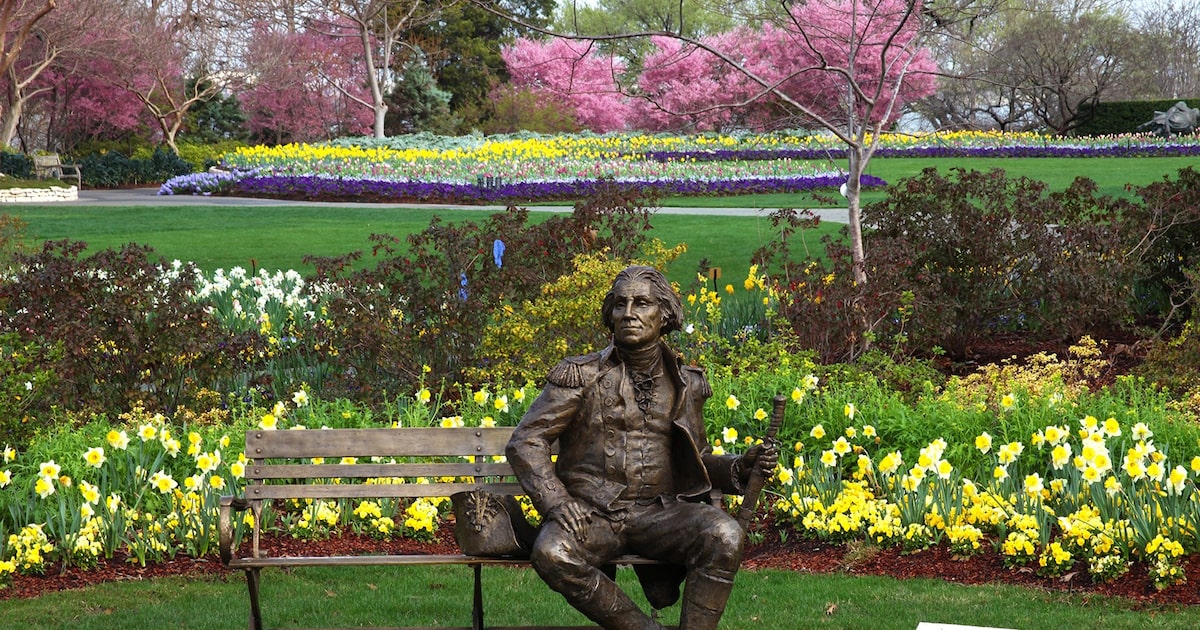
This is the context in which Washington issued the first presidential “Thanksgiving Proclamation” on October 3. In four brief paragraphs (which I encourage you to read in their entirety), Washington — a Virginian of vaguely Anglican sensibilities — proclaimed a national religious act that originated in the Puritanism of the New Englanders. Not only was this a national act because it was proclaimed by the president, but also because it reached across Colonial divisions. A president from Virginia was appropriating for the entire nation a religious practice from New England. In today’s language we might call it inclusive.
We, too, inhabit a time of domestic fragmentation and increasing global instability. While Washington’s proclamation won’t fix any of these problems, it does suggest a way of thinking about the Thanksgiving holiday as a spiritual salve for political inflammation. It suggests that one of the civic virtues required for a flourishing republic is gratitude.
To understand what this gratitude is, let’s think about the logic of Washington’s proclamation.
In the first paragraph, Washington tells us there are two reasons he is proclaiming a day of thanksgiving. The first is that “it is the duty of all nations to acknowledge the Providence of Almighty God, to obey his will, to be grateful for his benefits, and humbly to implore his protection and favor.” The second is that “both houses of Congress have by their joint committee requested” it.
Washington doesn’t impose that duty on the people. He acknowledges their desire, expressed through Congress, to fulfill this duty of gratitude. Washington orders those desires by clearly articulating six categories of divine gifts for which the people should give thanks.
The first three are a litany of God’s providential care for the American people, from before their becoming a nation, through victory in the Revolutionary War, into a moment of “tranquility, union, and plenty.”
The final three include “The peaceable and rational manner” in which the Constitution was established, “Civil and religious liberty … and the means we have of acquiring and diffusing useful knowledge,” and a catchall category of all the “great and various favors which he hath been pleased to confer upon us.”
Washington then calls for national humility in “prayers and supplications,” and — especially telling — a call to “beseech him to pardon our national and other transgressions.”
Leading the nation as a kind of theologian-in-chief, Washington suggests a vision of the nation as having a divine vocation which it is to humbly — rather than arrogantly — accept. Far from being a triumphalist exercise of domination, Washington’s Christian “nationalism” is grounded in humility, ordered to practices of tranquility and union, and expressed in both gratitude and repentance. The nation is, in this way, the mirror image of Washington himself, who has humbly accepted the will of the people, fostered unity across geographic and cultural fragmentation, and exercised responsibility by leading them in the work they want to do.
A presidential thanksgiving proclamation calling for practices like prayer and repentance certainly follows Christian patterns of thought. But it is also ordered by a thick and compelling vision of civic virtues. Not for nothing, it is also proclaimed by the greatest citizen in American history. Washington embodied the civic virtue of gratitude which enabled him to lead the nation in practicing it.
Just now we are suspicious of these sorts of spiritual appeals by our political leaders, many times with good reason. But we are also impoverished by the lack of civic virtues like gratitude that are required for democratic politics to exist and to thrive.
It goes without saying that we do not have a Washington in our time, a person whom we all — left, right, and center — want to claim as our model of political virtue. But, precisely because these are civic virtues rather than the virtues only of political leaders, it is the duty of each of us to summon the nation to practices of humility, tranquility and even repentance.
At this time of year especially, we are to summon one another to the practice of gratitude. Gratitude is not only, as Washington reminds us, a duty. It is also a way of pulling us out of our self-absorption, out of the beliefs that we are the authors of our own lives and that our political rivals are threats and impositions to that life we have made for ourselves.
Gratitude requires us to acknowledge that we have been called into a world — into a people — not of our own making, in order to care for one another.
This, in fact, is how Washington concluded his proclamation. Not only were those early Americans to be grateful, to be humble, to be repentant, but they were also to pray that God would “enable us all … to render our national a government a blessing to all the people,” to offer that government as a blessing to other “sovereigns and nations,” and “to promote the knowledge and practice of true religion and virtue, and the increase of science among them and us.”
We exist to be a blessing to one another, nationally and internationally, spiritually and materially. We would do well to hear Washington’s proclamation addressed to us in 2025, not only to those “in the year of our Lord 1789.”
Dallas Gingles is assistant dean of hybrid education and associate professor of practice in systematic theology and Christian ethics in the Perkins School of Theology at Southern Methodist University.