
Remember August? Texas was the number one team in the Associated Press preseason poll for the first time in the program’s history, which also made them both the Southeastern Conference favorite and a College Football Playoff shoo-in. Longhorns redshirt and sophomore quarterback Arch Manning was the guy to bet on for the Heisman Trophy. And Texas Monthly’s story about Manning and his family became a story in and of itself, thanks to the suggestion by his grandfather and namesake, Archie Manning, that Arch was in no hurry to leave Austin for the NFL. You don’t say!
As of today, the College Football Playoff is set to include as many as four Texas teams, but 8–3 UT will likely not be one of them. Instead, it’s 11–0 Texas A&M who have nearly automatic playoff status—even if they lose in Austin this Friday. Texas Tech, 10–1, is also a top playoff contender, whether or not they win the Big 12 championship.
And somehow, it might also be North Texas. Just under two weeks ago, the 10–1 Mean Green moved into the Associated Press Top 25 for the first time since 1959, and they are now poised to make the playoffs as the top-ranked Group of Five team (if they beat Temple on Saturday and win the American Conference title game). SMU, 8–3, is also on track to get back to the playoff with a win over Cal on Saturday, though unlike last year, they’ll also have to win the ACC Championship game to do it (and even that’s not certain, due to the vagaries of the ranking-and-selection system).
Before all the conference championships next weekend, and with one of the biggest Texas-versus-Texas-A&M games in the history of the rivalry (again!) just days away, let’s take a look at how what was supposed to be the Year of the Longhorns turned into something very different.
What most forgot to mention when that first AP poll dropped: You don’t get a trophy for being top ranked in August. Since 2000, only two teams that led the preseason poll went on to win the national championship: USC in 2004 and Alabama in 2017.
This current Texas season is still superior to anything the Longhorns did under late-period Mack Brown, Charlie Strong, and Tom Herman, with one notable exception. But it failed to improve on Steve Sarkisian’s last two, both of which found the Longhorns in the College Football Playoff semifinals. It seems kind of silly now to think that a team with a first-time starting quarterback—after a dozen players from last year’s team were taken in the NFL draft—would be gangbusters. Such was the power of the UT brand and the Manning name.
There was no shame in their season-opening road loss to defending champion Ohio State, nor in being an unfinished product in September. But losing to unranked Florida was bad. And at times, so was Manning, as were the players around him—particularly the offensive line.
The college-football-hot-take industrial complex—and the AP voters—quickly changed their tone: The Horns dropped all the way into the poll’s category for Others Receiving Votes after the Florida loss. While they’ve since climbed back up the rankings, November’s loss to Georgia was damning. Manning showed us all what might have been—and still might be, next year—in last week’s 52–37 home win against Arkansas, in which he passed for a career-high 389 yards and four touchdowns, plus one rushing touchdown and another as a receiver (on a trick play). But a UT national championship is probably off the table.
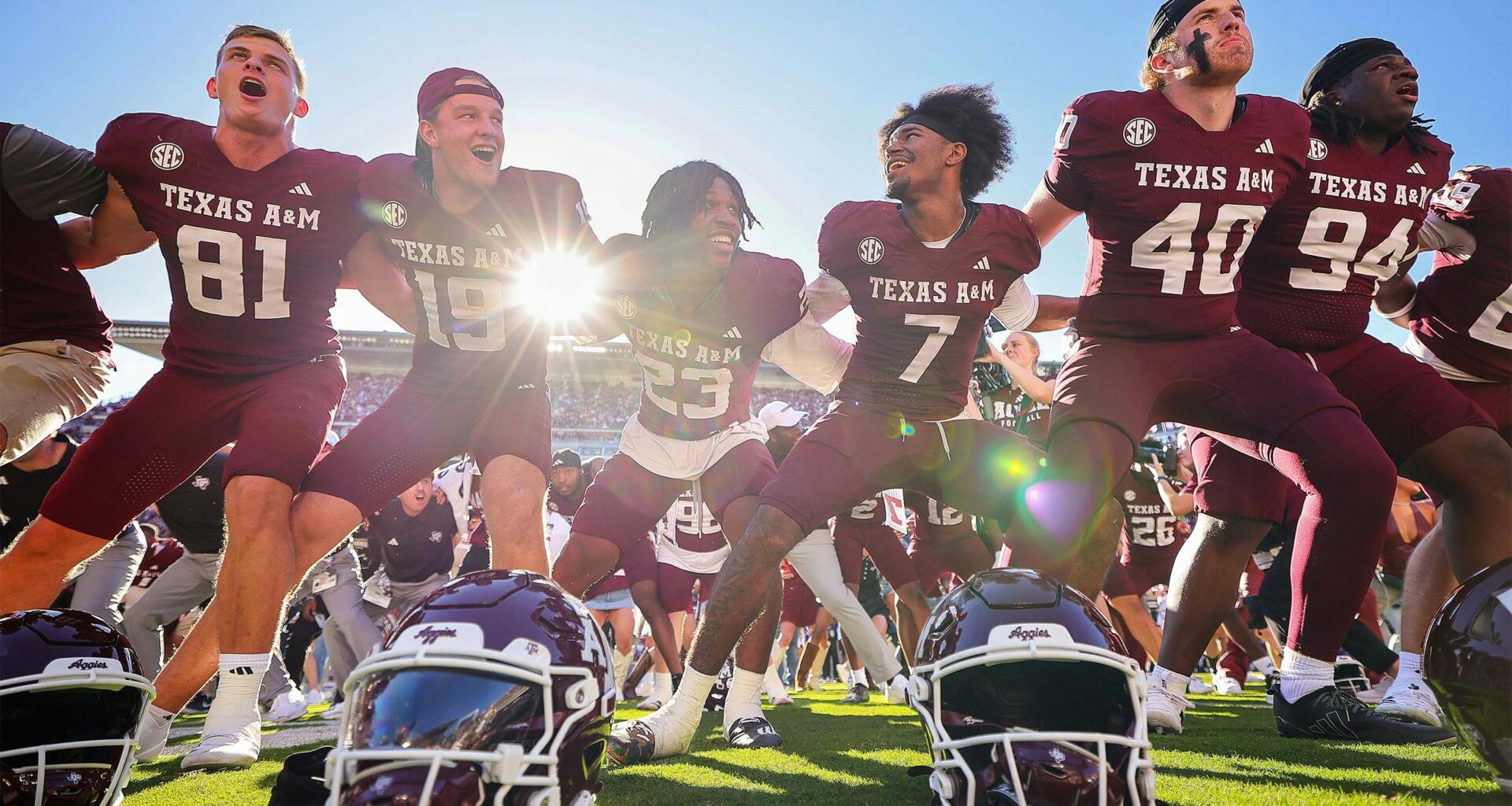
Instead, it’s Texas A&M that’s back.
The Aggies were expected to be good this season. Just not this good. They were nineteenth in the first AP ranking and picked to finish eighth in the SEC media poll. Instead they’re unbeaten, alone atop the conference, and number three in both the AP poll and College Football Playoff rankings (behind Ohio State and Indiana).
The Aggies’ second-year head coach, Mike Elko, has already received a fatter, longer contract, and while his defense this year isn’t quite the Wrecking Crew (Exhibit A: that recent 30–3 first-half deficit against South Carolina), it leads the country in third-down-conversion percentages and is ranked second in sacks. More importantly, the offense is unstoppable, with quarterback Marcel Reed and three big-play receivers joining an established running game to go from good to great (Exhibit B: the biggest comeback in school history in the second half against South Carolina). A&M is even favored on the road against the Horns on Friday.
The caveat: Since beating Notre Dame 41–40 in September, the Aggies have not faced any other likely playoff teams. That’s just how the SEC schedule lined up this year—no Georgia, Ole Miss, Alabama, Oklahoma, or even Vanderbilt. UT might actually be the best team A&M has faced since the Fighting Irish, unless it was Missouri. The Aggies will get their shot at Georgia—and their first SEC championship—soon enough; they can also lose to Texas and still go on to win a national championship. But nobody in College Station wants to do it that way.
The Dark Horse
The biggest star in the Texas Tech football program has been Board of Regents chairman Cody Campbell, a former Red Raiders offensive lineman and billionaire oilman mega-booster. But the players he and Tech’s NIL collective brought to Lubbock—including more than twenty in the transfer portal—have caught up.
With all of that new talent, the Raiders were expected to be better than last year’s 8–5 squad and compete for the Big 12 Conference title in a scrum of six or seven teams. But there’s been no scrum. Tech is one of the conference’s two dominant schools, and they’ve already beaten the other, BYU.
For all its portal hype, Joey McGuire’s team has also been fueled by returning quarterback and Lubbock local Behren Morton; Tech’s only loss, to Arizona State, came when Morton was out, injured. The Raiders are third in the country in scoring offense with 42.6 points per game, but this is not your father’s—which is to say, the late Mike Leach’s—Texas Tech. This time it’s all about the defense, which allows just 12 points per game behind veteran linebacker Jacob Rodriguez (who’s been the object of some Heisman hype) and national sacks leader, David Bailey, the second Raiders star to transfer in from Stanford (after softball pitcher NiJaree Canady). Tech looks ready to take on any SEC or Big Ten team in the CFP.
Texas’s Own Cinderellas
The SMU Mustangs—they’d rather you stop calling them the Ponies—only just got back into the playoff picture, thanks to Pitt’s upset of Georgia Tech. They could also get the shaft. A CFP berth is guaranteed to both the five highest-ranked conference champions and a single Group of Five team, but if the latter is also one of the former, the new ACC champion could be left out of the bracket for Miami (which is the ACC’s highest-ranked team but not on track to make the title game) or another SEC team.
Did you get all that? In that not-impossible scenario, either Tulane or North Texas would win the American and also be ranked ahead of SMU. But right now the CFP committee has SMU ranked twenty-first and Tulane twenty-fourth, so the Mustangs should be safe.
Either way, the best story in college football this year—North Texas—has a few more chapters left. We already knew Mean Green head coach Eric Morris, a former Texas Tech receiver and assistant coach, was a quarterback whisperer, having mentored both number one NFL Draft pick Cam Ward and current Oklahoma quarterback John Mateer, as well as Pat Mahomes and Baker Mayfield. But in his first two seasons, he hadn’t yet taken the Mean Green past its typical 6–7, minor-bowl-game ceiling. And what the transfer portal giveth—former Oklahoma and TCU quarterback Chandler Morris, no relation—the transfer portal taketh away: The University of Virginia made Morris an offer last year that he couldn’t refuse, after just one season in Denton.
Enter Drew Mestemaker. A walk-on from suburban Austin, Mestemaker hadn’t even started a game as quarterback since his freshman year in high school (as ESPN’s Dave Wilson noted, he was a safety and a punter). But with Morris headed to Virginia, Mestemaker took over in last year’s Servpro First Responder Bowl, and he now has the keys to America’s highest-scoring offense—the Mean Green are averaging 46.3 points per game. And Mestemaker himself leads the country in passing yards, with 3,469.
The Mean Green have Temple at home on Saturday and then would likely have to beat Tulane at Tulane in the American Conference championship game to complete the miracle run. A tall order, but the Mean Green have already won a lot of games they weren’t supposed to. As of this Tuesday, that habit has also already got Morris hired by Oklahoma State—but he’ll continue to coach the Mean Green for as long as they are playing. Will that deadline be December 6 (the conference title game), December 19 or 20 (the first round of the playoffs), or further out?
Here’s the fun part. Morris could bring his soon-to-be-former team back to the place where it all started for him: Lubbock. North Texas at Texas Tech is one of the first-round playoff possibilities, depending on how the seeds work out. So is SMU at Tech. Tech could also join Texas A&M as one of the four teams with a first-round bye—in which case, one of them could face UNT or SMU, maybe even at the Cotton Bowl in Arlington. It’d be a Texas New Year’s Eve for the ages.
Read Next