
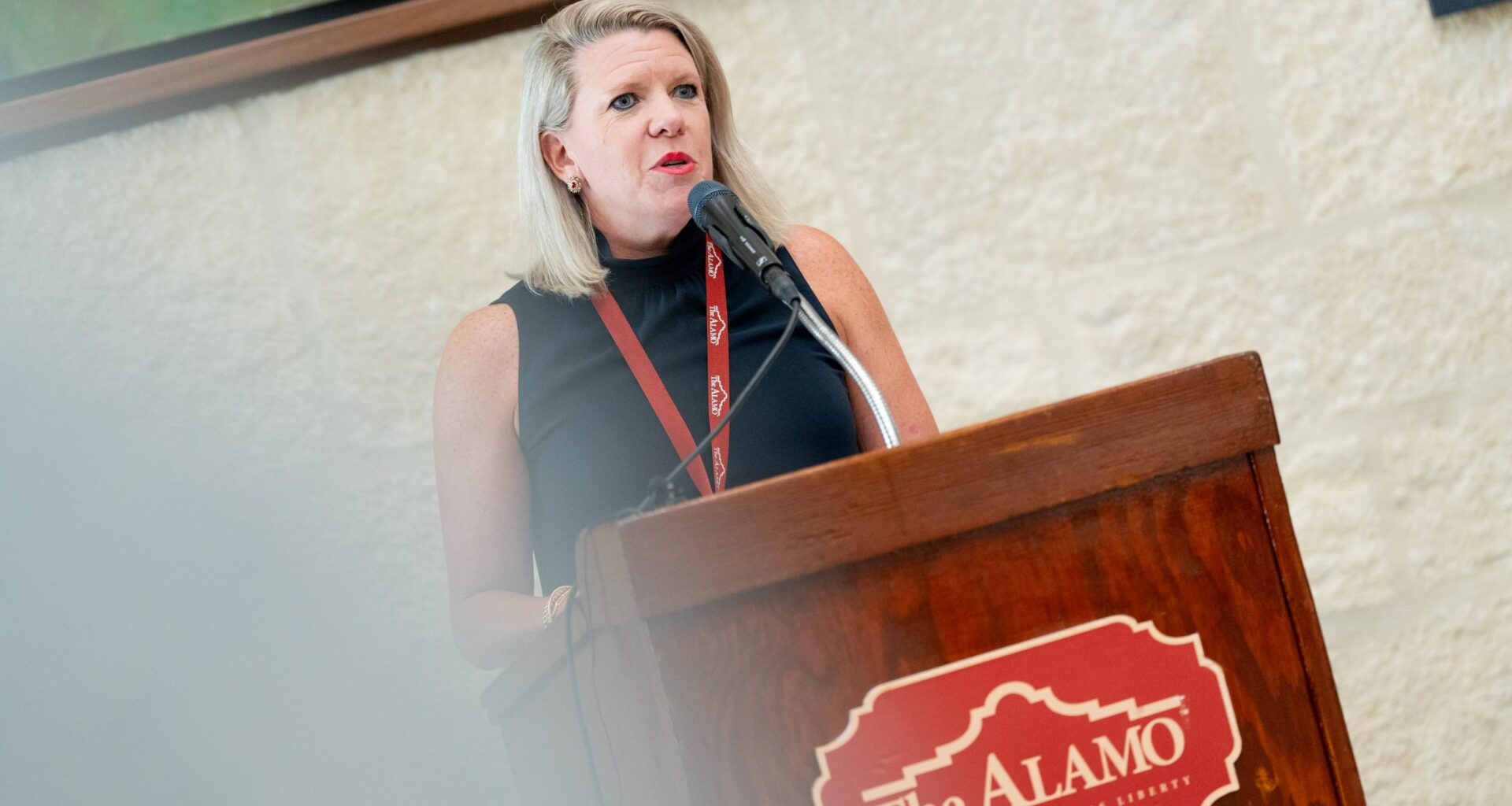
In the weeks since Kate Rogers was ousted from her role as CEO of the Alamo Trust, Inc., the GOP state leaders who called for her resignation say the half-billion dollar redevelopment plan she was overseeing is moving forward without a hitch.
But Rogers isn’t going quietly after passages from her two-year-old doctoral dissertation were held up as evidence her personal politics were “incompatible” with the way state leaders want the eventual museum, visitors center and surrounding plaza to convey the site’s history.
Last week, Rogers sued Lt. Gov. Dan Patrick, Land Commissioner Dawn Buckingham and members of the Alamo Trust’s board of directors, shedding new light on their efforts to influence such projects and asking that she be reinstated to her role.
In an interview with the San Antonio Report, Rogers said the current political environment compelled her to fight back against what she sees as a violation of academic freedom laws.
Texas’ higher education institutions face increasing scrutiny from GOP leaders, who’ve spent the past year pushing out professors they disagree with, auditing curriculum for references of race and gender and appointing political allies to top leadership roles at the state’s largest public universities.
University leaders have little leverage to push back, given the tremendous influence state and federal leaders have over their funding.
But Rogers is now free to speak her mind — and hopes doing so could make a difference beyond her case.
“People separate from their employment all the time. What’s unique about this situation is that the reason that I was asked to resign was because of something I wrote in my dissertation, which is protected speech under the First Amendment,” Rogers said.
“I felt compelled to fight that, because that’s a dangerous precedent,” she continued. “Somebody took the trouble to find my dissertation. I think it puts a lot of people at risk.”
The San Antonio Report sat down with Rogers to talk about how she went from an ally of Texas GOP leaders to an enemy, what her departure means for the ongoing Alamo redevelopment project and what’s next for a San Antonian who’s now suddenly in the state and national spotlight for her political views.
The conversation has been lightly edited for clarity and length.
Before these recent highly public disagreements with state GOP leaders — first a social media post they deemed “work” and then the dissertation — you were regarded by many as the person bringing state and local officials together on a project they’d long fought about. How did you wind up in that role?
I got called by a recruiter to take the job, sort of out of the blue. When I got the call I didn’t even know what the Alamo Trust was. I was recommended by a couple of local people. I think at that time [early 2021], because there was so much controversy surrounding the plan that was being advanced before I got there, that the board was looking for someone who understood the local landscape, but also the political landscape in Texas, which I find very ironic now.
What is it about the Alamo that’s made the political discussion around it so volatile for so long?
[The redevelopment] is very, very controversial, I think for multiple reasons. One is, you do have joint ownership of the physical space between the city and the state. There’s a lease agreement that’s now in place that helps to articulate who has control over what. So that’s one thing, there’s a physical space.
I think on both extremes, there’s the folks who want to say that the only reason for the revolution was slavery. And on the other extreme, you have people who don’t want to talk about anything but the 13 days of the siege. So there’s strong opinions on both sides.
My job when I was there was to try to balance those points of view. There’s a lot of emotion surrounding it, so that’s the final piece of it. What is the story you’re going to tell? What will the narrative be? What will people learn when they come to the site, be that school children or adult visitors?
In a recent exit interview with Texas Public Radio, former Assistant City Manager Lori Houston said it was really tough times at the Alamo before you arrived. How did you become the peacemaker?
Well, I think that was what the job called for. When I stepped into the role I wouldn’t have necessarily said that was going to be what I was doing, and I wasn’t always successful at it. Like I said, there’s strong emotions on both sides. We’re also at this point in our country where it’s hard to have productive discourse with someone who disagrees with you, right? We want to label people: “You’re woke, you’re a racist, you’re this, you’re that.”
That doesn’t help us to understand one another. So I tried to be a good listener. Sometimes, when I felt personally attacked, that was difficult. And when that happened, thankfully there were other great, strong people on the team, and maybe they had better chemistry with a certain individual who had a strong point of view, and maybe they could be a better listening listener or sounding board for that person.
I’m not going to blame one side or the other, because I saw bad behavior on both [the left and the right], honestly, in my role at the Alamo.
So it was a team effort of trying to understand all the different perspectives and trying to be respectful.
What was it like working with Lt. Gov. Dan Patrick, someone who championed this project but who is not popular in San Antonio? He not only steered a lot of state money to the Alamo redevelopment but also donated some personal items he’d collected for the museum, and once praised the way different points of view had come together to make it happen, before ultimately calling for your resignation.
I was pleasantly surprised in working with the lieutenant governor. I didn’t really know him before I took this role, only what you read or hear or see on the news, and he can be polarizing, for sure.
But in this role, he was always pleasant. The people in his office were always pleasant. He was certainly very generous. I mean, let’s be honest, this project would not be advancing forward were it not for him, so I had to be grateful for that. I’m still grateful, because it’s good thing for San Antonio, and a good thing for our state.
After everyone seemed to be on the same page at the museum groundbreaking a year ago, where did things fall apart? And do you think there could be backtracking on the agreements you’d reached before this?
So the new museum features eight galleries, including the lobby. The galleries are chronological, so you’re starting with the first — whatever word you want to use, indigenous, American, Indian, Native American, pick your word — that first [group of people who] occupied this part of Texas some 10,000 years ago. It moves up to the mission era, that part of our history, the Mexican rule over Texas, and the things that led up to the battle and then the battle itself. The battle gallery was always intended to be the largest, the most dramatic it is why most people come to visit the Alamo. No one ever disputed that. And then there’s a couple galleries that talk about what happened after the battle, during the Army Quartermaster era, and then the impact of the Alamo on popular culture.
That has been the plan for several years, and the physical space is largely designed in terms of the exhibits. The exact artifacts to go into the galleries have all been selected.
But there was still debate about the actual text that goes on the wall. In a museum interpretive planning process, normally, there are stakeholders that are involved in that. That’s very common practice. … [If you asked a museum], ‘How did you develop these text panels that are on the wall?’ They would say, ‘Well, we consulted historians, we had community [members] who gave input and feedback. So you start with a very robust and very long outline, and then you write a script from that.
That’s what was happening when I left. There was a script that was in process. It had gone through two drafts, and the Land Commissioner was not happy with its content. … She was upset about the number of times that words like patriotic and freedom were used versus the number of times that words like slavery and enslaved were used.
First [the Alamo Trust’s communications director] Jonathan Hume was fired [over a social media post recognizing Indigenous People’s Day], then me, then script writer Steve Harrigan.
It’s interesting to me that cancel culture was a term that was sort of created on the left, and now over on the right, it feels like, “Well, you can’t say that word. Whatever you do, don’t say that word.” It’s hard to navigate … and the script process will have to adapt to that as they move forward.
Political fights over the Alamo have been going on for a long time but in today’s political climate, presumably other museums and historical sites are experiencing similar issues?
I think any historical site is. You look at Monticello, which is one of my historic sites, and you look at the relationship between [former President Thomas] Jefferson and Sally Hemings. As new research comes to light, new facts are presented, which is what history is. New discoveries are made literally all the time, and you have to adapt to that. So yeah, I think any historic site is having to wrestle with this because that’s where history is made. There’s real archeology happening.
You look at James Monroe’s home, right down the road from Monticello, and the whole time that we’ve been thinking, this was James Monroe home. It wasn’t. The real house burned down, but through archeology, that was discovered in like the last 25 years.
At some point in the future, there could be new information about the Alamo that no one has ever learned before, and that’s going to force a change in the way things get told.
… My dissertation was actually about the role of U.S historic sites and museums and supporting social studies instruction in K-12 classrooms. My research sites were actually Mount Vernon, Monticello, Gettysburg, and the National World War II Museum in New Orleans. So while this has become this big, public thing, the interesting thing about it is, the dissertation wasn’t actually about the Alamo.
Were either the Indigenous People’s Day post or the dissertation, which talked about some of your personal disagreements with the conservative-dominated legislature, things you feel like you should have know would be a problem with state leaders? Or do you think they were reacting to pressure from the conservative activists in their base who those writings it and wanted them to do something about it?
What I hope comes out as part of this litigation is the truth. I’d like to know the answer to that question.
Buckingham voted for the recognition of Indigenous People’s Week when she was a [state] senator.
Dissertations, technically they belong to the school library once you publish them. But you know, the reality is, once you get it approved by your research committee, they go onto a shelf somewhere, and the only people that ever read them are other students down the road who are doing research on a similar topic. … Most likely someone called the university looking for it.
I think it’s important to remember who you write the dissertation for. The “Role of the Researcher” section [which Patrick took issue with] is supposed to talk about any biases that you might bring to the table as the research instrument in a qualitative study. Because I was a student at the University of Southern California, professors from USC didn’t have a lot of background or knowledge about Texas politics.
What I was trying to explain was the political complexity that surrounds the Alamo, because you have very conservative leadership at the state level, and much more progressive leadership at the city level, and you have to work to bridge those two.
[But], I think [Patrick thought] it sounded as though I was being critical of the Texas Legislature. I could see how someone could read it like that, and the legislature is the largest donor to the Alamo project.
I think it puts a lot of people at risk if we live in a place where you write something at one point in your life for a very specific purpose as a private citizen, and then later that it’s used as a weapon against you, for someone with a specific agenda. That doesn’t feel like the United States to me, it also doesn’t feel like Texas.
So what’s next for you?
It’s always been important to me that my work makes a difference in the world. I had a very long career at H-E-B, and what I loved most about the company is all the good they do in the community. So whatever I do next, it needs to be something that has meaning. I’ve been talking to folks about whether that’s here in San Antonio, or it could be someplace else.
Would you ever consider running for office?
I never say never. When all of this was happening and I was debating whether or not to pursue this lawsuit, I was talking to someone who was lamenting some of the folks who are in office today, some of this behavior that’s just not becoming of us as a state or a country. The reality is, part of us is where we are because a lot of good people don’t want to run because it becomes so ugly. But then again, if good people never run, nothing will ever change.