
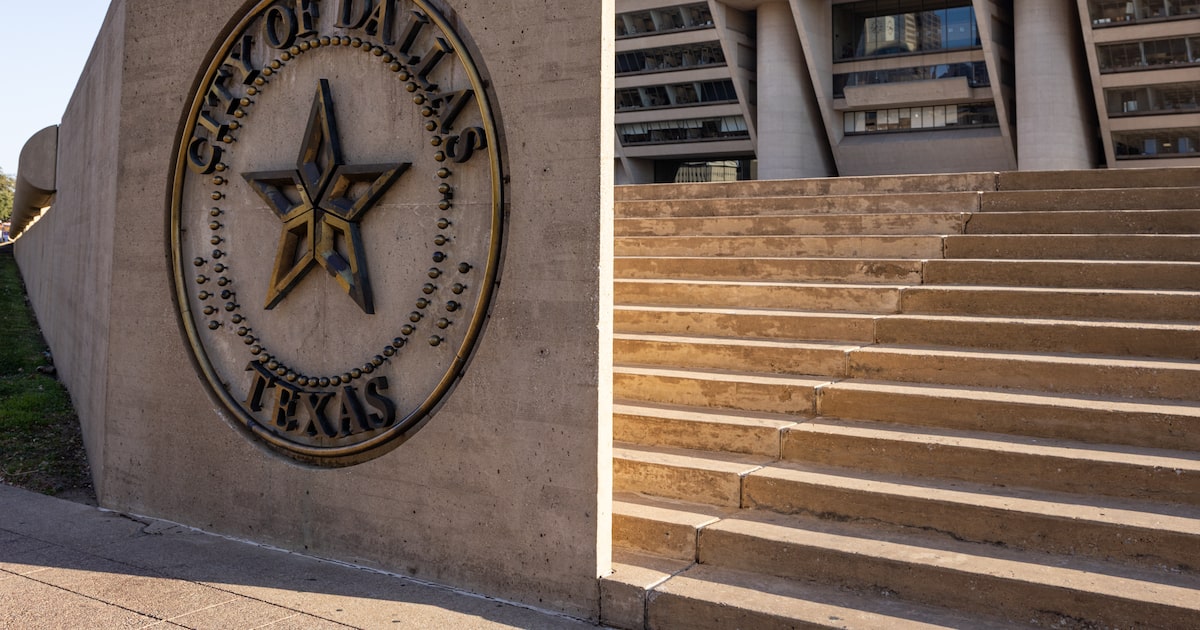
When inspectors assessed Dallas City Hall in fall 2016, they found a missing roof skylight covered only with plywood, plastic sheeting, and duct tape. It was just one sign of the then-38-year-old building’s mounting disrepair.
The roof, rated in a 2018 facility assessment report as “poor” condition, had leaking skylights, standing water, and missing materials. At the time, it was part of repair estimates totaling around $90 million to address concerns for the entire building. But nearly a decade of deferred maintenance has sent those costs soaring, with the latest projections now topping $345 million as city officials weigh the future of the iconic I.M. Pei-designed structure on Marilla Street.
Even with the assessment, estimates to upgrade City Hall varied widely. Dallas officials in 2018 estimated repairs could cost between nearly $19 million and almost $93 million, largely for electrical, fire and roofing upgrades. That tally stands in the shadow of estimated repair costs now totaling between $152 million and $345 million as city officials explore alternatives to City Hall, which is now 47 years old.
Related
The assessment, done by infrastructure consulting firm AECOM, found major safety risks with Dallas City Hall’s electrical system, which received the lowest possible rating: “failed.” The equipment was also old, corroded, and poorly maintained. In some areas, protective covers were missing, exposing live electrical parts, and some transformers and panels had wiring exposed. On top of that, the manufacturer no longer made some of the parts.
Political Points
Seven years later, the system remains largely unaddressed, and the building’s repair needs have only grown.
The 2018 report warned cost estimates could vary by 25% to 50% because they were preliminary. It also doesn’t include water damage or structural analysis, like for the underground parking garage, which are among the major issues now plaguing the building.
The 2018 report lists full replacement estimates, including $19.8 million for electrical system upgrades, $15 million for a new HVAC system, $14.5 million for elevators and lifts, and $13 million for floor and roof replacements. The 2018 report’s rough estimates now pale in comparison to today’s projections, which include up to more than $40 million for HVAC upgrades, up to more than $15 million for electrical repairs and upgrades and up to $4 million to replace the roof.
A similar facility condition assessment of City Hall or other city-owned buildings hasn’t been done since, and city officials say the process for a new assessment likely won’t begin until next year.
The City Council earlier in November directed City Manager Kimberly Bizor Tolbert to evaluate real estate opportunities, including potential relocation sites for Dallas’ municipal government, and report back to the council’s finance committee by February 2026 in light of recent speculation about the building’s mounting repairs.
The resolution also requires a third-party assessment of deferred maintenance costs for City Hall and an exploration of economic development opportunities for the downtown City Hall site.
Since 2017, the Dallas City Council has repeatedly ignored or cut funding for City Hall repairs through bond programs. Last year, a proposed $28 million in City Hall repairs was completely eliminated by a last-minute council amendment.
As part of Dallas’ latest $5.2 billion budget, the council approved around $14.5 million for major system repairs across all city-owned buildings. It’s unclear how much of that funding, if any, will be directed to City Hall.
Jack Ireland, the city’s chief financial officer, told council members on Nov. 12 that Dallas has about $10 million to $11 million in reserves that could be redirected for City Hall repairs, if necessary.
Dallas City Hall underwent a four-day inspection in the fall of 2016. The report rated most parts of the building, including the outside and inside windows, walls, doors, plumbing, HVAC, and fire suppression systems, as being in average condition.
Inspectors found several serious issues with the roof: leaking skylights above the main emergency stair towers, a missing skylight, and standing water across much of it. Estimates were at $1.35 million for a full replacement and another $660,000 for new roof coverings and openings, the report said.
The building’s backup power systems, including emergency generators, were also aging and unreliable. The report recommended a full upgrade of the uninterruptible power supply system, which supports critical functions like 911 dispatch.
Many Dallas residents and officials worry that exploring alternatives for the aging City Hall could lead to its demolition. This concern comes as the Dallas Mavericks search for a new arena before their lease at the American Airlines Center ends in 2031. Some have suggested the City Hall site as a possible location, though the team has not confirmed any relocation plans.
At recent meetings, residents have overwhelmingly opposed demolition, with many calling for the building to be preserved, demanding an independent review of city repair estimates, and accusing the city of prioritizing developer interests over preservation.
City leaders say the process is not a decision to demolish, abandon or save the building, but rather a way to gather all the facts. They describe it as a fact-finding mission to help the council make an informed choice about the building’s future.
Earlier this year, the city’s Landmark Commission started the process of designating City Hall a historic landmark, temporarily blocking significant changes to the building, such as demolition, for two years without the commission’s approval. Final approval of whether City Hall becomes a city landmark rests with the City Council.