
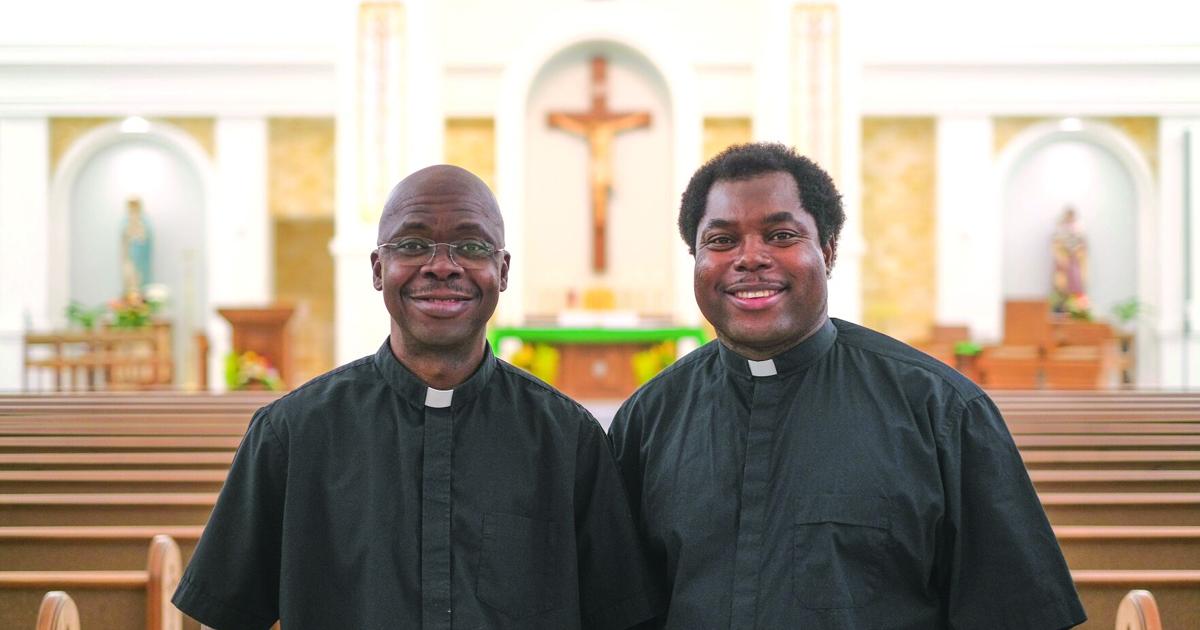
That two Catholic parishes are thriving within a mile of each other in Ahwatukee and share the same anniversary year is certainly a reason for many of their members to be grateful.
And for their pastors, it’s also something to marvel at – even if they can’t fully explain how it is that St. Benedict Catholic Church and Corpus Christi Catholic Church both have thrived despite their geographical proximity.
“I really don’t know,” said Fr. Manasseh Iorchir, V.C., pastor of St. Benedict. “Ahwatukee seems to be like a kind of unique town…such a loving community, very peaceful, and lots of schools. I think [there’s] a high percentage of middle class, in a way. So probably that could be it. It just happens to have a lot of Catholics here.”
But he quickly added that the deeper answer may not be demographics at all.
“For me, it’s the work of the Holy Spirit. God’s Spirit works in mysterious ways and ways beyond explanation. I feel God’s Spirit is working here.”
Corpus Christi Pastor Fr. James Aboyi, V.C., on the one hand offered a more practical observation as well: “Maybe we can credit the past pastors who served here before – they probably did a great job of reaching out to people.”
He also noted that St. Benedict – where he was pastor for five years until he was transferred to Corpus Christi with the added responsibility of overseeing six other East Valley parishes – draws heavily on Chandler Catholics while Corpus Christi’s congregation comprises largely Ahwatukee residents.
Aboyi also sees a biblical significance in the churches’ anniversary, noting the number “40” appears in several major Old and New Testament accounts.
The Israelites wandered in the desert for 40 years after fleeing Egypt. The Bible says it rained 40 days and nights as Noah set sail. Jesus fasted 40 days in the wilderness before beginning his ministry,
“Even in the Bible, 40 is a significant figure…a period of trial that always ends in a joyful way. So we pray for some wonderful things to happen around here at this 40-year mark,” Aboyi said.
A wandering of sorts
St. Benedict’s history in some ways echoes the Israelites’ first four decades of escape from Pharoah’s heel.
Established in 1985 in Chandler, 77 people on Dec. 1 of that year attended its first masses in the “upper room” of a strip mall, according to its history.
Within two years, its congregation of 24 registered families had grown to 106 and in April 1988, St. Benedict celebrated its first mass in a new church on Del Rio Street in Chandler. It grew to 676 families within the next seven years.
It was moved by the Phoenix Diocese to its home at 16223 S. 48th Street in 2004 to meet the projected growth of Ahwatukee.
That site already hosted St. John Bosco Catholic School and masses were celebrated in its multipurpose room, where 15,000 chairs and benches were moved in and moved out every week for Sunday mass for a year.
In 2007, the diocese named the school a ministry of St. Benedict and the parish acquired more land to the east, incurring a $3.2 million debt that the congregation paid off between 2013 and 2016 – 11 years ahead of schedule.
But St. Benedict still lacked what many parishioners would call a “real church,” as liturgies continued to be held in the large gymnasium-like building that had been used by the school.
A committee of devoted parishioners formed in 2013 started a capital drive to build a new church on the campus, with plans to use the existing “church” for other parish activities.
But tragedy struck in 2018. Pastor Fr. Bob Binta, the congregation’s beloved pastor and chief cheerleader for a new building, succumbed to cancer.
Economic headwinds driven largely by the pandemic’s disruption forced the building committee to refocus its objective: Instead of building a new edifice, it raised over $9 million to radically convert the gym-looking building inside and out into a spectacular house of worship.
Some parishioners donated more than money to the effort. Ahwatukee retired cabinet maker Frank Polimene made the main altar, lectern and cross in the nave as well as a smaller altar for a chapel inside the main church.
In January 2024, the new St. Benedict Church was dedicated, ending what the diocese newspaper called “a 40-year journey.”

Construction of Corpus Christi’s current church began in early 1996 and the building was dedicated a year later.
(Corpus Christi history)
Helped by friends
Corpus Christi’s storied past began with help from one of Ahwatukee’s pioneers.
The late Rev. Don Schneider, founder and longtime pastor of Mountain View Lutheran Church, allowed the congregation of Corpus Christi – which Phoenix Bishop Thomas J. O’Brien established in June 1985 – to celebrate its first mass in his church.
As the congregation grew from 300 to nearly 1,000 families, a successful building fund drive in 1987 produced Corpus Christi’s campus on 3550 E. Knox Road – thanks to the donation of its land by parishioners Frank and Mary Labriola.
The campus included a church seating 700 people, offices, six classrooms and a rectory for two priests.
As Ahwatukee grew through the early 1990s, Corpus Christi’s registered families soared from 1,000 toward 2,500–3,000.
Sunday Masses were packed, with standing room only and people even standing outside the doors at the busiest of the liturgies.
By 1994, parish leaders had launched a capital campaign that ultimately produced Corpus Christi’s current church.
Parishioners helped pour the foundation with some bringing soil from their yards. According to a church history written on the occasion of Corpus Christi’s 25th anniversary, Kurt Wagner, chairman of the building committee, was quoted as saying:
“I did four tours in Vietnam and once, while there, I filled a jar with sand. When we broke ground, I brought that jar and poured it into the ground where the sanctuary would eventually be. This way, our veterans will always be remembered and represented in a special way.”
In February 1997, Corpus Christi’s new church was dedicated.
A completely renovated St. Benedict church was dedicated in January 2024.
(file photo)
Looking to the future
Today, both parishes are headed by priests whose history has been intertwined in Ahwatukee for several years.
Both natives of Nigeria and members of the Via Christi Society religious order, Aboyi and Iochir worked together for several years at St. Benedict.
In 2021, about a year after his ordination, Iochir came to the U.S. and was assigned to St. Benedict, working there until he was briefly assigned to St. Steven’s Catholic Church in Sun Lakes.
A few months ago, both priests received their new assignments.
“I was very surprised,” Iorchir said of his reassignment to St. Benedict, noting priests rarely are reassigned to a church they had served at previously.
But it also felt like a homecoming, he said.
“I was coming back to a place that I knew,” he said. “Added to that was the fact that St. Benedict was the first parish I arrived at when I came to the United States. I forged a relationship with the members…so when I had to come back, it was like coming to a place I knew.”
Aboyi said he had not been unfamiliar with Corpus Christi because he had helped out with various liturgies in the past. “But it was still a good surprise,” he added.
U.S. Rep. Greg Stanton read a tribute to Corpus Christi into the Congressional Record a few weeks ago, calling it a “cornerstone of Ahwatukee’s Catholic community.”
The parish describes itself as “a welcoming community joyfully proclaiming the love of God through evangelization, prayer, sacramental living, and service,” with year-round ministries ranging from an active St. Vincent de Paul outreach to extensive children’s and youth faith-formation programs and a tradition of Perpetual Adoration of the Blessed Sacrament.”
St. Benedict today describes itself as a “vibrant and welcoming Catholic faith community” serving more than 1,300 families from Ahwatukee, Phoenix, Tempe, and Chandler.
The parish campus hosts a full slate of ministries: liturgical participation, children’s faith formation, youth ministry, adult formation, and outreach through St. Vincent de Paul, Knights of Columbus, Family Promise, and other groups.
Stanton also read a tribute to St. Benedict into the Congressional Record, noting the new church building stands “as a testament to the faith, perseverance and generosity of its parishioners.”
The two pastors say the relationship between Corpus Christi and St. Benedict is close.
“Yes, we collaborate very well,” said Iorchir. “We work as a team.”
The joint efforts include religious education, youth retreats, and the large seasonal confession services at Christmas and Easter.
As dean, Aboyi also coordinates priests and deacons for six to eight parishes in the region and represents the bishop on certain local matters.
When asked about the biggest pastoral challenge today, both pastors answered instantly: young people.
“Our desire is to have so many people come to church,” Iorchir said. “But how to reach out to young people is one of the most challenging things…Vocation is declining, and we need more young people who can replace us.”
He described a twofold concern: “Getting them first in the door, but then having them think of a vocation.”
Aboyi agreed completely: “Another problem is retaining young people coming to church, and satisfying their expectations of what their experience of the church and of worship is, and what we have to offer.”
At St. Benedict, one advantage is its parish school.
“We’re blessed to have a school as a ministry,” said Iorchir. “One of the things Father James did while he was here was getting the kids involved in the life and mission of the Church. And for the kids to be involved…their parents have to bring them, and their parents bringing them means their parents also get involved. I think that was a pretty smart strategy.”
Both pastors say the historic election of an American pope to lead the church for the first time has sparked interest among Catholics.
“It makes a big difference,” Aboyi said. “I think it gets the attention of many young people – maybe they can be pope one day or something. Some listen more now to the Church.”
Iorchir added, “People begin to realize that even the future of the Church has been placed in the hands of someone who is a citizen of the United States. It shows the Church has attained some appreciable level of maturity…[and] that the rest of the Church outside the United States will now see the United States as the true leader, even in the Church, as it should be.”