
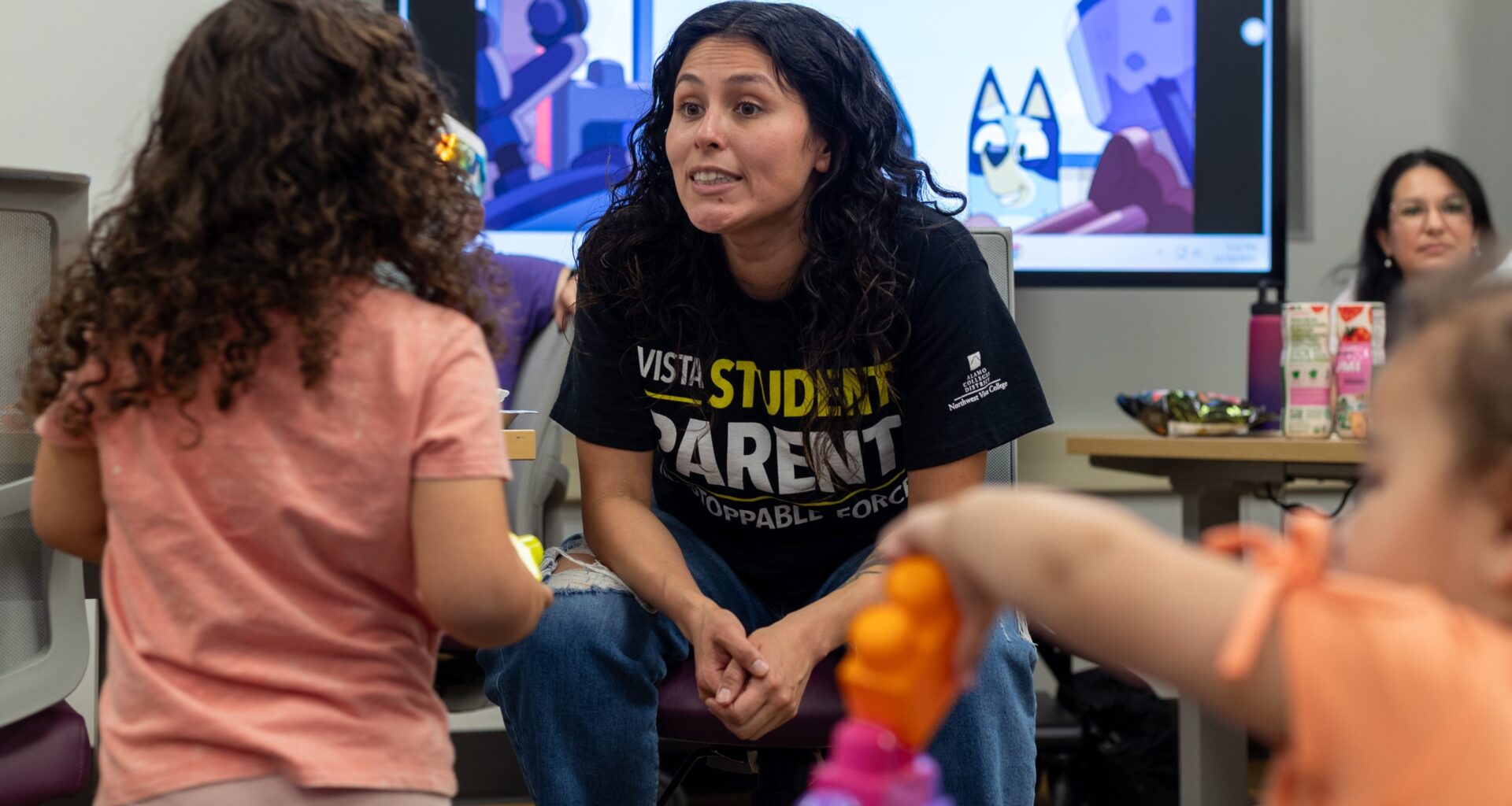
A few days after Perla Lopez started her first year at Northwest Vista College in 2023, she walked into her first student engagement fair with one goal; join a student club.
The tables lining Huisache Hall advertised all kinds of clubs and organizations — an anime club, a military club, a cat club.
But one lonely table stood out to Lopez among the rest.
“I see one club that only has one person sitting at the table,” Lopez recalls. “So I go over to that club and I see that it’s the parent club. … I talked to [this person] — who I didn’t know was my adviser at the time — and I told her I was a parent myself.”
Lopez, 27, was told that this brand-new club NVC Parent Club had no members and no officials yet. Before she knew it, she was emailing ideas for the club to her adviser and getting recruited to become its president.
“We want to build more awareness so that more student parents know that they have a community here,” Lopez said. “We are also working towards offering more resources, like more possibilities for child care.”
Out of the nearly 80,000 students enrolled across the Alamo Colleges during the 2024-25 academic year, approximately 15% reported being parents. The colleges are working to address their needs, especially child care, despite losing thousands in federal grants.
According to 2023-24 district-wide data, students who reported being parents had lower 3-year graduation rates and persistence rates than non-parenting students, meaning they were less likely to stay enrolled until completion of a degree or certificate.
Child care was the number one concern for most of the more than 11,400 Alamo Colleges District students who reported juggling parenting and college in the fall of 2024.
Each of the five colleges — San Antonio College, Palo Alto College, St. Philip’s College, Northwest Vista College and Northeast Lakeview College — have their own version of free or low-cost child care for their students.
 Palo Alto College’s Ray Ellison Family Center currently serves more than 30 students across three classrooms with student ages ranging from 18 months to four years old. Credit: Amber Esparza / San Antonio Report
To offer these options, each college relies on partnerships with other organizations, federal and state grants, as well as financial support from the alumni foundation and other gifts.
This summer the Alamo Colleges District secured a partnership with AVANCE-San Antonio, a local early childhood organization that operates Head Start and Early Head Start programs throughout the city.
This local partnership allowed Palo Alto College to continue operating an on-campus Head Start program for its students after losing a federal grant known as CCAMPIS, or the Child Care Access Means Parents in School Program that had funded this program for years.
According to federal records, Alamo Colleges District colleges — including San Antonio College, Palo Alto College and St. Philip’s College — received nearly $3 million in federal CCAMPIS grants between 2020 and 2023.
The three colleges were among the undisclosed number of colleges whose CCAMPIS grants were discontinued by the Trump administration as they cited links to diversity, equity and inclusion.
“We’ve had almost each college partner with somebody different just to be able to meet the needs, because we cannot meet the demand that is occurring right now,” said Esmeralda Sweeney, Alamo Colleges associate vice chancellor of student advocacy, retention, and completion.
Adding financial resources, child care and state-mandated parent advisors at each college has helped address these gaps, Sweeney said.
“We had a 20 to 30% jump,” Sweeney said. “We definitely want our parenting students to retain at the same rate, [we want to] remove those obstacles so that they are retaining and graduating at the same rate as our general population.”
Expanding support
Child care is the top priority for most student parents due to the high cost of quality child care, said Roddell Asher, Alamo Colleges District’s director of district-wide student engagement and leadership.
This isn’t the only support specifically aimed at parenting students.
Financial assistance for those who are left out of the in-house child care programs are also made available for qualifying students mostly through grants. There’s also financial assistance to cover other living expenses that might help free up money to pay for child care.
“There’s already funding in some way shape or form, but it’s not ubiquitous. It’s not across all five college campuses,” Asher said. “So we started to identify what practices are occurring at your college campus that would benefit students across the other sister campuses.”
The partnership with AVANCE is not new, Asher explained, in the past the group and the district offered combined resources like out-of-campus care. But their current efforts focus on the possibility of expanding in-campus care across all five campuses.
 Perla Lopez and her son Leonardo Lopez, 1, wear matching dinosour shoes during the Parenting Students meeting at Northwest Vista College on Nov. 20, 2025. Credit: Blaine Young for the San Antonio Report
“Today’s announcement is not only celebrating and supporting our parenting students at Palo Alto and [San Antonio College], but it’s also hoping we can expand child care, or drop-in [child care], to meet the needs of all of our students throughout the community,” Alamo Colleges Chancellor Mike Flores said on Nov. 12.
At Northwest Vista, where Lopez leads the 65-member parent club, the college offers free child care for children between age 5 and 13 through a partnership with the YMCA.
This service focuses on after-school care from 5 p.m. to 9 p.m. Monday through Thursday, and on Saturdays from 9 a.m to 4 p.m. About 25 children are currently enrolled in this program at a cost to the college of about $136,000 per fiscal year, college officials reported.
“The return on investment for us is very clear. This is increasing access, retention and student satisfaction that we anticipate is going to create change in that persistence and graduation gaps between parenting and non-parenting students,” said Janie Scott, Northwest Vista’s interim vice president of student success during a presentation to the board in October.
Northwest Vista had more than 2,300 students who reported being parents in fall 2024, 12% of the student population. Students who are parents complete their courses at the same rate as non-parenting students, officials found, but they lag behind on 3-year graduation rates and fall-to-fall re-enrollment.
The college expanded their offerings this year to include drop-in child care services for student’s studying and tutoring time, Scott said. But age requirements for those programs left out many student parents without on-site child care, including Lopez and her one-year-old son.
The college recently received a 5-year commitment from United Way in which it will receive $20,000 annually to offer students a stipend of up to $500 per academic year to help cover the costs of child care outside the campus.
“We just had a student come tell us that they pay $325 per week for childcare. And if we can help with at least that one week and a half with the $500, we are willing to do that,”said Pamela Frias, senior coordinator of student success at Northwest Vista.
On a recent evening before the Thanksgiving break, Frias and Jo Ann Gonzalez, biology professor and advisor at the parent club, helped hand out $25 turkey vouchers to the students who attended that week’s club meeting.
From these grocery vouchers to adding diapers, baby formula, baby snacks and children’s clothing to their student pantry and student boutique, the club has utilized grants and donations to help mitigate expenses for parents.
“I think there’s more awareness that there are services for students in general, but also specifically for student parents,” Gonzalez said. “I think there’s been a big push to advertise it and let students know that there’s a place for [them] here.”
Finding ways to expand
At San Antonio College, officials also leaned on partnerships to expand their offerings. The college’s Early Childhood Center has existed for over 50 years and today it has up to 82 slots for children as young as 6 weeks and up to 4 and a half years of age.
The college expanded the accepted age group — from starting at 12 months to the current 6 weeks — through a partnership with Upbring, a nonprofit organization run through the Lutheran Social Services of the South.
This partnership added close to 30 additional child care slots, and the CCAMPIS funding allowed them to allocate about 75% of all available slots for students. The rest of these are assigned for college faculty, staff or community members — including former students.
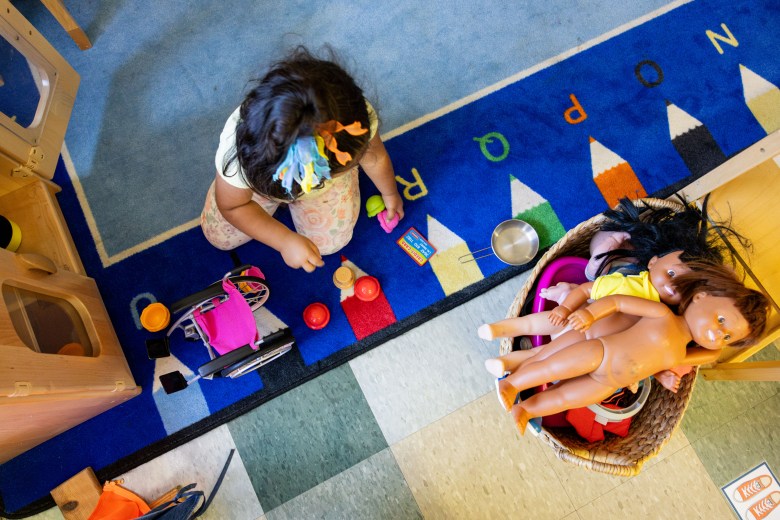 Although Palo Alto College was stripped of a federal grant for campus-based child care services this summer, it was able to open three Head Start classrooms at its Ray Ellison Family Center through a partnership with AVANCE-San Antonio, a local early childhood organization. Credit: Amber Esparza / San Antonio Report
“The college students in [early childhood studies] come here and do their practicums,” said Teresa Robledo, the center’s coordinator. “So being able to provide for those younger ages helps us make better students. … We also partner with the nursing department and their students do rotations here at the center as well.”
Through the federal grant qualifying, students who are parents receive tuition assistance for child care, meaning they would pay between $15 to $20 a week per child. Regular tuition for unqualified students or community members is between $163 and $191 per week.
The college has funding from the last round of CCAMPIS to continue operating in this way through next summer, Robledo said, but college officials are assessing what happens after that.
“I’ve been here for [29 years] and I’ve seen our parents come through here, continue and get their bachelor’s degree or more,” Robles said. “It’s just so awesome that we were able to play that role for their family.”
St. Philip’s College, located on the city’s East Side, also lost access to the CCAMPIS grants. President Adena Williams Loston said the grant had allowed them to offer low-cost child care on site and offer the students increasingly cheaper rates as they neared graduation to encourage persistence, plus give discounts to those with high grade point averages and those who volunteered at the center.
Some of these discounted rates might remain, but not all, due to the loss of federal dollars. The college is utilizing Perkins grants, which fund career and technical education programs, to supplement these costs.
“Students have compelling challenges and education is but one of their competing priorities” Williams Loston said. “A greater percentage of our students are now parenting students, roughly 27% of our students are parenting students. So now we have to deal with childcare, transportation… All of those [needs] are added on top of food and housing.”
Education as a ripple effect
The actual number of student parents on Alamo Colleges campuses may be higher than the district’s data currently shows, since they rely on self-disclosure by students. The colleges plan to do a deeper dive into this population and their needs through a partnership with the Texas Higher Education Coordinating Board.
“We also want to make sure that they’re academically on target,” Sweeney said. “How are they doing in their classes? How are they progressing in their degree? And how can we help them on the academic side?”
The ongoing challenge for the district is to figure out how to expand child care offered at the colleges, especially for younger children between 6 weeks and 4 years of age, Sweeney said, mainly because early childhood care is a costly service even with partnerships included.
For Lopez, having reliable child care through her family means she can spend a little extra time on campus after her classes to finish any homework or assignments. This is the only way she can then go home and focus solely on her child without.
Lopez said an expansion of resources for her and the thousands of parenting students could be what determines the number of classes they take, their level of involvement in campus activities and even their ability to complete their degree plan.
“I think that when parents are supported, their kids see that education is possible, it’s a ripple effect,” Lopez said.
The San Antonio Report partners with Open Campus on higher education coverage.