
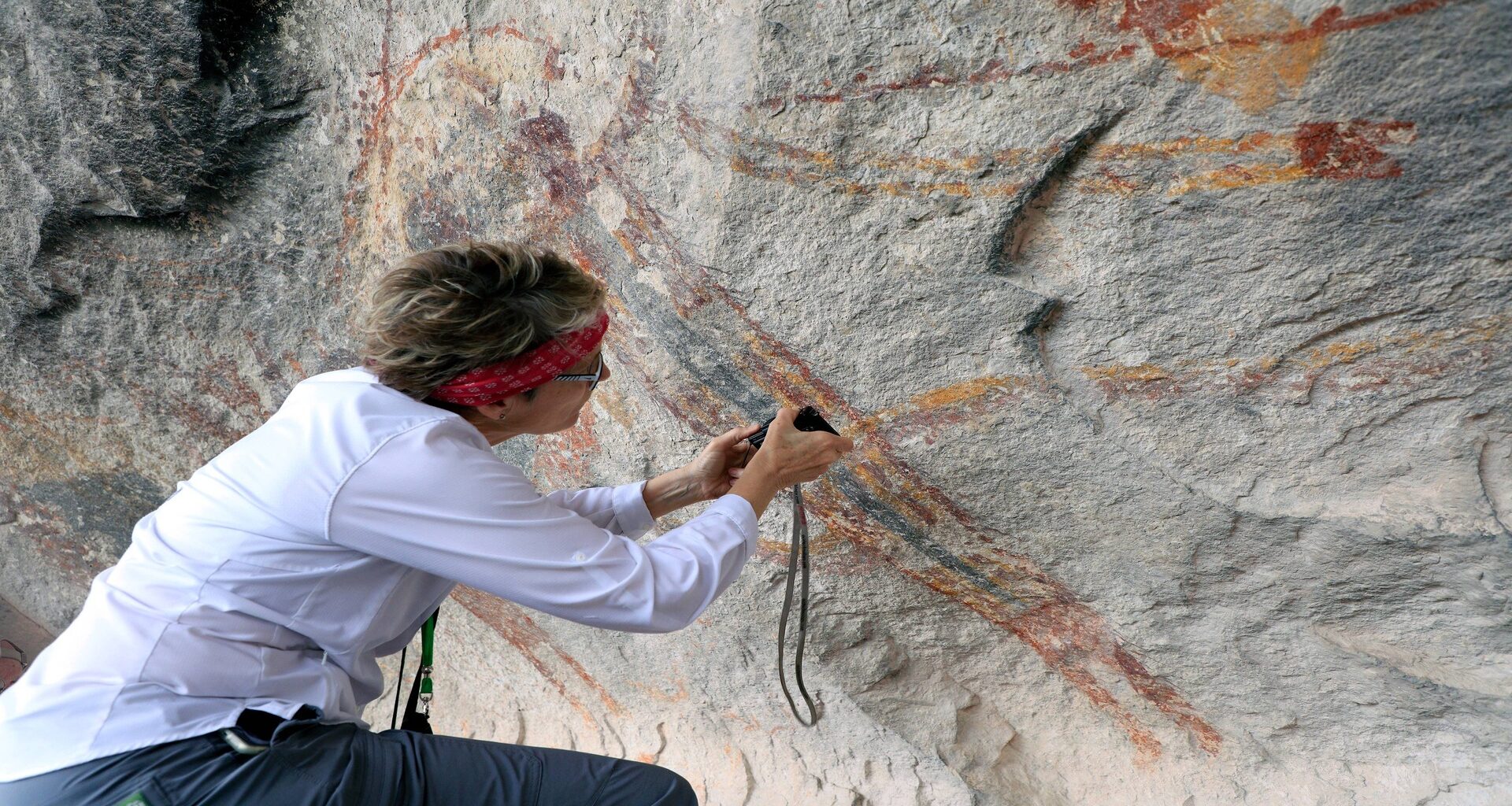
Texas researchers have now definitively dated a distinctive rock art tradition, a profound discovery shared across multiple ancient Mesoamerican cultures.
For thousands of years, ancient forager societies across southwest Texas and northern Mexico painted these stunning murals, known as the “Pecos River Style,” inside remote limestone rock shelters.
These colossal murals stretch up to 100 feet long and soar 20 feet tall. In a dramatic announcement by Texas State University, researchers revealed that “the canyons of Southwest Texas house a vast and ancient library of painted texts documenting 175 generations of sacred stories and indigenous knowledge.”
This monumental tradition is thus deeply embedded in the history and landscape of this US region. Though the desert climate perfectly preserved these significant American works, researchers only recently attempted to date the tradition, leading to a shocking contradiction of long-held archaeological beliefs.
“As an artist and archaeologist, I can tell you that this is a breathtaking discovery,” Carolyn Boyd told Texas State.
A seriously important rock art tradition in the US
To pinpoint the art’s origin, researchers employed 57 radiocarbon dating analyses across 12 sites, utilizing plasma oxidation and accelerator mass spectrometry, which firmly placed the tradition’s start at an astonishing 6,000 years ago.
“But it didn’t stop there,” Boyd explained to Texas State. “Using the same graphic style, symbol system, and rules of paint application, they continued to create these visual manuscripts for more than 4,000 years.”
These paintings—featuring humanlike, animal-like, and geometric figures—were previously assumed to be random additions, slowly expanded by different groups over time.
The bombshell research, just published in Science Advances, dismantled that theory.
“Another huge shocker is that the dates within many of the murals clustered so closely as to be statistically indistinguishable, suggesting that they were produced during a single painting event as a visual narrative,” Boyd said.
“This contradicts the commonly held belief that the murals were a random collection of images that accumulated over hundreds or thousands of years.”
A visual landscape that transmitted beliefs throughout the centuries
Texas State reported that stratigraphic and iconographic analyses proved that eight murals were created as unified compositions, strictly adhering to specific rules and an established iconographic vocabulary.
This composition structure proved to researchers that the art “faithfully transmitted sophisticated metaphysical concepts that later informed the beliefs and symbolic expression of Mesoamerican agricultural societies,” according to the news release.
“The compositional nature of the murals was further supported by our analysis of the painting sequence. Using a digital microscope to retrace the steps followed by the original artists, we discovered that the painters adhered to a rule-bound color application order,” Boyd explained.
“As a result, paint layers of multiple figures are intertwined, forming well-planned, highly sophisticated compositions – some spanning more than 100 feet long and 20 feet tall. They are visual manuscripts created according to a set of rules passed down from one generation to the next for more than 4,000 years.”
“But perhaps the most exciting thing of all is that today Indigenous communities in the U.S. and Mexico can relate the stories communicated through the imagery to their own cosmologies, demonstrating the antiquity and persistence of a pan-New World belief system that is at least 6,000 years old,” she concluded in a news release by Texas State.