
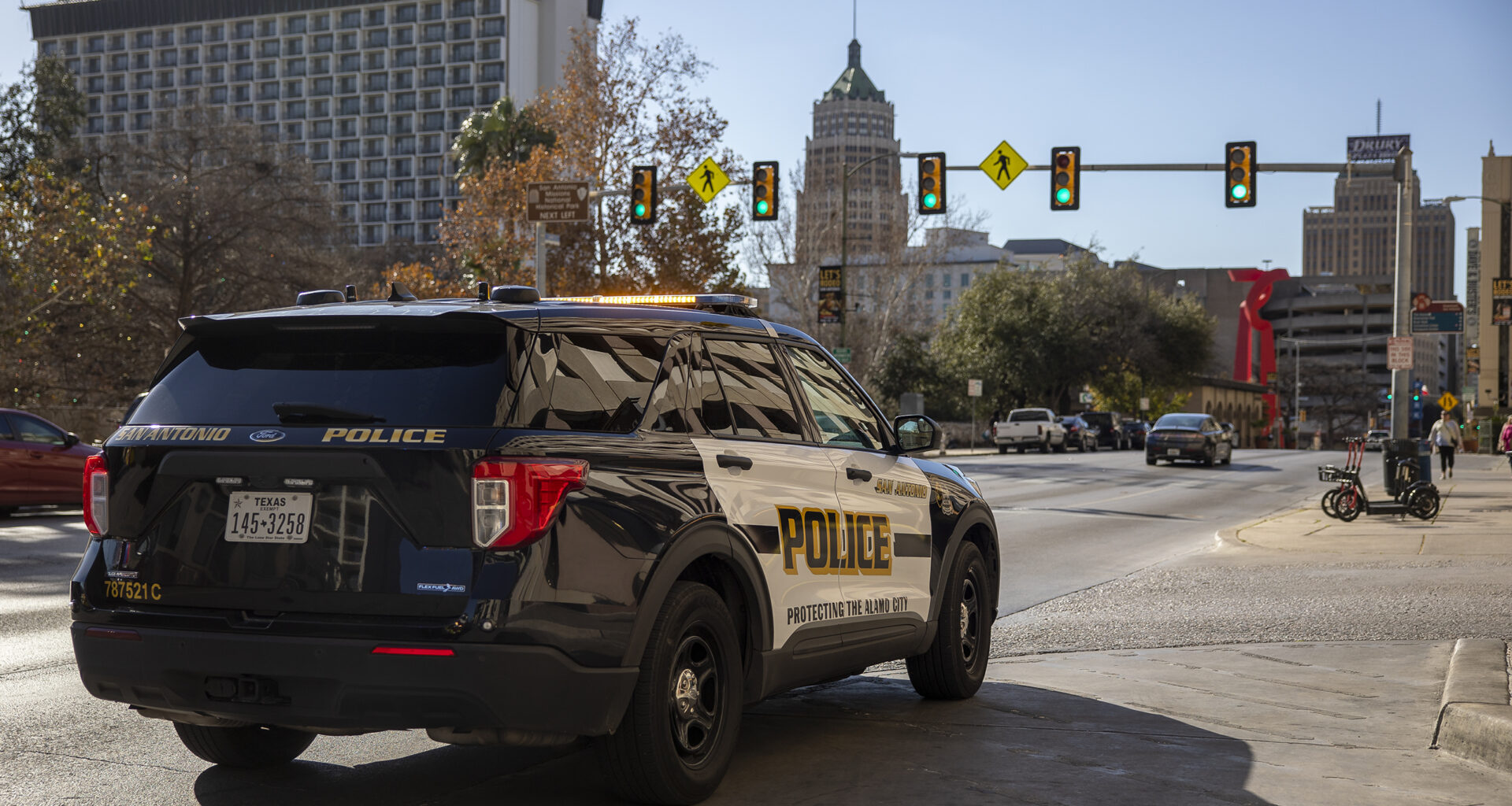
San Antonio is exploring whether retired police officers, civilian crash investigators or expanded online reporting could handle low-priority calls such as minor traffic incidents — a move city leaders say could free up patrol officers for higher-priority emergencies.
The idea, first proposed in a February council consideration request from District 1 Councilmember Sukh Kaur, received its first detailed public briefing last week. Kate Kinnison, the city’s chief innovation officer, outlined multiple approaches used by police departments for handling low priority calls across the state and country.
Kinnison presented two examples of alternative-response models from Denver and New Orleans, where civilians have either been hired as reporting technicians or contracted through private vendors. In Denver, 15 civilian technicians handled more than 15,000 hours of its nonemergency call load last year. Contracted crash agents in New Orleans covered roughly 25,000 hours of low severity crash work in 2023.
One option under review would mirror those models by hiring civilian technicians — but council members also emphasized a second, more specific approach: bringing retired SAPD officers back into the field to handle minor, non-injury calls.
Kaur said both she and the San Antonio Police Officers Association view retirees as the preferred starting point.
“Having talked to some of the police folks, we do understand that the priority is trying to see if we can get our retired officers back in the field somehow,” she said. “Making sure we are exploring that as our first priority — to give folks that still need their badge held or can be out there and are trained in case something does get elevated — would be preferred, based on the feedback I’ve received.”
Another alternative would shift San Antonio away from its current practice of sending officers to every traffic accident, following similar approaches in Houston and Dallas.
In Dallas, dispatchers refer callers involved in crashes with no reported injuries to file their reports online when vehicles are drivable and no crime is suspected. Since 2023, Dallas has required online reporting for minor collisions and several categories of low-level offenses such as shoplifting and harassment.
Houston’s policy similarly directs drivers to move drivable cars to a safe location, exchange information and file their crash reports at a police station within 24 hours unless injuries or criminal activity are involved.
While San Antonio already offers online reporting for several low-level crimes — receiving 8,274 online reports last year — the city still dispatches officers to all traffic accidents. A shift toward a Houston- or Dallas-style model would redirect officer response away from the roughly 98,450 minor, non-injury calls SAPD handles annually, about 5% of the department’s yearly average of 1.8 million dispatched calls.
Councilmember Kaur cautioned that simply directing callers online could make residents feel their concerns are not being addressed. She floated a virtual response approach similar to EMS’s telehealth system, which allows paramedics to consult with some 911 callers over video.
“Sometimes folks just want to see an officer, even if it’s a minor traffic accident,” she said. “With EMS and the way they do their Zoom system, if there could be a way to incorporate some of that technology — where it’s still an officer responding and they can still see them, and the officer can say, I acknowledge you, I acknowledge that this has happened, and here are the next steps — I think that would be great.”
Councilmember Jalen McKee-Rodriguez (D-2) said shifting minor calls to civilians or retirees could help San Antonio move closer to its longstanding goal of increasing officers’ proactive patrol time.
During this year’s budget cycle, the council debated expanding police hiring to meet a target of adding 360 patrol officers by 2029, but proposed amendments to fund additional positions failed on a 4–7 vote.
“In the context of the City Council right now, the goal is to hire as many patrol officers as we possibly can. Officers cannot be patrolling if they’re busy handling all of these low level calls. They cannot respond to the violent crime if they’re doing this. They can’t be proactive if they’re responding to these things,” McKee-Rodriguez said.
City staff plan to return to the Public Safety Committee in January or February with a deeper legal review, cost modeling and potential pilot options.
Those will include analyses of whether retired officers or civilian technicians could be hired under SAPD’s collective bargaining agreement, how online reporting could be expanded and whether a virtual response model is feasible.