

Three El Paso government entities – the county, city and University Medical Center – have received $5.2 million in opioid settlement funds from the state since 2023. Only a sliver of that amount has gone directly toward opioid risk mitigation, according to public records obtained by El Paso Matters.
The funds are part of the $3.3 billion Texas expects to receive over 18 years from national settlement agreements with drug manufacturers, distributors and pharmacy chains involved with the over-prescription of opioids in the 1990s, leading to the ongoing overdose epidemic.
The Texas Comptroller of Public Accounts began distributing payments to local governments and public hospital districts in 2023. Local governments may use their discretion to spend their payments, as long as the funds are used to address opioid-related harms in their communities.
The three El Paso entities have spent about $1 million combined, with nearly half going to companies involved with the construction of the county’s yet-to-be-built wellness center. About 12% went directly to recovery services and medication. There appears to be little to no collaboration between the city, county and hospital to make a unified effort in opioid harm reduction strategies.
Policy researchers have called for transparency and accountability in how jurisdictions use their funds, but found most local governments in Texas have not made that information easily accessible. One outlier is the city of Fort Worth, which created an online summary page with information about its funds. Neither the city or county of El Paso have similar pages online.
“As the largest recipients of settlement compensation, public entities in Texas and across the U.S. have a duty to use these funds responsibly and to report their expenditure decisions clearly to the public,” reads a report from Rice University’s Baker Institute for Public Policy.
This year, the state required UMC, which received the biggest share of the three El Paso government entities, to submit a report summarizing its opioid harm reduction projects in 2024. The hospital submitted a blank report with zero projects on it.
Meanwhile, the city has not spent or proposed how to use any of its settlement funds – though the El Paso City Council passed an opioid harm reduction resolution more than two years ago outlining specific ways to use that funding.
“That’s heartbreaking because we could certainly use it,” said Adan Dominguez, programs director for Project Punto Project de Partida, a recovery services organization in El Paso.
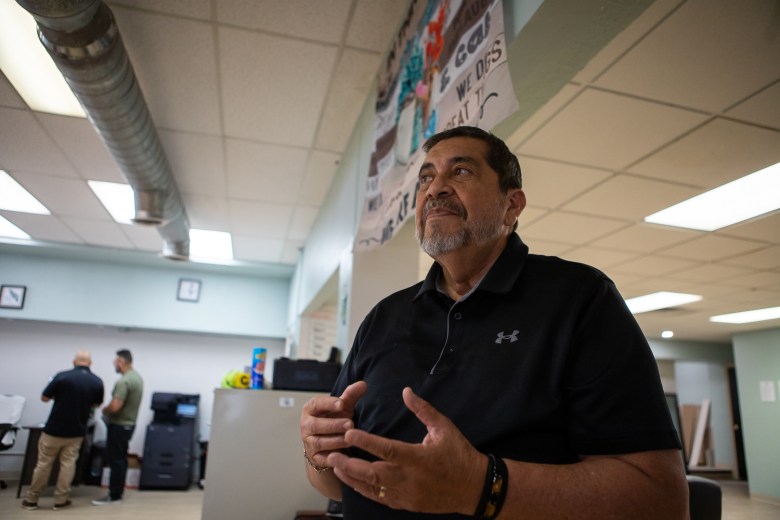 Adan Dominguez, program administrator for Punto de Partida, explains the organization’s mission and processes for serving clients, July 1, 2025. Punto de Partida offers support for people with substance abuse disorder by focusing on harm reduction and connecting people with resources for housing, legal aid, health services and more. (Corrie Boudreaux/El Paso Matters)
Since passing the resolution, the city has not reached out to Punto de Partida to discuss the strategies listed, despite being named as a partner organization, Dominguez said. Punto de Partida has a more communicative relationship with the county, he said.
While El Paso County has spent some funds on direct recovery services, about half of its expenditures have gone to demolishing the old Naked Harem strip club building and designing the site for the Corbin Sambrano Wellness Center, according to summaries provided by the County Auditor’s Office. The wellness center is delayed, however, after voters last year rejected a bond that would have funded its construction..
The surrounding municipalities of Anthony, Clint, San Elizario, Horizon City, Socorro and Vinton also claimed settlement allocations in smaller amounts.
Nearly 170 people in El Paso County died from opioid overdose in 2023 and 2024, according to an El Paso Matters analysis of data from the El Paso County Medical Examiner. Fentanyl, a painkiller stronger and more addictive than heroin, was involved in the majority of cases.
Here’s how much opioid settlement funds the city, county and hospital district have each claimed and what they’ve planned so far:
City of El Paso – about $824,000 received
The state has dispersed three payments to the city of El Paso:
$384,356 on March 1, 2023
$74,774 on April 16, 2024
$364,785 on March 31, 2025
El Paso Matters requested invoices and receipts for all expenditures made with opioid settlement funds.
“Should be easy, I don’t think FD (Fire Department), PD (Police Department) and Health have spent a dime yet,” wrote former Fire Chief and Deputy City Manager Mario D’Agostino in a May 30 email to the city’s chief financial officer.
El Paso Matters obtained emails through a public records request.
The three departments barely agreed on what the long-term strategy will consist of, D’Agostino wrote in the email. Dr. Hector Ocaranza, city-county health authority, said the city appointed the Fire Department to administer the opioid settlement funds and confirmed they have not spent any funds as of Nov. 12.
 El Paso city-county health authority Dr. Hector Ocaranza said the fire department will manage distribution of the city’s opioid settlement funds. (Corrie Boudreaux/El Paso Matters)
El Paso Matters requested comments from D’Agostino and Dr. Vinny Taneja, the public health director, in June and again in November. City spokesperson Soraya Ayub provided statements from Ocaranza.
The public health, fire and police departments are collaborating on a plan and working with the Paso del Norte Health Information Exchange, also known as PHIX, on a dataset that will be available to the community as a dashboard, Ocaranza said in November.
He did not provide a timeline for the city’s plan. A public records request from El Paso Matters shows there was confusion this year among city departments over how the opioid settlement would be divided up – or what the plan was for those funds.
“To my knowledge, DPH (Department of Public Health) did not receive any of those funds,” wrote Juan Saenz, grant project manager for the public health department, in an June 2 email to the department’s compliance officer
“Do we have an update to the program?” D’Agostino asked March 27 in a separate email thread with Ocaranza, police Chief Peter Pacillas and fire Chief Jonathan Killings. The email thread did not include the city’s public health director.
Killings replied that the Fire Department did not capture any of the 2024 opioid settlement funds awarded to the city, but will pursue part of the 2025 allocation for its naloxone distribution program.
“You all are included in the funding that’s why I have been asking for a plan,” D’Agostino responded.
Ocaranza said Taneja was not looped into initial conversations about the opioid settlement because he was not the public health director yet. Taneja had been the health director for more than seven months at the time of the email communication, however. The health director had since been briefed and he designated Ocaranza to continue working with the fire and police departments, Ocaranza said.
Meanwhile, the city’s momentum for opioid risk mitigation appears to have slowed down since the departure of city Rep. Alexsandra Annello, who left office in January 2024 when her term expired, Dominguez said.
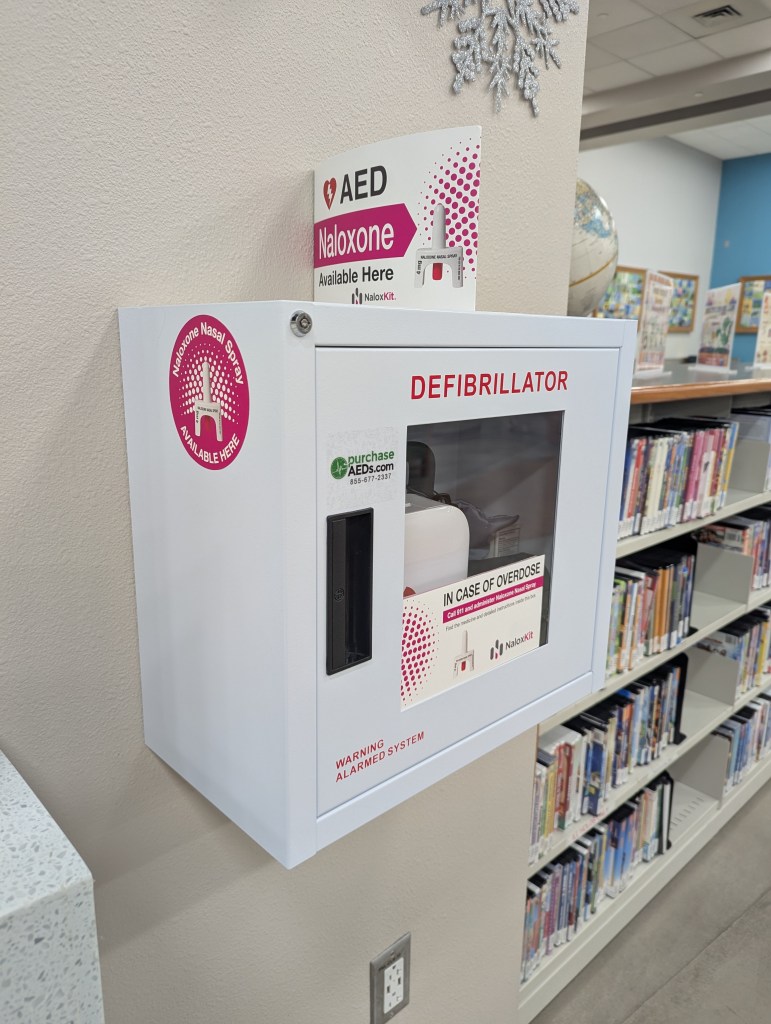 Naloxone, a drug used to reverse opioid overdose, seen at El Paso Public Library, Richard Burges branch Nov. 22, 2025. (Priscilla Totiyapungprasert / El Paso Matters)
During her term, Annello pushed for the El Paso Police Department to increase the availability of Narcan for police officers. The City Council also approved in May 2023 a resolution from Annello and city Rep. Chris Canales directing the city to invest in opioid risk mitigation strategies.
The broad list of strategies include working with community partners such as the El Paso Harm Reduction Alliance to expand the distribution of naloxone, a drug used to reverse opioid overdose; increase access to medicated-assisted treatment; and facilitate rapid screening and referral to harm reduction services.
Canales said there was initial conversation about using some of the opioid settlement funds to expand the fire department’s Mobile Integrated Health program, which would include increasing deployment of naloxone across the community, as well as improving education and access to care.
“I was confident that this year we would be able to move towards some of the more difficult to implement action items such as a needle exchange, but a significant loss of federal funding for the City’s Public Health Department has made that much more difficult,” Canales said. “It has been a struggle to even sustain the programs that we already have.”
Canales said the opioid settlement funds do not put a patch on federal funding loss.
At the time of the resolution, D’Agostino discussed creating a task force to discuss how to use the opioid settlement funds, said Jamie Bailey, an organizer for the El Paso Harm Reduction Alliance. The group is eager to work with the city on implementing these interventions, particularly at this time when many local harm reduction and recovery programs have experienced funding cuts, Bailey said.
“I expect that City staff will bring funding recommendations based on that collective work to the City Council for consideration in the coming few months,” Canales told El Paso Matters in a November email.
El Paso Matters asked the city if it had created that task force. A spokesperson responded that the El Paso Harm Reduction Alliance was leading it. But Bailey said as of November, the city had not asked her group to form or lead a task force, and that the city has yet to reach out to her about opioid risk mitigation projects.
El Paso County – about $1.74 million received
The state has dispersed three payments to El Paso County:
$813,721.16 on March 1, 2023
$158,303.50 on April 16, 2024
$158,303.50 on March 31, 2025
The county has spent more than two-thirds of what it’s claimed from the opioid settlement.
Contracts show the county awarded $50,000 to the Recovery Alliance of El Paso to purchase and distribute naloxone.
The county awarded Aliviane, an addiction treatment center, $25,000 for naloxone and $50,000 to support 20 clients with comprehensive treatment services.
The county is also using its opioid settlement claim to pay the full-time salary and employee benefits of senior justice and rehabilitation services manager, who’s received $114,500 in wages so far this year.
 A rendering of the El Paso County Corbin Sambrano Wellness Center taken from a 2024 county document.
Roughly $411,000 of the opioid settlement claim went to two companies, MNK Architects and JSR Construction and Remodeling, to tear down the former Naked Harem strip club in the Lower Valley and plan the Corbin Sambrano Wellness Center.
The wellness center is not dedicated specifically to substance use disorder. It would house “mental health services, law enforcement liaison center, victim resources and life skills education, community and meditation garden” among other amenities, according to the county’s project summary.
The project has a more than $29 million price tag, most of which is construction costs. But El Paso voters rejected in November 2024 a bond proposition for new county annexes that would have paid for construction.
The wellness center sits in limbo. The county now has to find funds to move it forward, or can put the proposal back on the ballot in November 2026 – the required two years after it was first voted down.
El Paso County Hospital District – about $3.2 million received
The El Paso County Hospital District led by UMC received the largest total allocation in El Paso. The state has dispersed:
$2.6 million on Aug. 29, 2024
$618,000 on May 7, 2025
UMC attorney Daniel Collins provided El Paso Matters the invoice from for one purchase the hospital has made with the funds this summer: a clinical surveillance software from Vigilanz used to monitor prescription drug dosing.
“Such software supports efforts to ensure appropriate prescribing and dispensing, as
as well as support efforts to decrease utilization of opioids,” Collins wrote in response to the records request.
 Demonstrators lie on the ground to represent the 12 people who die each hour from drug overdose during the El Paso Harm Reduction Alliance’s event to mark International Overdose Awareness Day, Aug. 31, 2024. (Corrie Boudreaux/El Paso Matters)
Kevin Lyons, a spokesperson for the Texas Comptroller of Public Accounts, said the most common strategy used by hospital districts is treatment and care coordination, such as opioid clinics for patients with substance use disorder and medications for opioid use disorder at the local county jail.
The state requires hospital districts to submit an annual report of how they used their funds for opioid harm reduction strategies in the previous calendar year. The report template asks for project titles, description and treatment types.
The first report was due March 31. UMC was among nine of 25 hospital districts in Texas that did not use their funds in 2024, Lyons confirmed in November.
Michael Nuñez, chief financial officer for UMC, said June 25 the district had not used its settlement funds yet because it was in “the process of determining what expenses can be claimed consistent with approved opioid abatement use categories.”
Information about how hospital districts can use their funding is available on the council’s website. The state also emailed hospital districts about a webinar in February to “provide an overview of the distributions, discuss required documentation and FAQs, and answer questions.”
Emails obtained by El Paso Matters show the Texas Opioid Abatement Fund Council had to chase the hospital district for its report. After repeated email reminders from the state between March and June, UMC submitted its report June 10 with no projects listed.
The city, county and UMC expect to receive their next payment in 2026.
Starting at the end of this year, the city and county will have to report its calendar-year expenditures to the Texas Comptroller of Public Accounts. Lyons said the Opioid Abatement Fund Council has not sent finalized reporting instructions to local governments, but would send out instructions “soon.”
Local governments must identify how settlement funds were used to remediate opioid-related harms by selecting from the state’s list of core strategies and other approved uses, Lyons said.
Related
LISTEN: EL PASO MATTERS PODCAST