

Touting progress his administration has made for small businesses and families, Dallas County Judge Clay Lewis Jenkins on Monday filed to run for a fifth term as the county’s chief elected official.
This year, Dallas County set aside $1 million to cover a portion of child care costs for employees at qualified businesses, which Jenkins said was aimed at getting more people into the workforce and improving outcomes for kids. County officials are also developing arrest diversion programs to provide stabilization services instead of jail for people experiencing mental illnesses and substance abuse issues.
Jenkins, 61, a Democrat, said continuing these programs and supporting emergency management initiatives across the county will be a focus in the next four years if reelected.
“It is inspiring for me and my team to have the opportunity to help people at their lowest point,” Jenkins said at a news conference flanked by his wife, two toddlers, mother and nanny. “Nothing really matters if you can’t keep people safe, so when disaster strikes, we try to do everything we can to help our neighbors.”
Breaking News
With one week remaining for candidates to file for the March primary ballot, Jenkins so far faces no Democratic challenger, according to the candidates list released by the Dallas County Democratic Party.
Dallas County Republican Party Chair Allen West declined to release the GOP’s list of primary candidates until the filing deadline on Dec. 8, but at least one Republican is vying to face Jenkins in the Nov. 3 general election.
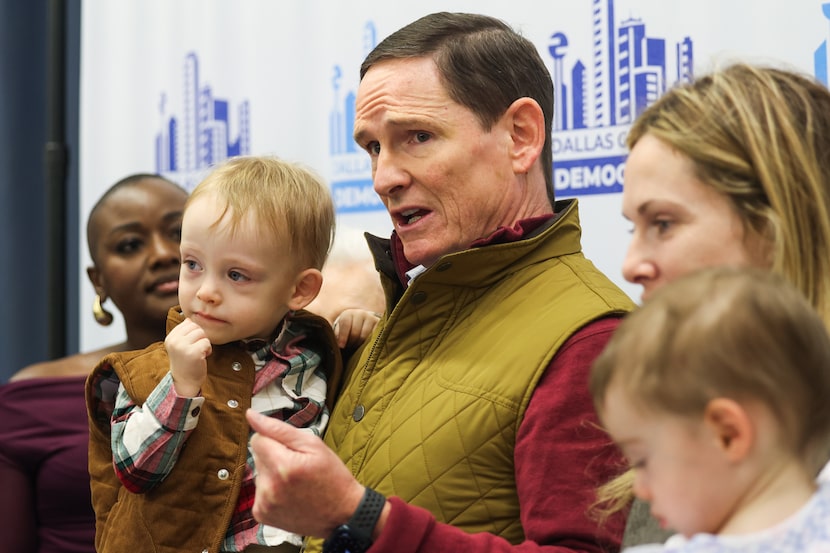
Clay Lewis Jenkins, Dallas County Judge, speaks on his goals for his re-election at the Dallas County Democratic Party Headquarters on Monday, Dec. 1, 2025, in Dallas. Jenkins will be campaigning for his fifth term.
Christine Vo / Staff Photographer
Mike Immler, 73, a retired Air Force colonel and former executive of two businesses geared toward service members, confirmed he intends to file for county judge in the Republican primary this week.
A first-time political candidate, Immler said he is not convinced the public is “getting the most value for the dollars being spent” by the county government. After retiring last year as vice president for a financial planning service for military families, he said he has the time to dedicate his business and military acumen to public office.
“I’ll bring business skills to running a large organization like Dallas County,” Immler said. “I believe I can help improve financial responsibility, I can improve economic growth, I can improve social services and mental health.”
Jenkins had $513,898 in campaign contributions as of June 30, the most recent financial report available. A report for Immler was not yet available.
Of dozens of state, county and judicial offices on the ballot next year, just a handful have contested Democratic primary races so far in blue Dallas County, according to the filing list.
Party chair Kardal Coleman said he expects a flurry of Democrats to complete paperwork in the remaining week of the filing period.
“We still have seven days left, and there will be excitement over the next seven days up and down the ballot,” Coleman said.
Jenkins, who owns a personal injury law firm, first took office as county judge in 2011 and won his most recent four-year term in 2022 with 62 percent of the vote against Republican challenger Lauren Davis. County judges in Texas are not part of the judiciary but serve an administrative function, overseeing county government as members of Commissioners Court.
The county judge is paid $213,254 annually, according to human resources records.
Two other seats on the Commissioners Court are up for reelection next year. District 2 Commissioner Andrew Sommerman and District 4 Commissioner Elba Garcia have both filed for reelection.
Neither had fellow Democrats filed against them in the primary as of Monday morning. Pedra Geter, a psychologist and evangelical preacher, filed campaign finance paperwork earlier this year to run for Garcia’s District 4 seat, but she did not return a phone call or text message asking if she would register for the ballot.
Looking ahead, Jenkins said there are still challenges. For the county to fully implement its jail diversion programs, modeled after an initiative launched in Miami-Dade County, Florida, 20 years ago, officials will have to advocate for changes in state law to allow for the involuntary commitment of defendants to mental health programs instead of jail.
He also pointed to successes he wants to continue, like the county’s child care benefits program. The pilot allows business owners to receive about $1,500 per employee annually for child care costs if they also match that amount. While that doesn’t fully cover daycare expenses, Candice Jonson, owner of Candee Skin in Desoto, said it has been impactful for her skincare business.

Candice Johnson, owner of Candee Skin, speaks about Clay Lewis Jenkins’, Dallas County Judge, Employer Match Child Care Program at the Dallas County Democratic Party Headquarters on Monday, Dec. 1, 2025, in Dallas. The program offers employees a $3000 annual subsidy to help provide childcare.
Christine Vo / Staff Photographer
One of Johnson’s 17 employees is participating in the program, and it has allowed her to go from working one day a week to being employed full time, Johnson said at Jenkins’ kickoff event.
Jenkins said he has also prioritized the county’s support of Health and Human Services programs that have helped decrease the number of certain sexually transmitted diseases and better track data to improve public health.
“These are all kind of blocking and tackling sort of things,” Jenkins said. “There’s a lot of good work, and it’s because there’s a lot of good people in those positions making that happen.”