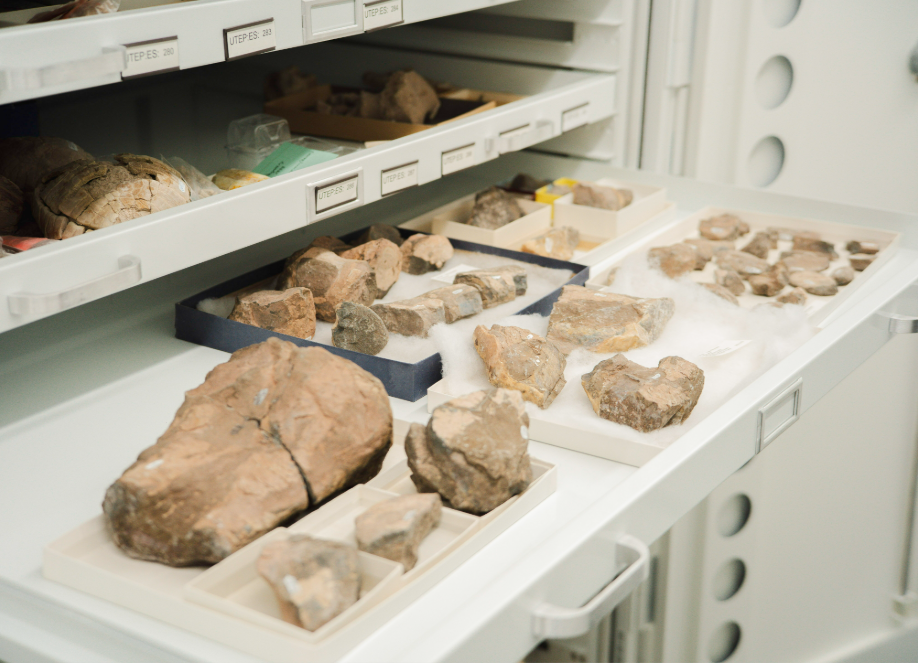
While mapping geological formations at the Indio Mountains Research Station, a natural laboratory owned by the University of Texas at El Paso (UTEP), structural geologist and associate professor of earth, environmental and resource sciences Jason Ricketts, Ph.D., noticed something strange peeking out of the soil.
There were fragments that weren’t part of the landscape which were later identified as belonging to a Tenontosaurus, a dinosaur usually found in parts of Arizona, Colorado and Central Texas. The fossils had been buried for more than 115 million years and expanded the species’ known range. It also marked one of the first fossilized dinosaur bones ever uncovered in the El Paso region.
Ricketts said he was not even looking for fossils that day; in fact, paleontology wasn’t on his mind.
“I was out there as part of a separate project. We weren’t thinking about fossils at all. I was mapping [geological formations] with a graduate student and as I walked, I saw something that didn’t look like anything else. I stopped and looked at it, and recognized it as a fossil,” Ricketts said.
Ricketts, who specializes in structural geology (the study of how rocks break, deform and the record of tectonic history) was in the area as part of a U.S. Geological Survey project to map the region.
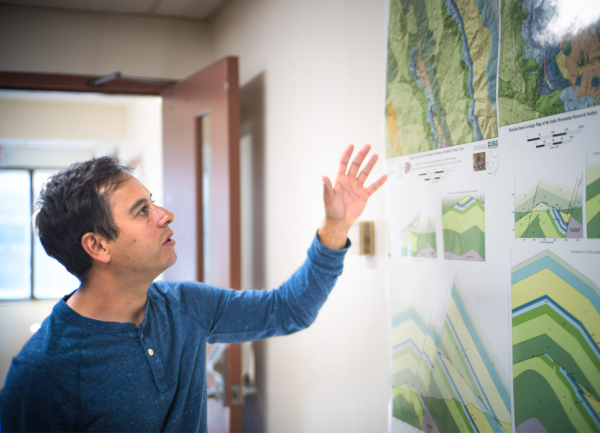 Jason Ricketts, Ph.D., points to the area on his map where he discovered Tenontosaurus fossils while conducting fieldwork in the Indio Mountains in Hudspeth County, Texas. (Victoria Adler)
After collecting a few fragments and noting their location, curiosity drew Ricketts back a few weeks later, bringing his family along.
“I went out there with my kids, my wife [her] mother. We spent a weekend out there digging around and playing in the desert, finding more dino fossils,” Ricketts said.
Unsure of exactly what he’d found, Ricketts reached out to Spencer Lucas, Ph.D., a paleontology curator at the New Mexico Museum of Natural History and Science. After analyzing the bones’ shapes and measurements, Lucas confirmed they belonged to Tenontosaurus, a four-legged herbivore. The largest piece recovered was a femur, along with several intact vertebrae.
Fossilized bones are rare in West Texas, where dry desert conditions make preservation difficult. Ricketts said this discovery was as much about timing and luck as it was about science.
“For it [an animal] to be preserved it has to die and get buried quickly. If it’s on the surface, something eats it or it decays. It takes very special circumstances to preserve them in the first place, and then even those rare ones that get preserved. It takes somebody just happening to find them as they erode out of the ground,” Ricketts said.
Ricketts explained that the bones were likely scattered after the dinosaur’s death and carried by river currents before being buried in thick mud.
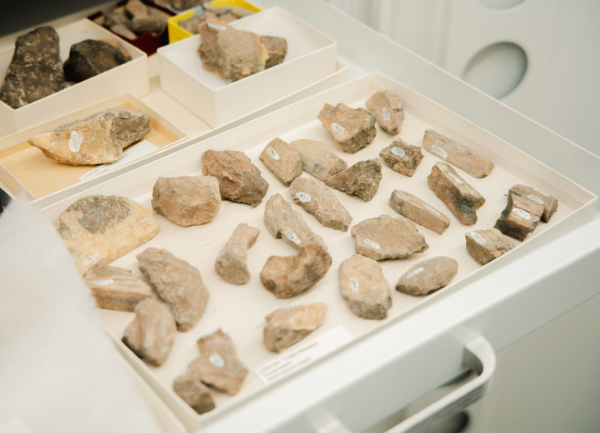 Pieces of an incomplete right femur from the Tenontosaurus, are stored at UTEP’s Biodiversity Collections. (Victoria Adler)
Today, the fossils are housed in UTEP’s Biodiversity Collections, where students and researchers can study them. One UTEP undergraduate has already helped curate and label the fossils. Ricketts hopes future fieldwork may lead to more discoveries in the Indio Mountains region.
“There’s probably more out there,” Ricketts said. “If we find more, maybe we can add to the collection [of fossils] and learn even more about the area.”
For Ricketts, the unexpected discovery served as a reminder of what makes fieldwork rewarding, and how often science advances through simple luck.
“If you’re open to new discoveries and just making observations about the world around you, it’s amazing what things you’ll learn about the world,” Ricketts said.
The discovery of the Tenontosaurus fossils in West Texas identifies how much of the region’s prehistoric history remains undiscovered just beneath the earth’s surface.
Jewel Ocampo is a staff reporter and may be reached at [email protected]. St